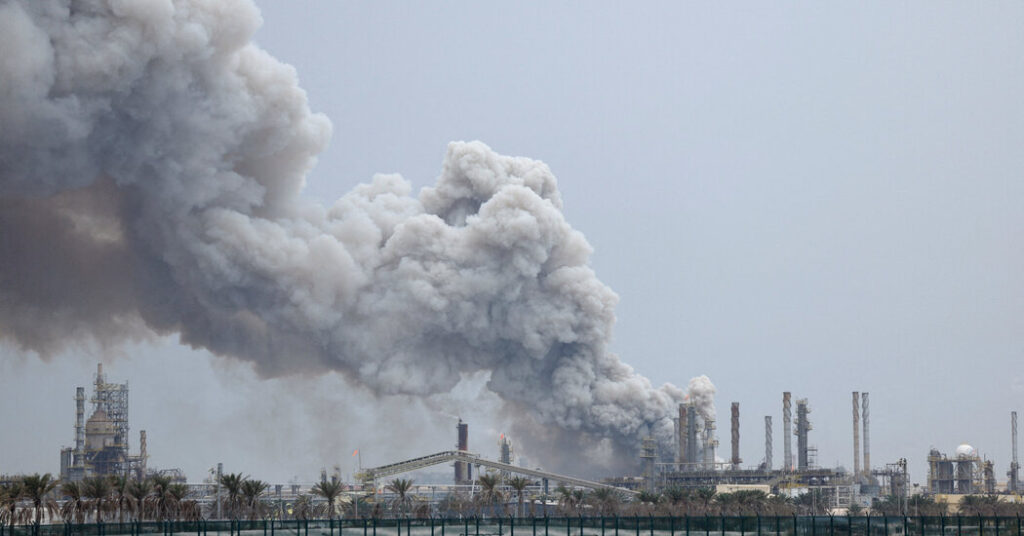
A sharp upswing in the price of oil eased on Monday after top officials from the United States and six other industrialized nations effectively signaled that they were not yet worried about the world running short of fuel because of the escalating conflict in the Middle East.
Oil prices were trading at less than $100 a barrel at noon on Monday, but well below the highs reached overnight after finance ministers from the G7 nations said they were prepared to release oil from their strategic reserves — but not just yet.
“We’re not there yet,” Roland Lescure, France’s finance minister, told reporters in Brussels after a virtual meeting with his counterparts from the other six countries. “What we’ve agreed upon is to use any necessary tools, if need be, to stabilize the market, including the potential release of necessary stockpiles.”
Nevertheless, Fatih Birol, the executive director of the International Energy Agency, described the deteriorating energy supply in the Middle East as “creating significant and growing risks for the market.”
The I.E.A.’s 32 member countries, including all of the G7, have more than 1.2 billion barrels of oil and refined fuels such as gasoline in reserve. In emergencies, governments can access another 600 million barrels held by companies in those countries. The world uses more than 100 million barrels of oil daily.
International oil prices have risen from less than $73 a barrel, where they were trading before the United States and Israel attacked Iran on Feb. 28. The widening conflict has severely restricted the flow of oil and natural gas from the Persian Gulf.
Traffic has slowed considerably in the Strait of Hormuz, a narrow waterway on Iran’s southern coast through which about one-fifth of the world’s oil is shipped to customers — many of them in Asia. Without that access to market and lacking secure storage, some in the region have started to cut oil production and processing.
The war has also cut off natural gas supplies from Qatar, one of the world’s largest exporters of liquefied natural gas, or fuel that has been cooled for shipment. Prices for the colorless fuel, which is used to heat homes and produce electricity, have also surged, particularly in Asia and in Europe, which import a lot of it.
As of Monday, L.N.G. prices at the main trading hub in Japan were up about 73 percent since the war began; natural gas prices in Europe had nearly doubled.
Anna-Kaisa Itkonen, a spokeswoman for the European Commission, sought to downplay concerns about access to natural gas.
“We are much better prepared than we were in 2022,” she said, referring to the period after Russia invaded Ukraine. “We’re far less dependent on suppliers from the region than we used to be in Russia.”
The G7 is made up of Britain, Canada, France, Germany, Italy, Japan and the United States.
Jeanna Smialek and Joe Rennison contributed reporting.
Rebecca F. Elliott covers energy for The Times.
The post G7 Countries Hold Off on Releasing Emergency Oil Supplies appeared first on New York Times.