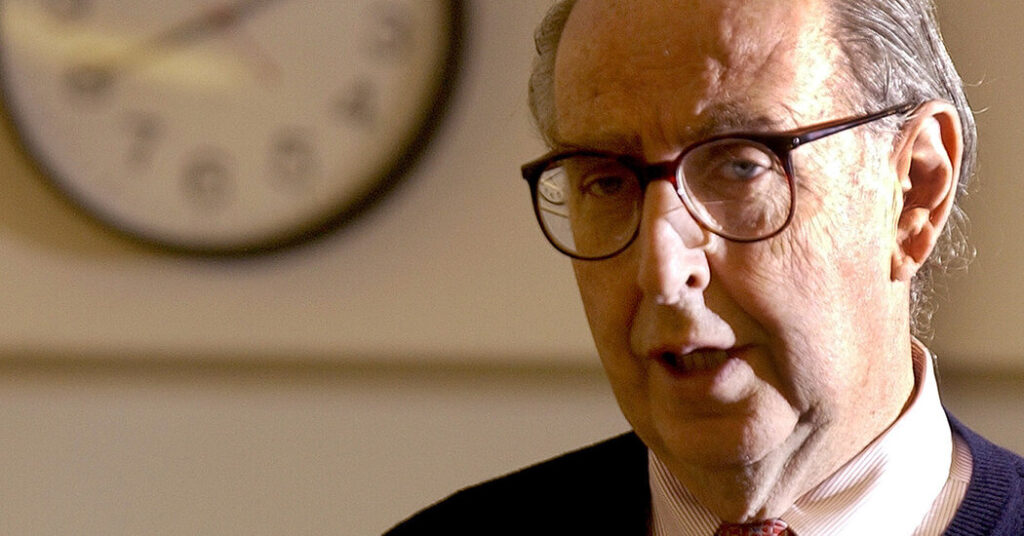
Colman McCarthy, a pacifist who wrote a crusading column in The Washington Post for nearly three decades and taught nonviolence to high school and college students, urging them to oppose war, capital punishment and the consumption of meat, and to hand out carrots on Halloween, died on Feb. 27 in La Romana, a city in the Dominican Republic. He was 87.
His death, at his son John’s home, where he had been living, was caused by complications of pneumonia.
Mr. McCarthy’s topics in his column and in the classroom were lofty: peace, poverty, capital punishment, animal rights and, as he put it, the “war-preparation economy.” He was opposed to all violence — no exceptions. He would not stand for even “The Star-Spangled Banner,” which he considered a battle hymn about bombing people.
“From his personal choices to political ones, he was a steady and relentless force for good,” the singer Joan Baez, a friend and admirer, said in an interview. “He never veered from the path of nonviolence.”
In Washington, a city of predictable talking points in human form, Mr. McCarthy stood out as idiosyncratic and somewhat ungovernable. He pedaled his Raleigh three-speed bicycle to work, chuckling at drivers stuck in traffic. At dinner parties, if steak was on the menu, he ate a banana. An avid marathoner, he would sneak into events because he believed that registering to race was preposterous.
“Running is the personification of freedom,” he said. “You’re not controlled by authority.”
Little in Mr. McCarthy’s life unfolded as planned.
A standout golfer, he intended to join the PGA Tour after graduating in 1960 from Spring Hill College, a small Jesuit school in Alabama where he discovered the writings of Thomas Merton, the American Trappist monk and theologian. On his way home to New York after college, Mr. McCarthy stopped at a Trappist monastery in Conyers, Ga., to spend a few days resting and clearing his head.
He stayed for more than five years.
“The hard beds were healthy,” he later wrote in The Washington Post. “The vegetarian diet was the essence of physical fitness. The silence was a relief. The manual labor — milking cows twice a day and pitching silage in between — was invigorating. And best of all, the company was good.”
As a lay brother, he took temporary vows. When he wasn’t tending cows or shoveling manure, he basked in the stillness of time, reading hundreds of books and writing endlessly in his journal.
Eventually, he craved civilization, so he began giving blood regularly at the local Red Cross. Afterward, he would read magazines at the barbershop next door.
One day in 1965, the monastery’s abbot paid him a visit.
“I think you can do better than shovel manure, even though you’re doing it for the Lord,” Mr. McCarthy recalled him saying in a 1994 interview on C-SPAN. “Go try writing.”
Through various connections, he landed on the sports desk of United Press International in New York. An abject failure at sportswriting — he knew little of sports beyond golf — he turned to writing freelance articles for religious publications.
In 1966, Mr. McCarthy wrote a mildly critical article in The National Catholic Reporter about poverty programs in Harlem overseen by R. Sargent Shriver, the founding director of the Peace Corps who was then the head of the Office of Economic Opportunity. Mr. Shriver called him and said: “I read this article you wrote criticizing me. I’m sitting here surrounded by yes men. I need a no man, and you seem to be eminently qualified.”
Mr. Shriver hired him as a speechwriter. Now living in Washington, Mr. McCarthy also began submitting opinion pieces to The Post, including one about Mr. Merton. In 1969, the newspaper hired him as an editorial writer, and he eventually began writing a column that was syndicated.
He never wavered from promoting peace, even when his own country was attacked.
“There are no guarantees that nonviolence will always work, any more than there are that violence will always work,” he told The Sun magazine in 1991. “All you have is a choice between two failures. Both systems have failed; which failure do you want to align yourself with?”
In 1982, while still writing for The Post, he created a course on nonviolence that he taught at Washington-area schools and colleges. He founded the Center for Teaching Peace in 1985 and continued teaching after leaving the newspaper in 1997.
Part standup comic, part missionary, Mr. McCarthy had an engaging shtick during his nearly 40 years as a teacher.
He brought a live turkey to discussions about eating meat. He offered $100 to anyone who could identify a list of historical figures that included Robert E. Lee, the Confederate war general; Napoleon, the French emperor and military leader; Dorothy Day, a journalist and anarchist; and Jeannette Rankin, the first woman elected to Congress and the only member to vote against entering both World Wars.
The students typically knew the warriors; no one had heard of the peacemakers.
“I can always count on American miseducation,” Mr. McCarthy wrote in his book “Teaching Peace” (2015). “Students get the point of the quiz: they’ve been well taught about men who break the peace but know little or nothing about women who make the peace.”
Mr. McCarthy often brought guest speakers to class: Adolfo Pérez Esquivel, a Nobel Peace Prize-winner from Argentina; exonerated inmates from death row; Lily Flores, a school maintenance worker who had fled El Salvador; and Ms. Baez, among many others.
A not-insubstantial number of his students followed — or tried to follow — his path, working in civil rights and public interest law, in homeless shelters and war zones. (It is assumed that far fewer of them were committed to handing out carrots on Halloween.)
“He shoved some hard lessons down our throats,” Amy Harfeld, a child-welfare advocate who took his class at Bethesda-Chevy Chase High School, said in an interview. “And it was necessary to wake up a bunch of rather privileged adolescents to challenge what we thought we knew about the world.”
Colman Joseph McCarthy was born on March 24, 1938, in Glen Head, N.Y., on Long Island, to Lucy (McCrystal) McCarthy and John McCarthy, a lawyer who provided free services to immigrants.
Growing up, Colman stuttered, and he often spent hours alone, writing. One day in fourth grade, a teacher told a student who struggled with his own writing to consult Colman for help. “I overheard that,” he later told The National Catholic Reporter, “and I’ve been on a high ever since.”
He attended Spring Hill College for “18 reasons,” he often said: It had a golf course. During his time there, he played in two PGA tournaments and planned to turn pro until his detour to the monastery.
Mr. McCarthy married Mavourneen Degan in 1967. After she died in 2021, he moved to the Dominican Republic to live with his son John, who had started a literacy and community baseball program there.
In addition to John, he is survived by two other sons, James and Edward; and six grandchildren.
Mr. McCarthy viewed grades and exams as “forms of academic violence,” he often said. But he did assign homework.
“Every class, I say your homework is to tell someone you love them today,” he said on “CBS Sunday Morning” in 2020. “And if you can’t find someone to tell that you love them, look a little harder. And if you still can’t find them, call me up. I know where all the unloved people are — they’re everywhere.”
The post Colman McCarthy, Journalist Who Waged Peace in the Classroom, Dies at 87 appeared first on New York Times.