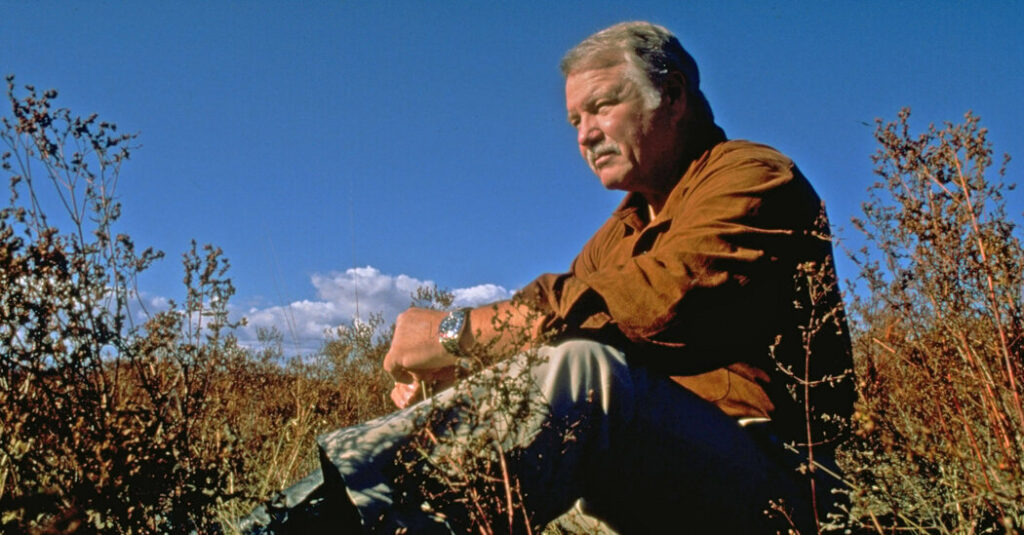
Bo Gritz, a decorated Special Forces officer during the Vietnam War who spent the 1980s planning private raids into Laos in a fitful search for American prisoners, and then, in the 1990s, became prominent in the world of far-right politics, militia organizing and apocalyptic conspiracy-mongering, died on Feb. 27 at his home in Sandy Valley, Nev. He was 87.
His wife, Judy Gritz, announced his death on Facebook. She did not provide a specific cause.
Mr. Gritz (rhymes with “fights”) was often compared with roguish Vietnam-era fictional characters like Colonel Kurtz (played by Marlon Brando) in “Apocalypse Now” (1979); John Rambo (played by Sylvester Stallone) in “First Blood” (1982); and Col. Hannibal Smith (played by George Peppard) in the 1980s TV show “The A-Team.”
All three were brilliant but troubled soldiers unable to leave the battlefield behind, not unlike Mr. Gritz. Like them, he tapped into a rich vein of populist anger over America’s defeat in Vietnam.
And also like them, he led a larger-than-life career that was at least partly made up.
Mr. Gritz served four tours in Vietnam as a Green Beret, during which he led a roving contingent of mostly Cambodian guerrillas deep behind enemy lines. He received more than 60 medals and commendations for his service.
But former comrades and journalists later raised questions about his record. In some cases, they said, his awards had come at his own recommendation.
In Mr. Gritz’s telling, he retired from the U.S. Army in 1978 at the request of a Pentagon intelligence official, who wanted him to develop a clandestine program to locate U.S. prisoners of war still alive in Southeast Asia. (It is unclear whether such a request was ever made.)
Just five years before, North Vietnam had released its remaining 591 American prisoners. But it became a matter of truth to some veterans, including Mr. Gritz, that hundreds had been left behind, primarily in Laos.
In 1981, Mr. Gritz put out a call for Special Forces veterans for a private rescue mission. They trained at a cheerleading camp in Central Florida. For guidance, he hired a psychic. Unsurprisingly, the plan fell apart after the volunteers soured on it.
A year later, thanks to money from the actors Clint Eastwood and William Shatner, Mr. Gritz and a small band of American civilians crossed from Thailand into Laos with a team of Lao guerrillas. A few days in, Laotian government forces attacked, killing two guerrillas and capturing an American.
Mr. Gritz returned to Thailand, paid a ransom to free the man and turned himself in to the Thai authorities. He and his accomplices were convicted of a long list of crimes, but were let go on the promise that they would not return.
They arrived home as heroes. Mr. Gritz claimed he had evidence that some P.O.W.s had never returned home, including photographs and human remains. He was profiled in magazines and invited to testify before Congress.
But the remains proved to be those of an Asian man and a chicken. And in his testimony, Mr. Gritz conceded that his photographs showed nothing — though he said his certainty was proof enough.
“I have the same evidence that might be presented to a convention of clergymen that God exists,” he told Congress in 1983.
Politicians and the news media turned on him. The White House blocked him from a meeting between President Ronald Reagan and a veterans group in June 1983. Even many of his admirers began to question his hold on sanity.
“There’s no question about his skills as a soldier,” one former Green Beret, William P. Yarborough, told The Washington Post in 1983. “But his former incarnation as a Green Beret has gotten him a little out of phase with reality.”
Mr. Gritz, convinced that powerful forces were trying to undermine him, gravitated toward anti-government fringe groups.
In the mid-1980s, he developed a second career training clients in how to survive in the wilderness, or in the event of societal collapse. He also became involved in politics. With an anti-government platform that included abolishing trade deals, halting immigration and cutting foreign aid, in 1988 he ran as the vice-presidential candidate of the Populist Party.
He withdrew from the race after the party selected David Duke, a former grand wizard of the Ku Klux Klan, as its presidential nominee; Mr. Gritz denounced him as racist and antisemitic.
But Mr. Gritz trafficked in some of the same prejudices. In 1989, he founded a group called the Center for Action, whose newsletter pushed anti-Jewish conspiracy theories about global finance and the “new world order.”
He ran for president in 1992, again on the Populist Party ticket. He received 0.1 percent of the vote, or twice what Mr. Duke received in 1988.
Through the 1990s, Mr. Gritz became one of the best-known figures on the radical right, especially after he negotiated an end to a standoff between federal agents and an anti-government activist named Randy Weaver at Ruby Ridge, Idaho, in 1992.
Around the same time, he founded a community in northern Idaho, Almost Heaven, that attracted Christian nationalists, anti-government militants and white supremacists with the promise that the government would stay away.
He said law-enforcement officials saw him as too much trouble. “I know what they’re going to say: ‘Gritz is going to have a .50-caliber up here, he’s going to have cannons, he’s going to have explosives in the trees,’” he told The New York Times Magazine in 1995. “So I think they’re going to leave us alone.”
James Gordon Gritz’s martial self-image took root early. He was born on Jan. 18, 1939, in Enid, Okla. Both his parents were pilots during World War II: His father, Roy, flew B-17 bombers, and his mother, Leona, flew for the Women Airforce Service Pilots.
Neither came back. Roy Gritz died when his plane was shot down, and Leona remarried and stayed in Europe.
Raised by his maternal grandparents, Bo was fed stories about heroic soldiers and pilots and spent hours playing soldier on the family farm.
When he was 14, he used proceeds from his father’s life insurance policy to enroll at Fork Union Military Academy in Virginia. He was made commander of the cadet corps his senior year.
Soon after graduating, Mr. Gritz saw a flier for the Green Berets, a relatively new Army branch assigned to unconventional warfare. He sailed through the group’s rigorous training and later qualified as a pilot, parachutist and underwater demolitions expert. He went to Vietnam in 1964.
In perhaps his best-known mission, in 1966, he and his men were sent to recover the top-secret black box of a U-2 spy plane that had crashed in Laos.
Mr. Gritz said that when they located the crash site, the box was missing. Convinced it had been taken by Viet Cong forces to a nearby camp, they attacked it, killing dozens and liberating the black box.
(The mission was recounted at length by the American commander in South Vietnam, Gen. William Westmoreland, in his 1976 memoir “A Soldier Reports.” But questions remained about the details. One of the American officers who had accompanied the Laos mission said that there had been no raid on a Viet Cong camp, and that the black box had been found at the crash site.)
Mr. Gritz returned to the United States in 1969. He received a degree in law and corrections from the University of Nebraska at Omaha and a master’s in military science and a master’s in communications, both from American University in Washington.
After leaving the Army, he worked for several years as a consultant for Hughes Aircraft. Mr. Gritz said the job was a cover for his P.O.W. work — a claim that Hughes denied.
Following Ruby Ridge in 1992, he continued to offer himself as a civilian negotiator, but with less success.
In 1996, he failed to persuade the Montana Freemen, a right-wing militia, to end a standoff with law enforcement agents. Two years later, he led volunteers through the North Carolina forest to find Eric Rudolph, who was wanted in connection with the bombing at the 1996 Olympics in Atlanta. Once again, he failed. Mr. Rudolph was arrested in 2003.
By that time, Mr. Gritz had lost much of his public following, save for a core group of like-minded survivalists.
In 1996, one of them, a Connecticut woman named Linda Wiegand, persuaded him that her ex-husband was molesting their two boys as part of a satanic cult.
Mr. Gritz and his son James traveled to Connecticut, to help. After the police saw them in a car outside one of the boys’ school, they arrested them for attempted kidnapping. After a lengthy, widely-publicized trial, they were acquitted.
In 1998, while the trial was ongoing, Mr. Gritz’s third wife, Claudia, filed for divorce. He attempted to kill himself with a revolver, but missed his heart.
He married Marla Kirsch, whom he met at a survivalist convention, in 1999. Along with her, his survivors include two children from his first marriage, James and Jay Gritz, and two children from his second, Micheil and Melody Gritz.
By 2000, Mr. Gritz and his wife had relocated from Idaho to southern Nevada. Almost Heaven collapsed in the mid-2000s.
Mr. Gritz’s last turn in the public eye came in 2005. He traveled to Pinellas Park, Fla., to carry out a citizen’s arrest of Michael Schiavo, who was seeking court approval to remove the feeding tube of his wife, Terri Schiavo, who was in a vegetative state.
He and four others were arrested on misdemeanor trespassing charges, which were later dismissed.
Clay Risen is a Times reporter on the Obituaries desk.
The post Bo Gritz, Vietnam Veteran Called a Real-Life Rambo, Dies at 87 appeared first on New York Times.