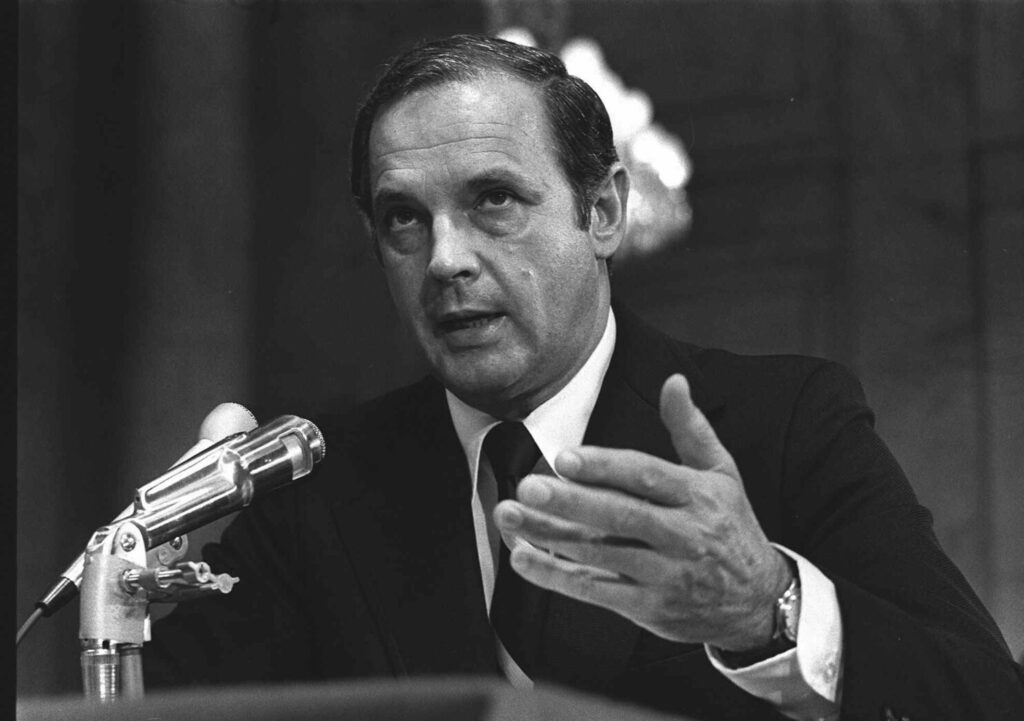
“I was hoping you fellows wouldn’t ask me about that,” said Alexander P. Butterfield, a former White House aide summoned before the staff of the Senate Watergate committee on July 13, 1973.
His questioner had alighted on a matter that would electrify the investigation of corruption and cover-up in President Richard M. Nixon’s administration. It involved a wiretapping — not the attempt by Nixon campaign operatives to eavesdrop on the Democratic national headquarters at the Watergate building in 1972, but the president’s secret bugging of his own office conversations.
Mr. Butterfield, then chief of the Federal Aviation Administration and previously the White House deputy chief of staff, insisted on his loyalty to the president but did not want to lie. On Nixon’s order, he had supervised the placement of a voice-activated recording system that operated at locations including the White House and the Old Executive Office Building from February 1971 until July 1973.
Three days after his appearance before the committee staff, Mr. Butterfield repeated his knowledge in the glare of camera lights, during televised hearings that riveted millions of Americans.
“Mr. Butterfield, are you aware of the installation of any listening devices in the Oval Office of the president?” asked Fred Thompson, the Senate committee’s minority counsel and a future Republican senator from Tennessee.
The witness hesitated.
“I was aware of listening devices,” he said. “Yes, sir.”
Few figures in the Watergate investigation proved more crucial than Mr. Butterfield, who died March 9 at 99, at his home in the La Jolla section of San Diego. His revelation of the White House tapes — with their promise of exculpation or, as it turned out, incrimination of high administration officials — propelled the events that led to Nixon’s resignation on Aug. 9, 1974.
Four decades later, Mr. Butterfield made further revelations about the Nixon presidency when he turned over to Bob Woodward, the reporter who helped uncover the Watergate affair for The Washington Post, a cache of documents taken from the White House and never before been seen by the public.
Those documents, some of them classified, along with Mr. Butterfield’s recollections of an administration that he described as a “cesspool,” became the subject of Woodward’s book “The Last of the President’s Men” (2015).
During Nixon’s first term, Mr. Butterfield was an administrative jack-of-all-trades, handling the president’s schedule, couriering documents to and from the Oval Office, planning state dinners and serving as secretary to the Cabinet.
Besides Nixon’s valet, The Post once reported, Mr. Butterfield was “generally the first man the president saw in the morning” and “often the last man Nixon saw at night.”
Interviewed for Woodward’s book, Mr. Butterfield recalled Nixon as awkward, easily angered and paranoid. Once, after noticing that some staffers had displayed photographs of John F. Kennedy in the Executive Office Building, Nixon ordered Mr. Butterfield to clear the place of images of other commanders in chief. Mr. Butterfield did so, then submitted a memo titled “Sanitization of the EOB.”
On another occasion, Nixon instructed Mr. Butterfield — and Mr. Butterfield agreed — to place a spy among the Secret Service agents assigned to Kennedy’s younger brother, Sen. Edward M. Kennedy (D-Massachusetts), a potential future candidate for president.
In an 2015 interview with The Post, Mr. Butterfield recalled thinking to himself, “I am now an accomplice in an abusive government.”
He also handled internal White House security, the capacity in which he oversaw the installation of the recording system.
After Nixon’s reelection in 1972, Mr. Butterfield became FAA administrator, an assignment awarded to him in part for the two decades he had served in the Air Force. Widely described as hardworking and competent, he remained generally out of the limelight until Watergate investigators were tipped off to the possibility of a taping system at the White House.
Mr. Butterfield was believed to have been one of only a few people who knew about the recording devices. He said he decided that if investigators posed an “indirect or fuzzy question,” he was “justified in giving an indirect, fuzzy answer.” But when he was asked the “$64,000 question, clearly and directly,” he said, he felt he “had no choice but to respond in like manner.”
“I didn’t want to lie,” he told Alicia C. Shepard, author of the book “Woodward & Bernstein: Life in the Shadow of Watergate.” “I never entertained the thought of lying. But I knew what a big secret this was to Nixon.”
Testifying before the Senate committee, Mr. Butterfield said that Nixon had installed the system “to record things for posterity, for the Nixon library.” Later, before the House Judiciary Committee, Mr. Butterfield said that, contrary to Nixon’s claims, the president had been intensely involved in the operations of his 1972 reelection campaign, which had been marred by the so-called “dirty tricks.”
For months, Nixon faced off with investigators including special prosecutor Archibald Cox, who sought the tapes’ release. In October 1973, Attorney General Elliot L. Richardson and Deputy Attorney General William D. Ruckelshaus left office rather than obey a presidential order to fire Cox. Solicitor General Robert H. Bork ultimately obliged in the event that became known as the Saturday Night Massacre.
Nixon relented in the summer of 1974, when the Supreme Court rejected his argument of executive privilege and ordered him to surrender the subpoenaed recordings. They included a conversation that became known as the “smoking gun,” in which Nixon and H.R. “Bob” Haldeman, his chief of staff and Mr. Butterfield’s onetime superior, discussed a scheme to use the CIA to divert the FBI investigation of the Watergate break-in.
With that evidence of his apparent complicity in the cover-up, Nixon lasted only a few more days in office. Outside the White House, Mr. Butterfield was described in some circles as a hero. Within the administration, however, “the inner sanctum” had decided he “did the wrong thing,” he told the New York Times.
In March 1975, under President Gerald Ford, Mr. Butterfield resigned as FAA administrator. Shortly thereafter, when People magazine asked him whether he had been fired, he said he did not think there was “any question about that.”
The magazine also inquired whether Mr. Butterfield had heard from Nixon since his resignation.
“Oh, no,” Mr. Butterfield replied. “I’m sure that he hates me as much as anyone can.”
Air Force veteran
Alexander Porter Butterfield was born on April 6, 1926, in Pensacola, Florida, where his father, a Navy aviator, had been sent on assignment. The younger Mr. Butterfield, after joining the Air Force in 1948, received a bachelor’s degree from the University of Maryland in 1956 and a master’s degree from George Washington University in 1967.
During the Vietnam War, he commanded reconnaissance operations in Southeast Asia and was an assistant to Defense Secretary Robert S. McNamara in the Johnson administration.
He received decorations including the Legion of Merit and Distinguished Flying Cross and attained the rank of colonel before Haldeman, an old acquaintance, recruited him to the White House after Nixon’s election in 1968.
Mr. Butterfield said that, after his tenure in the Nixon administration, he had difficulty advancing in the private sector.
“I’m too controversial, I guess, in some people’s view,” he told The Post in 1982. “Plus, a company doesn’t want one of its executives to be in the news. It’s bad form.”
Mr. Butterfield was an official at aviation, financial and consulting firms before retiring in the mid-1990s. His death was confirmed by his wife, Kim Butterfield, who did not cite a specific cause.
Mr. Butterfield’s previous marriage, to Charlotte Mary Maguire, ended in divorce. For many years, he dated Audrey Geisel, the widow of Theodor Seuss Geisel, the children’s author better known as Dr. Seuss.
In addition to his wife, whom he married in 2021, survivors include two daughters, Susan Carter Holcomb and Elizabeth Gordon Buchholz; eight grandchildren; and 13 great-grandchildren. His son, Alexander Jr., died last year. A daughter, Leslie, died in infancy in 1950.
For decades, Nixon’s White House tapes — thousands of hours of which have now been released — have continued to fascinate historians and the public. Mr. Butterfield advised director Oliver Stone on the 1995 film “Nixon,” in which actor Anthony Hopkins portrayed the beleaguered president and Mr. Butterfield had a cameo appearance.
He said he disliked being known as “the man who revealed the existence of the tapes,” and that he had felt torn between a desire to respect the president and the need to be honest with investigators. But he also said that “in the deep recesses of my brain, I was eager to tell.”
The day of Nixon’s resignation, Mr. Butterfield told Woodward, he watched people weep in the White House’s East Room.
“I could not believe that people were crying in that room,” he said. “It was sad, yes. But justice had prevailed. Inside I was cheering. That’s what I was doing. I was cheering.”
The post Alexander Butterfield, who revealed Nixon White House tapes, dies at 99 appeared first on Washington Post.