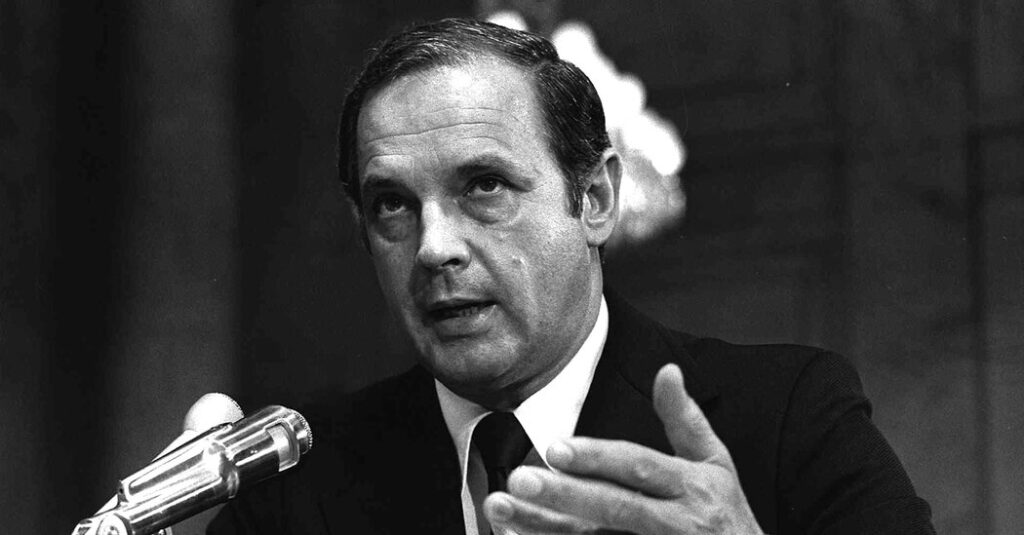
Alexander P. Butterfield, who disclosed to the U.S. Senate and to a stunned nation the existence of Richard M. Nixon’s White House taping system, blowing the cover on the Watergate conspiracy and sealing the fate of the only American president to resign from office, died on Monday at home in the La Jolla section of San Diego. He was 99.
His wife, Kim Butterfield, confirmed the death.
On July 16, 1973, Mr. Butterfield, the head of the Federal Aviation Administration and a former White House aide, appeared before the Senate Watergate Committee. The panel had already heard allegations of criminality against the president, but there had been no hard evidence, no “smoking gun.”
Mr. Butterfield had been in charge of White House security but had not been a member of Nixon’s inner circle and did not appear to be a major witness. But under questioning by Senator Fred D. Thompson, a Tennessee Republican who was chief minority counsel to the Watergate committee, Mr. Butterfield dropped a bombshell.
Q. Mr. Butterfield, are you aware of the installation of any listening devices in the Oval Office of the president?
A. I was aware of listening devices, yes, sir.
Under the folksy prodding of Mr. Thompson and of Senator Sam J. Ervin Jr., a North Carolina Democrat who was the panel chairman, and Samuel Dash, the committee’s chief counsel, it all tumbled out — the story of a secret, sophisticated recording system that the president himself had authorized and that for more than two years had picked up virtually all of Nixon’s meetings and telephone conversations.
The microphones were hidden in the Oval Office, the Cabinet Room, the Lincoln Sitting Room, Nixon’s hideaway in the Executive Office Building and his lodge at Camp David in Maryland. The system was mostly sound-activated, and the tapes — thousands of hours of talks with presidential aides, cabinet officials, congressional leaders and national and foreign dignitaries — were kept by the Secret Service.
Mr. Butterfield’s disclosures immediately transformed the Watergate inquiry into a fight over access to the tapes, which were crucial because they could resolve competing claims by Nixon and his chief accuser, John W. Dean III, his former White House counsel.
The president had insisted that he had not been aware of the break-in at the Democratic National Committee offices at the Watergate complex in Washington on June 17, 1972, or of any cover-up. But Mr. Dean testified that Nixon had not only known of the break-in but had been deeply involved in its cover-up, authorizing the payment of hush money for the burglars and promising them executive clemency if all else failed.
Mr. Dean, an assiduous note-taker who cited dates and locations of the incriminating conversations, said he had warned the president that his aides, H.R. Haldeman, John D. Ehrlichman and others, had obstructed justice. He said he had urged Nixon to make a full disclosure because Watergate had become “a cancer growing on the presidency.”
The Supreme Court finally ordered the president to surrender the tapes, which showed that he had played a central role in the cover-up. Many of his aides went to prison, and Nixon, facing impeachment, resigned on Aug. 9, 1974. He was pardoned by his successor, Gerald R. Ford, who had the taping system removed.
Never implicated in wrongdoing, Mr. Butterfield said he believed Nixon had installed the tape system to keep a historical record of his official business. He said that he had testified reluctantly but that he believed that the president was guilty. “There’s absolutely no doubt about that,” he said in 1995 as a consultant for Oliver Stone’s film “Nixon,” released that year.
To a national audience that had watched Mr. Butterfield’s testimony on television, the disclosures struck like a thunderclap. But to a handful of Washington officials who were familiar with a back story, the questions put to Mr. Butterfield in the public hearing were obviously too pointed to be spontaneous guesses. In fact, Mr. Butterfield had made virtually all of his crucial disclosures in a closed-session background interview with Watergate Committee staff members three days earlier.
Paradoxically, the staff members’ suspicions about a taping system had been aroused by a document supplied by J. Fred Buzhardt, the special White House counsel defending Nixon.
Trying to impugn Mr. Dean’s testimony against the president, the Buzhardt document contained what looked like verbatim quotations from meetings Nixon had with Mr. Dean. The committee’s chief investigator, Scott Armstrong, realized that such precision suggested the existence of an Oval Office taping system, a theory that had been put forward, without proof, by Mr. Dean.
Mr. Butterfield, in his background interview on July 13, was asked by Donald G. Sanders, the deputy minority counsel, if there was any validity to Mr. Dean’s hypothesis that Oval Office conversations had been taped.
“I was wondering if someone would ask that,” Mr. Butterfield replied. “There is tape in the Oval Office.” Pressed further, he told of carrying out Nixon’s directive to install the taping system and explained how, when and where it worked. “Everything was taped as long as the president was in attendance,” he said. “There was not so much as a hint that something should not be taped.”
The full Watergate Committee and the White House were promptly informed of Mr. Butterfield’s disclosures, but Nixon would not learn of them until they were made in the open Senate hearing three days later.
Alexander Porter Butterfield was born on April 6, 1926, in Pensacola, Fla., to Horace B. and Susan Alexander Butterfield. His father was a Navy pilot, and the boy grew up on naval stations in Florida, California and Virginia.
He married Charlotte Mary Maguire in 1949; they were divorced in 1985. In addition to his wife, Kim, he is survived by two daughters, Susan Carter Holcomb, and Elizabeth Gordon Buchholz, eight grandchildren and 13 great-grandchildren. His son, Alexander Jr., died last summer, and a daughter, Leslie Carter Butterfield, died in infancy in 1950.
After two years at the University of California, Los Angeles, where he met Mr. Haldeman, Mr. Butterfield joined the Air Force in 1948 and had a sterling career, rising to the rank of colonel, logging 7,800 hours of flying and winning the Distinguished Flying Cross. While serving in West Germany in 1951, he flew with the Skyblazers, the Air Force’s jet fighter acrobatic stunt team.
He was a fighter squadron commander in Vietnam in 1963 and 1964, a military aide to a special assistant to Defense Secretary Robert S. McNamara in 1965 and 1966, and a Pentagon official in Australia from 1967 to 1969.
While in the Air Force, Mr. Butterfield earned a bachelor’s degree from the University of Maryland in 1956 and a master’s degree from George Washington University in 1967. He earned another master’s degree from the University of California, San Diego, in 2004.
Learning in late 1968 that Mr. Haldeman was to be chief of staff to the newly elected Nixon, Mr. Butterfield wrote to his old college friend for a job. Mr. Haldeman hired him as chief of White House security, with official titles of deputy assistant to the president and secretary to the cabinet. On orders relayed by Mr. Haldeman’s aide, Lawrence M. Higby, Mr. Butterfield worked with Secret Service personnel to install the taping system. Only Nixon, Mr. Haldeman, Mr. Higby and the technicians knew about it, he said.
Nixon appointed Mr. Butterfield federal aviation administrator, to oversee safety in the airline industry, four months before his Watergate testimony. He resigned in 1975. He was later an executive for airline services and insurance companies and a management consultant. He had lived in La Jolla since 1992.
In his book “The Last of the President’s Men” (2015), the journalist Bob Woodward wrote that after Nixon announced his resignation in August 1974, Mr. Butterfield watched him give his farewell speech to a sobbing White House staff on television. “I could not believe that people were crying in that room,” Mr. Woodward quoted him as saying. “It was sad, yes. But justice had prevailed. Inside, I was cheering. That’s what I was doing. I was cheering.”
Ash Wu contributed reporting.
Robert D. McFadden was a Times reporter for 63 years. In the last decade before his retirement in 2024 he wrote advance obituaries, which are prepared for notable people so they can be published quickly upon their deaths.
The post Alexander Butterfield, Who Revealed Nixon Tapes in Watergate Scandal, Dies at 99 appeared first on New York Times.