“Are we glad to see you,” Timothy O’Leary said to a full house at Lisner Auditorium on Saturday. “Welcome to the uninterrupted, slightly relocated 70th anniversary season of Washington National Opera.”
The audience applauded, and O’Leary, the opera company’s general director, continued. “We deeply appreciate your understanding and your solidarity, and your belief in creative freedom,” he said.
After yet more applause, he concluded: “Thank you for believing in the idea of American civil society whereby institutions that are mission-based like this are created and nurtured by we the people, and they are governed and owned by we the people.”
Without ever naming it, O’Leary was speaking about the John F. Kennedy Center for the Performing Arts. That was Washington National Opera’s home until January, when it abruptly severed ties with the performing arts institution, joining an exodus of artists who have come to see it as a cultural proxy for President Trump and his political allies.
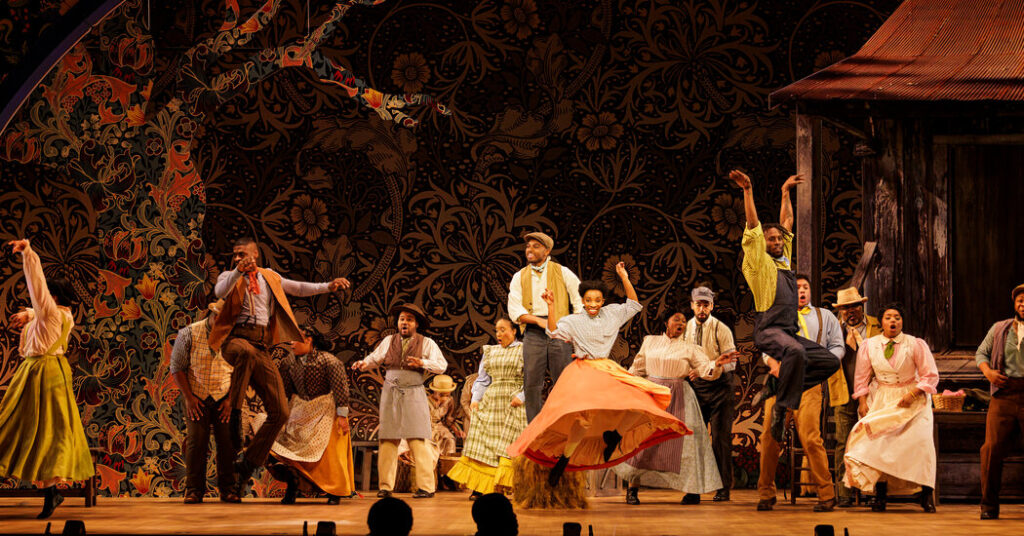
When O’Leary was done and it was time for the show, the genial plucks of a banjo at the start of Scott Joplin’s “Treemonisha” doubled as a kind of declaration. Washington National Opera had pulled off the risky, difficult feat of abandoning its home, and all the security that came with it, and opening a new production within two months.
Fifteen years ago, the Kennedy Center saved Washington National Opera, which had been struggling financially and slowly withering. They merged administrative functions, and the company was given access to the center’s broad performing arts complex, whose theaters could accommodate productions big and small. At the time, the company’s leader saw this as insurance for “a very bright future.”
That was more or less the case until President Trump re-entered the White House last year and installed Richard Grenell as the Kennedy Center’s executive director and interim president. On social media, Trump said the center would be free of drag shows and anti-American propaganda. Grenell wanted productions at the complex to be guaranteed to bring in as much revenue in ticket sales and donations as they cost to mount. But opera can’t do that. It works around the schedules of artists and is planned years in advance, before financing is fully settled; and most performances lose money anyway.
Within the first year of Trump’s second term, artists pulled out of performances, donors were shaken, and ticket sales plummeted. Then Washington National Opera left, too.
Work on the season was well underway, but opera, the most complicated of performing arts, isn’t easy to relocate. And few theaters in the Washington area compare to the house at the Kennedy Center. Within a week of its departure, though, the company announced new venues for its main stage productions.
“Treemonisha” ended up at Lisner Auditorium, at George Washington University, where Washington National Opera got its start in 1957. It’s not an ideal theater. Plain, cream-colored walls converge at a proscenium that is wide but short. The pit can’t hold enough instruments for most classic operas. The acoustics are serviceable at best.
And Saturday’s performance didn’t exactly scream triumph. Joplin’s score, whose original orchestration has been lost, was touched up by the composer Damien Sneed and the playwright Kyle Bass. But it’s still a problem opera, with a weak libretto full of awkward syntax and a clumsy approach to dramaturgy.
Directed by Denyce Graves, the production was humbly straightforward and friendly to singers, often placing them front and center, and facing the audience. But as Francesca Zambello, the company’s artistic director, said in an interview, elements of the staging had to be abandoned to fit the new theater. An upright piano and banjo downstage interacted with the cast so rarely they seemed to have been moved there from the pit.
It’s a miracle, though, that “Treemonisha” happened at all, and as smoothly as it did considering the shuffle of planning and philanthropy that happened behind the scenes. Now, there is a lot more work to be done.
This season, Washington National Opera has two more main stage productions to get through. “Treemonisha,” a parable of knowledge’s power over superstition, was the start of an American triptych that is sure to be freshly resonant as it continues with Robert Ward’s adaptation of “The Crucible,” which sets Arthur Miller’s tale of disinformation run amok to music; and “West Side Story,” a cautionary tale of tribalism.
Washington National Opera, though, is so much more than its big offerings. The Kennedy Center, luxuriously, had the theaters to showcase the company’s programs that were less commercial but invaluable to the art form, chief among them, the American Opera Initiative.
Each year since 2013, the company has commissioned three one-act operas, offering opportunities to those who need them most: composers outside the mainstream or at an early stage in their careers. Carlos Simon, who would become the Kennedy Center’s composer in residence, wrote one. And some were turned into full-length works that traveled to other theaters, like Missy Mazzoli and Royce Vavrek’s “Proving Up,” and Huang Ruo and David Henry Hwang’s “An American Soldier.”
It’s a program of real artistic merit and national importance. “Proving Up” recounted a harrowing tale of 19th-century homesteaders in Nebraska. “An American Soldier” dramatized the real story of Danny Chen, who was brutally hazed in the Army and killed himself in 2011.
This is the type of work that the Kennedy Center’s new leadership has shown little interest in presenting. (“An American Soldier” would be a magnet for controversy today.) But it’s also the hardest programming for a company in Washington National Opera’s position to keep alive.
The latest American Opera Initiative showcase, originally scheduled for January, wasn’t part of the announcement of rescheduled shows and new venues. Zambello said it would still take place, with plans to perform it in late May at the company’s rehearsal studios, miles away from the Kennedy Center, and that she was optimistic about the program’s future and funding.
“We’re basically trying to keep the 70-year-old company as it was,” she said, “but keep the values, the mission, the things that give us integrity.”
Trying is a good way to put it. This “Treemonisha” was admirable but clearly a product of its circumstances, like the next American Opera Initiative performance. Now that the company has proved it can be independent, it needs to prove that it can still matter.
Joshua Barone is an editor for The Times covering classical music and dance. He also writes criticism about classical music and opera.
The post After Leaving the Kennedy Center, an Opera Company Shows Signs of Life appeared first on New York Times.