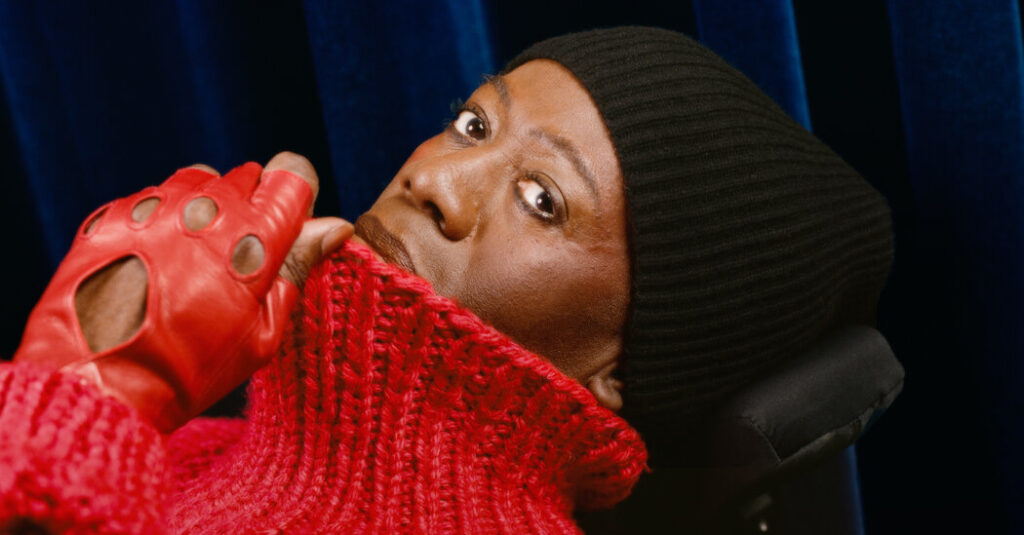
J. Alexander, the “America’s Next Top Model” runway coach also known as Miss J, does not mince words.
J, born Alexander Jenkins, was unapologetic when he told contestants on the reality show not to blame photographers for unflattering photos, but to “blame your parents for bad DNA.” A former model himself (who often walked runways in drag), J was also unvarnished when he told “Top Model” aspirants that it was their responsibility to “maintain your size.”
In a recently released Netflix documentary series, he revisits his time on the show along with others, including Tyra Banks, the “Top Model” creator and one of the many people whom J taught how to strut (a group he has said also includes 1990s stars like Nadja Auermann, Claudia Mason, Susan Holmes and Meghan Douglas).
The “Top Model” docuseries tussles with the complicated legacy of a show that promoted inclusivity but also body shaming and racial stereotypes. (In some photo shoots, contestants were made to embody ethnicities different from their own.) Another topic that J, 67, contends with is his health: In 2022, he had a stroke that impaired his ability to speak and to move. Walking, the act that he made into an art form, has since become a daily struggle.
“It’s a lot of me healing and dealing, soul searching,” J said of his recovery on a call with The New York Times. He was living in Paris before the stroke, which occurred while he was visiting New York, where he grew up in the Bronx. The rehabilitation process has kept him in the city.
His recovery has required him to use a wheelchair as well as a cane, and it has coincided with a time when some designers have shown more willingness to put models who use wheelchairs on runways.
In an interview that has been edited and condensed, J spoke about how his stroke has influenced his perception of the runway and about his career before, during and after “Top Model.”
At the time of the stroke, what was going on in your life?
I had just come to New York for Thanksgiving and Christmas. It happened Dec. 27. They found me on the floor in the bathroom, and they rushed me to the hospital, I was told.
I woke up in the I.C.U. I spent a month and a half in rehab — the first rehab. Then they took me to another rehab center. I spent a year and five months there.
What has recovery been like?
Grueling. It’s taking time. I engage myself by watching TV, doing crossword puzzles. I hate to read! But I did read a couple of books, maybe 10, and watch old videos — old fashion shows and new fashion shows.
I’m weak on the right side, and I can’t sit without a brace. I’ve learned how to use my left hand; my right hand was dominant. I take medication five times a day. I’m doing occupational therapy, physical therapy and speech therapy. I can walk with assistance and a cane, and I’m getting stronger on the right side. You can imagine, when I get to walk, I’m going to fly away.
Has using a wheelchair and cane altered the way you define “working the runway”?
I think it requires walking. It should allow the clothes to move.
At the same time, in wheelchairs, you could get a good sense of flowing and movement as long as your dress doesn’t get caught up in the wheels. Will I teach girls in wheelchairs? Maybe.
How do you define a good runway performance?
When you add your own personality to it. I’m teaching basics, and you have to add personality to it. Make it your own, make it come alive. You’re carrying the clothes.
A critique of your time on “Top Model” is that you were harsh to contestants. What do you say to that?
That’s to sell newspapers and magazines. I don’t think I’m a harsh critic at all. A fun critic, not a harsh one.
I had to, basically, whip them into shape. I saw so many girls pass through there. They would show how they walked first, then I’d say they’re not doing it right. I’d show them my walk, and they’d all laugh. I was there to make it right. Maybe some people took it hard.
What was your childhood like? I know you were the sixth of nine children.
A normal childhood, I think, within the limits. My mother would beat my behind when it was needed. She said to respect young and old, black and blue, because manners will carry you when money cannot.
I had a penchant for clothes. I was wearing, like, my jeans on backward. I don’t know why, but I did it. I felt that I was creative, if that makes any sense.
My mother would say, “If you want what other people have, you go out and buy them, because I’m not paying for them.” So I sold newspapers. I graduated high school, and was a messenger. I was a stock boy. And I would make clothes for girls in the streets.
How did you get into modeling? Was it always an aspiration?
Not really. I met someone from Japan who said to come over to Japan because they were more into using avant-garde models. I said OK. I was there for two years; two and a half years, maybe.
In Japan, the shoes didn’t fit. They had to make shoes for me. That’s when the cross-dressing started. I took it to full force. I was putting on makeup, not perfectly, and doing outrageous hair — long. I was getting into clubs for free because I was dressing outrageously. In the clubs was where I learned my runway technique. I just walk, walk up and down, you know, sashay and up and down the club.
How did you go from modeling to coaching?
I was doing nontraditional shows. Jean Paul Gaultier and things like that. It was very short-lived because I was androgynous, and the industry wouldn’t get into that, really.
At shows, I was saying to models, “Oh, you should walk like this and like that, give it attitude.” And they said, “Well why don’t you just teach me how to walk?” Then I began to teach.
Have you ever worked with anyone and felt as if, no matter how much you tried, you could not help them?
No.
Yola Mzizi is a reporter for the Styles section and a member of the 2025-2026 Times Fellowship class, a program for journalists early in their careers.
The post Working a Runway Without Walking appeared first on New York Times.