Aida Quilcué, an Indigenous leader and a Colombian senator, said she was driving through rural southwest Colombia with her security detail when about a half dozen armed men in camouflage stopped them by a bend in the road.
The men, scarves pulled over their faces, ordered her to remain silent. They walked her a short distance into a thicket and forced Ms. Quilcué and her two bodyguards to kneel, guns drawn against their backs, she said in an interview.
News of her disappearance last month shot up the upper echelons of the Colombian government after passers-by spotted her abandoned pickup truck, prompting the defense minister to announce a search for her. After holding her for several hours, she said, the men fled and Ms. Quilcué was free.
“I’ve had many scares, many difficult situations, but this time I felt closer to the danger of being assassinated,” said Ms. Quilcué, a well-known Indigenous activist whose husband was assassinated in the same region in 2008. “I simply asked God and the spirits to get me out of there.”
Her account is the latest in a series of violent episodes targeting political candidates that have rattled the South American country and left Colombians on edge as they head to the polls for congressional elections on Sunday.
In the run-up to the vote there has been a spike in homicides, kidnappings and death threats against politicians and party activists that has raised alarms among election monitors and political parties.
Experts said the current cycle of political violence is the most serious since Colombia’s landmark 2016 peace accord with the Revolutionary Armed Forces of Colombia, or FARC, meant to end a brutal decades-long internal conflict. The FARC’s disarmament left a power vacuum filled by other groups that compete over land, money and control of drug routes.
Since last year, the United Nations has tracked 32 homicides and more than 120 threats and attacks against political leaders in Colombia. The Electoral Observation Mission has issued alerts for 185 municipalities, or about 16 percent of Colombia’s municipalities, where it said the risk of “electoral fraud and violence” was alarming.
The violence has been concentrated in rural parts of the country where armed groups have been accused of coercing residents to vote for their preferred candidates and of retaliating against politicians they consider a threat to their interests, such as drug trafficking and illegal mining.
The security concerns pose a key test for Colombian officials and their ability to safeguard elections ahead of a crucial presidential vote in May to replace Gustavo Petro, the country’s leftist president, who is barred from running for another term.
The recent violence comes as the Colombian government has suspended peace talks with other armed groups and has vowed to aggressively go after drug traffickers amid pressure from the United States.
Colombia is still reeling from the assassination last summer of Miguel Uribe, a presidential hopeful and grandson of a former president who was shot during a rally in Bogotá, the country’s capital. His murder shocked Colombians who believed they had moved past an era when armed insurgents and drug cartels routinely killed and kidnapped politicians and other high-profile figures.
“His assassination completely changed the environment,” said Alejandra Barrios Cabrera, the director of the Electoral Observation Mission, the country’s top election watchdog.
The Colombian government has raced to reassure the country’s 41 million voters as they prepare to elect a new Senate and House of Representatives, with more than 300 seats on the ballot. Colombians will also hold primaries to decide who will represent three coalitions in May’s presidential elections.
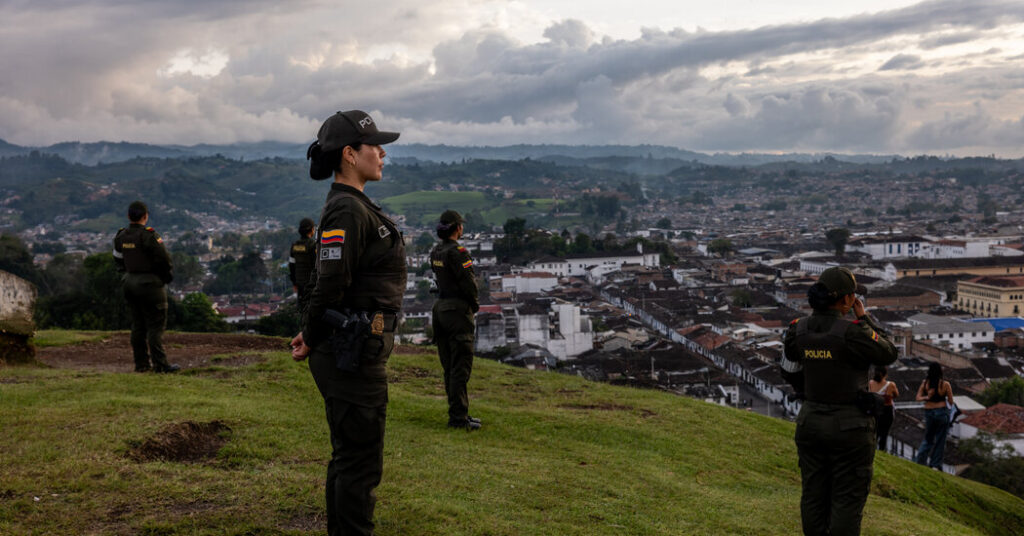
The country’s defense minister said the military would mobilize nearly 250,000 soldiers to protect thousands of voting sites, no matter how remote. The government has released videos of armed troops in riot gear who will be deployed to the polls.
Some of the largest armed groups in the country, like the National Liberation Army, or E.L.N., and the Ejército Gaitanista de Colombia, commonly known as El Clan del Golfo, recently declared a cease-fire. They vowed to let Colombians vote “in liberty.” But smaller, more fragmented groups have not followed suit.
Freedom House, a nonprofit that promotes democracy and liberty, ranks Colombia in the middle of the pack among Latin American countries in terms of civil liberties and political freedom, noting its ability to hold elections is largely considered free and fair.
But experts have also warned of a recent backslide in the rule of law under pressure from armed groups that have hindered participation in areas where illegal mining, cocaine cultivation, and drug trafficking proliferate.
Those concerns intensified in the days before Sunday’s elections as Colombians have been inundated with nearly daily reports of aggressions targeting candidates.
In Arauca, a remote region bordering Venezuela, the two bodyguards of a senator were fatally shot last month by the E.L.N., Colombia’s largest insurgent group, according to Colombian authorities.
And just on Wednesday, Maria Bolivar Maury, a congressional candidate, released a video in which she said that assailants on a motorcycle had fired at her car while she was driving in Córdoba, in northern Colombia.
“Three shots struck the vehicle,” she said in the video, “three attempts to silence a voice.”
Mr. Petro’s interior minister released an image of the bullet-riddled S.U.V. that she was traveling in when attacked and vowed to investigate the episode.
Some politicians have publicly accused each other of fabricating threats to gain sympathy from voters.
Ms. Quilcué, the Indigenous senator, said she was not sure if the armed men who detained her realized who she was.
Colombian authorities said they were investigating the episode, which they said occurred in an area controlled by a FARC dissident group.
Many Indigenous people live in Colombia’s less populated and rural regions and have long suffered from violence by armed groups seeking to influence their vote and who, experts say, surveil and restrict their movements through checkpoints and lockdowns.
Scott Campbell, the Colombia representative for the United Nations High Commissioner for Human Rights, said residents in those regions “live in a climate of fear where they can’t speak out and express their political views or opinions without fear of serious reprisal.”
“If a political leader from the left or the right is assassinated in that zone, the population will, without much difficulty, interpret that as to who they shouldn’t support,” he added.
As their ranks have swelled, armed groups have grown emboldened. Some have banned certain candidates from entering their territories.
“It is intolerable that in so many parts of the country, campaigning in peace remains an exception,” said Lidio García, the president of Colombia’s Senate.
Despite the violence, election monitors expressed confidence in the country’s electoral system, noting Colombia’s long track record of holding largely free elections during periods of greater violent conflict.
“It speaks to the resiliency of the Colombian democracy,” said José Antonio de Gabriel, the head of the European Union’s Electoral Observation Mission in Colombia.
Simón Posada and Annie Correal contributed reporting.
Luis Ferré-Sadurní is a reporter for The Times based in Bogotá, Colombia
The post Violence on the Campaign Trail Rattles Colombia Ahead of Elections appeared first on New York Times.