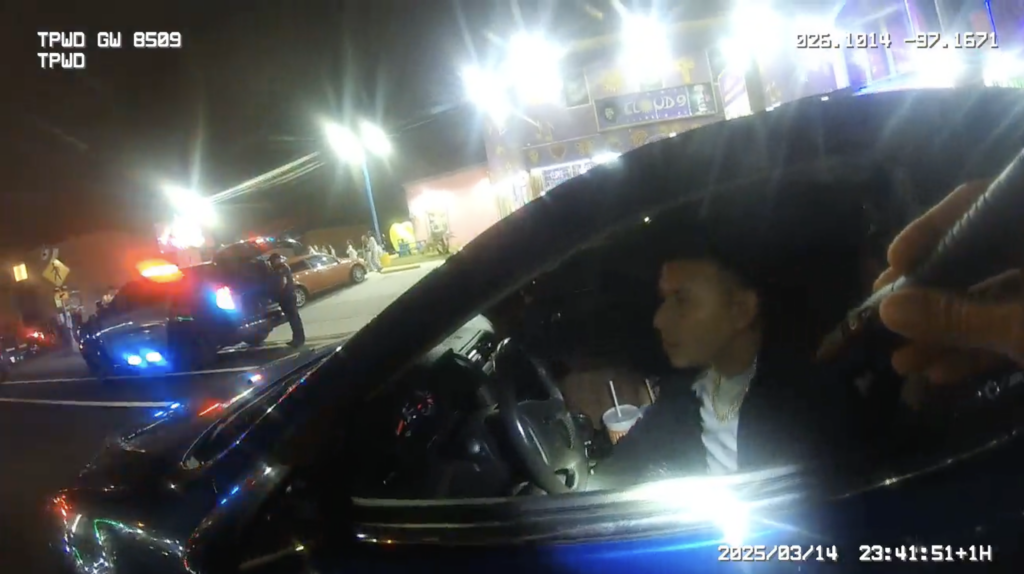
Video released by investigators in the fatal shooting last March of a U.S. citizen by a federal immigration agent calls into question a U.S. Immigration and Customs Enforcement spokesperson’s claim that the victim “intentionally ran over” a different agent before being shot.
The investigative material released Friday by the Texas Department of Public Safety shows that Ruben Ray Martinez, 23, was given conflicting instructions as he encountered law enforcement officers from multiple agencies near the scene of a previous vehicle accident in South Padre Island, Texas, in the early-morning hours of March 15.
His car moved forward very slowly in the moments before Homeland Security Investigations Agent Jack C. Stevens fired three shots into Martinez’s blue Ford sedan. The footage does not show Martinez speeding up rapidly or appearing to target a second Homeland Security Investigations agent, Hector Sosa.
Martinez was under the influence of alcohol and had marijuana in his system, according to autopsy records, as different officers allowed him to keep going and shouted at him to stop.
Sosa told investigators that Martinez’s car struck his legs, causing him to fall over the hood before Stevens opened fire. It is not clear from the nighttime footage whether the slow-moving car actually hit Sosa. Footage from a nearby business shows the hood of the Ford. But the video is grainy and skips through some portions and does not definitively show whether there is a figure on top of the hood.
Geoffrey P. Alpert, a professor of criminology and criminal justice at the University of South Carolina, said the chaotic scene, and its handling by law enforcement, raises “a lot of red flags.”
“The contradictory orders are confusing and may have been a strong influence,” Alpert said. “The speed is slow and doesn’t appear threatening. Could the officer have moved away? At worst, all he has to do is step aside. We call it officer-created jeopardy.”
The body-camera and surveillance footage was released along with witness statements and other material after a grand jury in Texas declined to indict Stevens in connection with Martinez’s death.
In an e-mailed statement, acting ICE director Todd M. Lyons said: “We stand by the grand jury’s unanimous decision that found no criminality. This incident was investigated from every possible angle by an independent body, and it cleared our officer.”
The evidence provides a raft of new information about the first known DHS fatal shooting of a U.S. citizen since President Donald Trump returned to office and began his aggressive immigration crackdown.
More than a dozen people have been shot by DHS personnel over the past 14 months, including two other fatal shootings of U.S. citizens during immigration enforcement operations. In January, immigration personnel in Minneapolis shot Renée Good and Alex Pretti in separate incidents days apart. Three months earlier, a Border Patrol agent shot and injured Marimar Martinez in Chicago. In each of those three cases, administration officials accused the victims of endangering the officers before they were killed, and some of their characterizations were proved false once more information about the shootings became public.
In a fourth case, two ICE officers were suspended and placed under federal investigationafter making false statements about the nonfatal shooting of a Venezuelan immigrant, Julio Cesar Sosa-Celis, in Minneapolis.
While those cases drew immediate and intense public scrutiny, DHS did not publicly acknowledge that one of its agents had fatally shot Ruben Martinez in South Padre Island, Texas, until last month, when a lawsuit brought by a nonprofit government watchdog group unearthed the agency’s narrative of the incident.
According to those internal DHS documents, officers and agents commanded Martinez to stop and get out of his car as he approached law enforcement personnel from several agencies who were securing the scene of a vehicle accident involving multiple injuries. Martinez “accelerated forward, striking a HSI special agent who wound up on the hood of the vehicle,” the internal documents say.
In a statement that followed the public disclosure of the killing, a DHS spokesperson said Martinez “intentionally ran over” the agent.
After the investigative material was released Friday, lawyers for Martinez’s mother, Rachel Reyes, said the footage called the government’s narrative into question.
“These new videos confirm that Ruben’s car was barely moving when he was shot,” Charles M. Stam and Alex Stamm said in a statement. “That he was shot at point-blank range through his side window by an ICE agent who was in no danger.”
Parts of the lawyers’ statement characterized the video footage in ways that are not supported by The Post’s analysis. They said, for example, that Martinez was braking his car, not accelerating, and that no one was on the hood of the vehicle or in front of the vehicle when Martinez was shot.
But The Post found that the footage is not clear enough to make those determinations. The audio on at least one body-camera recording released by authorities appears to be off by several seconds, making it seem as though Martinez’s brake lights were on and the car appears almost stopped when Stevens opens fire. But two other videos — a body-camera recording from another officer and footage from a nearby surveillance camera — capture the gunshots after the sedan has turned slightly left.
Asked about the discrepancy, the lawyers said: “We have seen no information or evidence that places any officer in harm’s way that justified a federal agent shooting and killing Ruben. That’s the bottom line. And we’ve seen no video or written evidence that Sosa was struck by Ruben.”
The first part of the footage shows Martinez stopping his car as a Texas game warden, identified as Juan Rosendo, holds a flashlight and peers into the driver-side window. Rosendo instructs Martinez to pull into a parking lot after seeing Martinez conceal what he believes to be an open bottle of alcohol.
Then a South Padre Island police officer tells Martinez to keep going, pointing to the line of traffic bypassing the vehicle wreck.
Martinez, however, continues toward the intersection where the crash took place. Officers who moments earlier let him pass begin to call after him: “Stop him, stop him, stop him,” says an officer.
What follows is only partly captured on body-camera recordings and surveillance footage: An agent identified as Stevens stands near the driver’s side of the car. Sosa appears to be in front of the car as it slowly turns left, away from the crash scene. Because of the poor quality of the footage, it is not clear whether Sosa is struck.
After Stevens fires, the car is seen completely stopped. Martinez can be seen weakly setting one foot out of the car. Stevens pulls him to the ground and officers handcuff him before medical attention is provided.
About a minute after the shooting, Stevens and a female HSI agent turn Martinez onto his back. Blood has already soaked through his shirt. Paramedics arrive shortly after to render aid.
Martinez was transported to Valley Regional Medical Center in Brownsville, Texas, and pronounced dead, according to the documents. Sosa was transported to a hospital and treated for a knee injury after being hit by the vehicle, police documents say.
The killing was investigated by the Texas Department of Public Safety and presented to a grand jury in Cameron County, Texas, on Feb. 25, with jurors declining to charge Stevens.
Martinez’s friend, Joshua Orta, witnessed the shooting from the passenger seat. In a written statement later provided to lawyers for Reyes, Orta rebutted key elements of the DHS narrative: “I was present, and I state clearly and without hesitation that Ruben did not hit anyone,” Orta wrote. “The trooper seemed to be trying to get in front of the car, like he wasn’t moving out of the way when we tried to turn around and leave like the police officer told us to do.”
But Orta, who was killed last month in an unrelated vehicle crash in San Antonio, offered a less definitive account to investigators in the hours after the killing — an account that more closely matches what can be seen in the video footage.
He said Martinez seemed to be nervous as they navigated where law enforcement had set up. “He didn’t know where he was going. He went through the officers and then I guess he panicked, because we ended up right by an accident,” said Orta.
When they reached the intersection, the two were told to halt. Martinez stopped, Orta said, but then turned the wheel left, and the car “moved a little bit.” Martinez, he added, “gets hesitant, he gets scared.”
“I saw the officer kind of like get on the hood,” Orta told investigators. “He didn’t hit him, you know what I mean, caught his feet.”
He recalled hearing an officer on the side of the car again say “stop, stop” and then hearing three shots. “We just ended up right there,” said Orta. “I know he didn’t, like, mean to hurt no officer.”
The post Video of ICE shooting of Texas man raises questions about government claim appeared first on Washington Post.