As President Donald Trump started a spiraling war in the Middle East, his administration has acknowledged that another war he claimed to have ended is still going on.
Trump has repeatedly counted decades of fighting between Rwanda and the Democratic Republic of Congo as one of eight wars he settled as he openly sought a Nobel Peace Prize. In December, he brought the leaders of both Central African countries to the U.S. Institute of Peace to sign an agreement called the Washington Accords.
“In my first 10 months I ended eight wars,” he said in his Feb. 24 State of the Union address, going on to list “the Congo and Rwanda.”
But on Monday the Treasury Department imposed sanctions on the Rwandan military and four senior officers, saying they are supporting militants in eastern Congo who resumed fighting within days of the December pact. The State Department followed on Friday with visa restrictions for unspecified senior Rwandan officials.
Adding to U.S. frustrations with Rwanda, the country has detained a U.S. citizen, which has not been previously reported. Didier Nizeyimana, 34, of Austin, was arrested in February while visiting family in Rwanda after his YouTube account posted a video criticizing the government, according to his girlfriend, Solange Muhoza. Staff from the U.S. Embassy are providing consular assistance to Nizeyimana, have visited him in jail and are staying engaged in his case, a State Department spokesperson said.
“I have a kid who needs to see her dad,” Muhoza told The Washington Post.
At the center of the peace deal was Massad Boulos, the father-in-law of Trump’s daughter Tiffany. Trump originally tapped Boulos, who is Lebanese American, as an adviser on Arab affairs, but Boulos switched to African affairs last year as special envoy Steve Witkoff and Trump’s son-in-law Jared Kushner took the lead on handling negotiations in the Middle East.
Boulos pushed to sign the Washington Accords in December instead of waiting for signs of progress between Rwanda and Congo on the ground because he wanted the win, according to a U.S. official who, like others, spoke on the condition of anonymity because they weren’t authorized to speak to the press.
Boulos declined to be interviewed through a spokesperson. A State Department spokesperson said: “A peace agreement does not result from perfect conditions on the ground; it creates them by establishing a framework for de-escalation, accountability, and trust-building, serving as the launchpad for real progress including lasting ceasefires, expanded humanitarian access, and reduced violence.”
In addition to stopping the violence, the Washington Accords aimed to expand U.S. investment in valuable minerals on the Congolese side of the border.
“The United States is taking decisive action to hold Rwanda accountable for its blatant and ongoing violations of the Washington Accords, and its failure to uphold the commitments made to President Trump,” a senior administration official said. “President Trump is the Peace President, and we will continue to use all available tools to ensure a nonviolent end to this conflict and the adherence to the historic agreement he brokered.”
As the truce fell apart, Vice President JD Vance stepped in. He called Rwanda’s president, Paul Kagame, to urge him to comply with the steps he agreed to in the peace process, two officials said.
Kagame succeeded in delaying the sanctions for several months by calling on Sen. Lindsey Graham (R-South Carolina), a Trump adviser who then intervened with the White House, according to the U.S. official. Graham’s role was first reported by the Wall Street Journal. His office did not respond to requests for comment.
Analysts said the new sanctions marked a serious response to a regime that was long treated as a reliable partner and whose leaders cherish their perceptions in the West.
“Given how close the U.S. and Rwanda have been in the past, it’s really quite shocking to see Washington sanctioning Rwanda’s army,” said Michela Wrong, the author of several books about Rwanda and Congo. “It marks a major break in the relationship.”
The Rwandan government called the sanctions one-sided and accused others of violating the truce. Secretary of State Marco Rubio said on Friday that the Congolese also need to uphold their commitments by neutralizing their associated armed groups.
“Rwanda is ready to lift its defensive measures in tandem with the DRC fulfilling its obligations under the Washington Accords,” Kagame said at a diplomatic reception on Friday, using an abbreviation for the Democratic Republic of Congo. “You know that you can trust us. We are reliable.”
Rep. Sara Jacobs (D-California), the ranking Democrat on the House Foreign Affairs subcommittee on Africa, said the sanctions should have happened three months ago.
“President Trump is more interested in announcing peace and the end of wars than actually doing the hard diplomatic work to achieve that goal,” she said. “I urge President Trump and his administration to take consistent high-level engagement and action to get the peace process back on track.”
Rwanda has long enjoyed sympathy in Washington since Kagame’s movement overthrew the regime responsible for the 1994 genocide. Kagame organized one of the continent’s most effective militaries — a top contributor to U.N. peacekeeping missions. He takes care with his image in the West, with visits to American universities and NBA games.
At the same time, Kagame has sought to expand Rwandan control over eastern Congo, home to valuable resources such as gold, tin and tantalum used in electronics. Rwanda and allied militants in Congo, known as the March 23 Movement or M23, say they are fighting remnants of the forces who committed the 1994 genocide and then fled to eastern Congo.
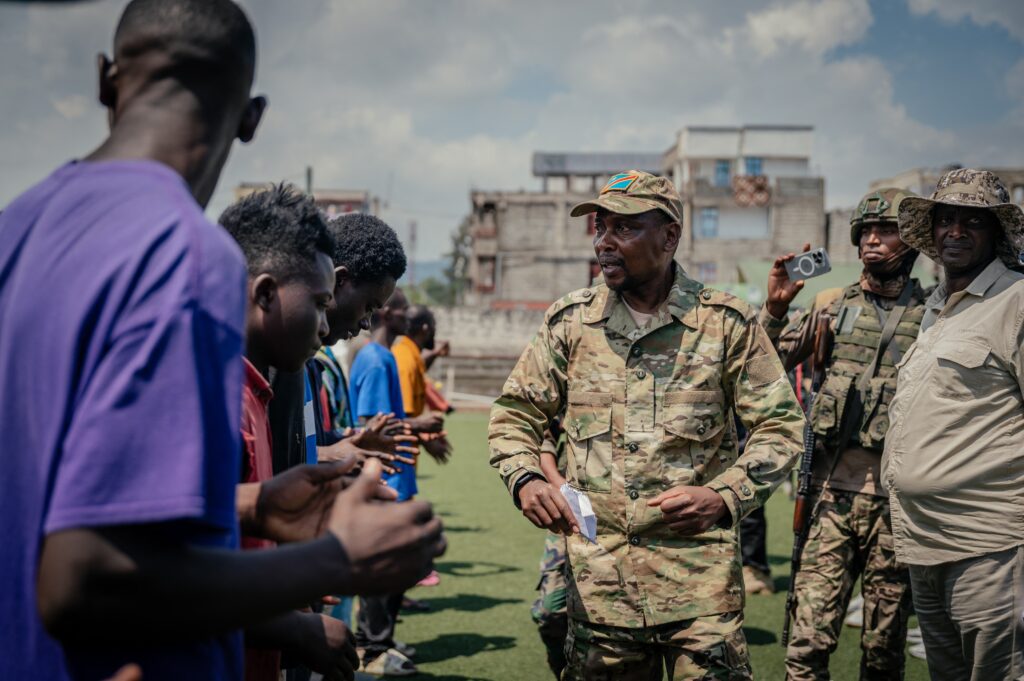
The U.S. said Rwanda’s military equips, trains and fights in eastern Congo alongside M23, which has committed summary executions, attacks on women and children, and torture. A previous M23 offensive ended in 2013 when the U.S. and Western allies cut aid to Rwanda.
Shortly after Kagame signed the Washington Accords in December, M23 attacked the Congolese city Uvira near the border with Burundi, which the U.S. said risked a wider regional war.
The U.S. condemned the offensive and demanded a complete withdrawal. M23 left the city but stayed in the surrounding hills, according to Yale Ford, an analyst who tracks the conflict for the Critical Threats Project at the American Enterprise Institute. The militants also conducted a drone attack on a Congolese air base far from the front line, he said.
For its part, M23 denied serving Rwanda, instead arguing for an ancestral claim to the land in eastern Congo.
“We are not part of the Washington Accords,” the group’s deputy spokesman, Oscar Balinda, said in an interview. “We did not go to Washington, we did not participate in any way whatsoever.”
In February, a U.N. panel said M23 was targeting people documenting human rights abuses in the region, including two women protesting the forced expulsion of civilians who were abducted and tortured.
American policymakers increasingly see Rwanda as an aggressor and are more interested in access to Congo’s minerals, said Jason Stearns, a professor at Simon Fraser University in Canada who has studied the conflict for 25 years.
“This is a war that is going to take a long time to solve, there’s no doubt about that,” he said. “There are many actors involved in this crisis who would actually prefer a war to peace. And so for the U.S. to be able to get this over the finish line, they’ll have to invest substantial political, economic capital in making this work at a moment where U.S. diplomacy has been hollowed out by budget cuts and staff cuts.”
Ombuor reported from Nairobi. Aaron Schaffer in Washington contributed to this report.
The post Trump said he ended a war in Africa. U.S. sanctions say otherwise. appeared first on Washington Post.