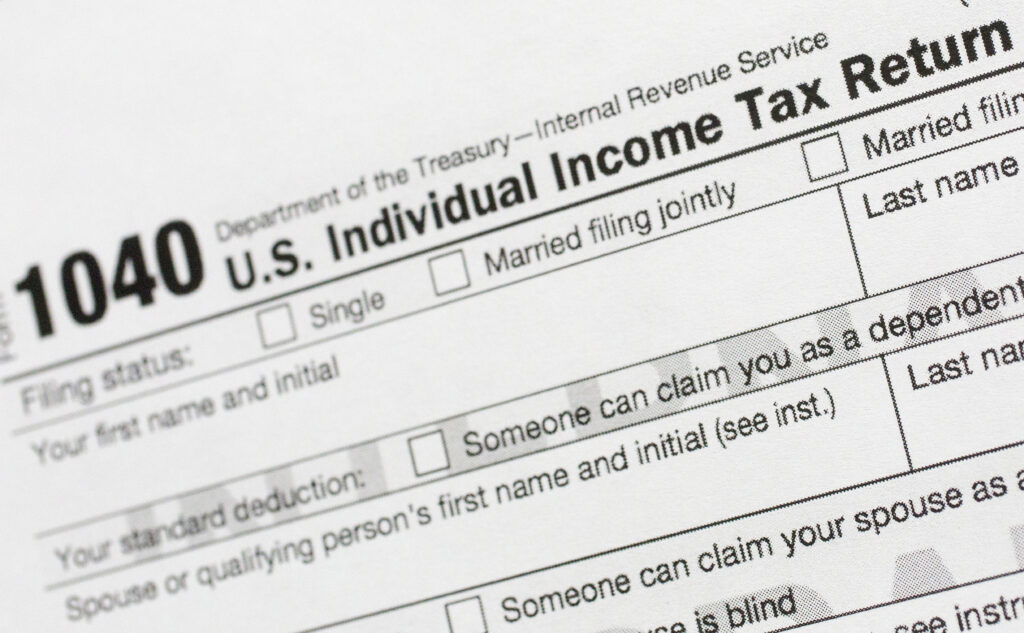
Over the next few months, as millions of Americans see potentially larger income tax refunds hit their mailboxes or bank accounts, President Donald Trump wants filers to think of who made them possible: Donald Trump.
The administration and its allies are trying to gain political capital in a midterm election year from larger tax refunds they say result from Trump’s policies — and particularly his One Big Beautiful Bill. GOP lawmakers structured key provisions of the 2025 tax law so that several of its most popular benefits apply retroactively to the start of the year, boosting refunds this filing season.
Unlike tax cuts that appear gradually in paychecks, refunds arrive all at once — one of the few moments when tax policy becomes visible to millions of Americans.
“Tax Refunds this year, because of ‘THE GREAT BIG BEAUTIFUL BILL,’ are substantially greater than ever before,” he said in a Truth Social post on Feb. 20 that highlighted new tax-saving presidential policies, including no taxes on tips or overtime, interest deductions on car loans, and no taxes on Social Security. “In some cases, estimates are that over 20% will be returned to the Taxpayer. So, when you get your Tax Refund, think about what a wonderful President you have.”
The data so far suggests refunds are larger, though not by as much as the administration has claimed. White House press secretary Karoline Leavitt has said people can expect an extra $1,000 on average. Treasury Secretary Scott Bessent, who is the acting IRS commissioner, has said early returns averaged north of 20 percent. According to early IRS figures, the average refund this filing season is up about 11 percent — roughly $360 — compared with the same point last year.
The push comes at a moment when many Americans remain pessimistic about the economy. Trump has positioned himself as the antidote to economic ailments that dogged Joe Biden’s tenure, promising to “end inflation” on his first day in office. He has said his signature policies — imposing wide-ranging tariffs, slashing regulations and trimming the fat from the federal government — would produce not just economic benefits, but usher in an American “Golden Age.”
That sweeping progress has so farnot materialized. Some 60 percent of Americans disapprove of the job he is doing, according to a recent Washington Post-Ipsos poll. Only 32 percent of Americans approve of how he has dealt with inflation, and 41 percent approve of his handling of the economy. Trump’s tariff policies have sent the stock market into paroxysms and were ultimately labeled unlawful by the Supreme Court; there has been no DOGE dividend. While the country has not slid into a recession, and has even seen some economic bright spots, the president’s bullish messaging countervails the experiences of a large swath of struggling Americans who elected him in hopes of gaining a better economic footing.
“The challenge has always been how do you make it tangible. How do you connect the policy changes [for people] who are not following the day-to-day workings in Washington to their bottom line, to their pocketbooks and their job security,” said Garrett Watson, director of policy analysis at the Tax Foundation, a policy nonprofit.
“The reason why you’re seeing the refund thing become so salient in the political conversation right now,” Watson added, “is because it is … a bottom-line number that they can latch onto and materially connect the dots between policy changes and their financial situation.”
The strategy has also highlighted a familiar tension inside the Republican Party. Fiscal conservatives have long argued that tax cuts should be paired with deficit reduction rather than structured to produce visible payouts to voters. Trump himself has repeatedly vowed to shrink the national debt.
Trump rolled out the No Tax on Tips pledge during a campaign rally in Nevada, after campaign officials encouraged him to lean into more populist messages. The pledge was especially resonant in Nevada, a battleground state that is home to Las Vegas and nearly half a million tipped workers. Republicans seized on the impulse, sending a No Tax on Tips bill through the Senate, though the measure wasn’t enacted until Trump signed a tax-and-spending measure in 2025.
Congressional Republicans structured the populist elements of that bill to be retroactive to 2025, increasing refunds and making a yearly tax refund feel more like a government rebate payment. That’s a direct lesson from 2017, said Andrew Lautz, director of tax policy at the Bipartisan Tax Center. Then, Republicans metered out the tax cuts, and voters didn’t perceive the money as a windfall all at once.
“There was a concerted interest from Republican policymakers, the Trump administration, Republican Congress, this time around to backdate some of the benefits,” Lautz said. “A lot of the biggest benefits — the tips deduction, the overtime deduction, the larger child tax credit — are backdated to January 1, 2025, specifically so that people can experience them this filing season.”
A tax refund, of course, is not a rebate from the government, and is actually the result of an overpayment — essentially a no-interest loan taxpayers make to the treasury each year. Still, the administration’s rhetoric has sought to turn something as ho-hum as doing your taxes into a gift from the president.
“Tax refunds are shaping up to be supersized in 2026, thanks to the ‘big, beautiful bill’ signed into law last summer by President Trump.”https://t.co/gTe1UxyFSf
— Karoline Leavitt (@PressSec) February 27, 2026
“Thanks to President Trump signing the largest middle-class tax cut in history, this is shaping up to be the biggest tax refund season ever — and we are in it now,” Leavitt said in a Feb. 10 press briefing. “From no tax on tips, overtime or Social Security to auto loan interest deductions on new American-made vehicles, plus increases to the standard deduction and child tax credit, more money is flowing back into the pockets of hardworking Americans.”
Efforts to derive political benefits — or to stave off political consequences of economic policies — by putting cash directly into Americans’ pockets is, of course, not an invention of the Trump administration. As president, Gerald Ford sent one-time rebate payments of up to $200 to Americans in 1975. George W. Bush twice offered stimulus checks. One was billed as a tax rebate, and another was billed as recession relief. And the covid era marked the most direct payments to Americans in U.S. history. Trump offered $1,200 per adult in the spring of 2020 and an additional $600 in late 2020. And Joe Biden’s American Rescue Plan included $1,400 in direct payments and also monthly payments to families from the expanded child tax credit.
Republican strategist Alex Conant said there is a reason politicians on both sides of the aisle keep offering rebates to Americans: They’re effective economic policy.
But restructuring tax filing season as a de facto government rebate is a novel idea, he said. It remains to be seen whether it will be effective for Republicans, especially at a time so many other issues are competing for Americans’ attention.
“I think to the extent that people are getting bigger rebates than they expected, that will be welcome news to taxpayers, and hopefully make them feel better about the their economic situation,” Conant said. “The challenge for Republicans is that these rebates are coming now, and the election is not until this fall, and people have short memories.”
The post Trump is betting that bigger income tax refunds will boost the GOP appeared first on Washington Post.