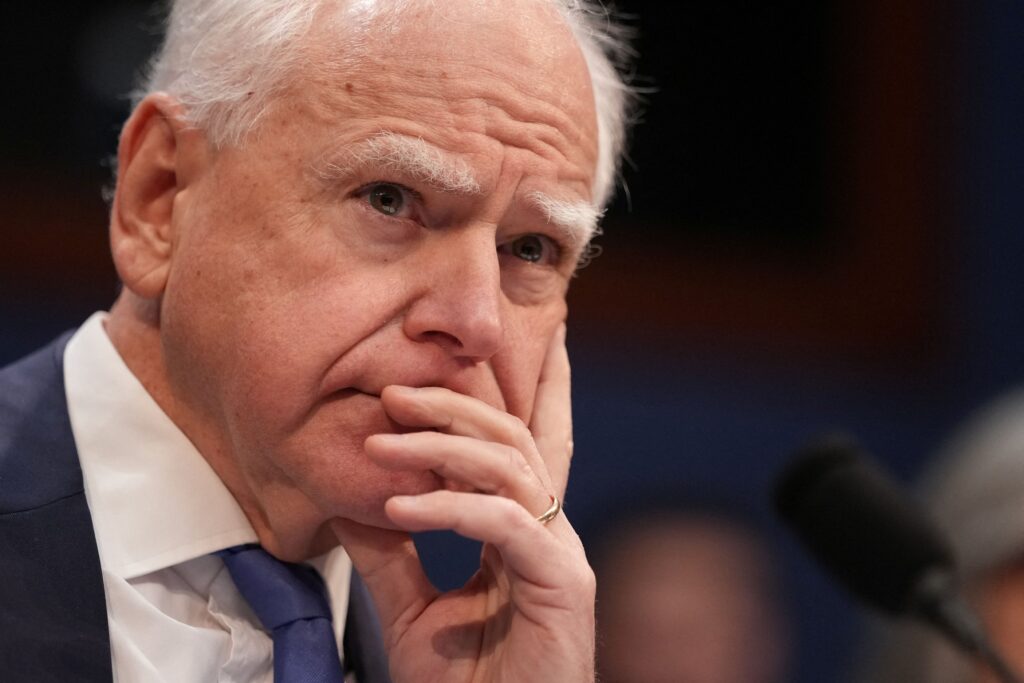
For Minnesota Gov. Tim Walz, who rose to national prominence as the 2024 Democratic vice-presidential nominee, the past year has been a cascade of nightmares.
“It was a privilege to do so. I know she would have been a fantastic president,” Walz said of his decision to accept former vice president Kamala Harris’s invitation to share the ticket. But he added: “I do think it comes with its own billion-dollar hits against you. So you know, you stick your head up, they’re going to come for you.”
The presidential race didn’t end as he had hoped, and since then, Walz and his state have been at the center of one trauma after another. The worst of them came to a head in January, when two Minnesotans were gunned down by federal immigration officers.
Two days after the death on a Minneapolis sidewalk of Alex Pretti, a 37-year-old intensive care nurse, Walz got a phone call. It didn’t start well, the governor recalled in an interview with The Washington Post.
“Well, Tim,” President Donald Trump told him, “everything went fine in Louisville and New Orleans,” other places where his administration had conducted high-profile crackdowns.
“Mr. President, you didn’t shoot anybody in those cities,” Walz retorted, referring to Pretti and Renée Good, a 37-year-old mother of three, who had been killed by a federal immigration officer 17 days earlier.
Trump backed off and turned to finding a way out of the explosive situation. “He was calling because he had to get out of there, and in typical form, they had to save face,” the governor said. (The White House declined a request for comment on the conversation.)
Walz offered no concessions, but that same day, Trump dispatched border czar Tom Homan to Minneapolis, replacing heavy-handed Border Patrol official Gregory Bovino. Soon after, what the administration had dubbed Operation Metro Surge was winding down.
Minnesota has suffered what the governor described as “generational trauma.” But its residents also offered the rest of the country an opportunity to observe the state at its best, he said.
Amid the massive and largely peaceful protests, America “got to see what it means when PTAs morphed into grocery running for folks, parents in reflecting vests surrounding a school at drop-off points around the buses,” Walz said. “What they got to see was, and what Minnesotans always knew, there is something unique about Minnesota. We give more to charity. We volunteer more. Our voter turnout is more. All of those things are part of a community that looks out for their neighbors.”
After Department of Homeland Security Secretary Kristi L. Noem was fired Thursday, Walz posted on Xthat she had “done a stunning amount of damage and it’s good she’s gone. But this doesn’t change the fact that we need a complete overhaul of DHS, impartial investigations into the killings of two American citizens, and information on children that were taken from Minnesota.”
Nor does it change the fact that Walz and his state remain a fixation of Trump and the GOP. On Wednesday, the governor and state Attorney General Keith Ellison (D) were called before a contentious hearing by the House Oversight Committee, in which Republicans offered scorching condemnation of their handling of a sprawling welfare fraud scandal centered in Minnesota’s Somali community.
In a 53-page report released shortly before the hearing began, the GOP-led panel claimed Walz and Ellison were aware of credible reports of fraud as early as 2019 and allowed “$300 million in federal child nutrition funds and potentially $9 billion in Medicaid-related funds to be lost or placed at serious risk.”
Walz denied their finding, saying in the interview that “when red flags came up,” state officials responded, but that in a crisis such as the covid-19 pandemic, “the role of these public programs is to get the resources out to people. … You have to do both. It’s not a zero-sum game.”
Last month, the administration said it would freeze $259 million in Medicaid payments for Minnesota as part of a “war on fraud”; on Monday, the state sued, saying the federal government has “weaponized Medicaid against Minnesota as political punishment.” (Recent federal data indicates the improper payment rate by Minnesota’s Medicaid program is 2.2 percent, about a third of the national rate of 6.1 percent.)
Meanwhile, political violence has punctuated everyday life in Minnesota. The first in a series of unspeakable traumas, and a deeply personal one for Walz, came this past June. Minnesota state Rep. Melissa Hortman — the minority leader and former House speaker who Walz said he hoped might succeed him as governor — was shot dead, along with her husband and dog, by a gunman dressed as a police officer who showed up at their front door in a Minneapolis suburb. Earlier that evening, the man charged in the shooting, who is believed to have been politically motivated, was alleged to have shot a state senator and his wife 17 times.
Walz said he has been unable to shake his sadness, though he tried to “stuff it down inside” with Minnesota stoicism. “It about broke me,” he said. Since then, Trump has amplified on social media a baseless conspiracy theory that Walz was behind her killing.
“I know how impacted he was by Melissa’s assassination,” Minneapolis Mayor Jacob Frey said. “They were from a political partnership perspective, and just from a friendship perspective, about as close as close can get. You go through tragedy like that, and you see it on his face.”
Ten weeks after Hortman’s death, gunfire ripped through the stained glass windows at Annunciation Catholic Church on the southwest side of Minneapolis, killing two children, ages 8 and 10, and injuring 14 other people before 23-year-old assailant Robin Westman died of a self-inflicted gunshot wound in the parking lot.
In early January, amid growing national scrutiny of how the governor’s administration and Minnesota authorities had handled the welfare fraud probe, Walz announced he was ending his bid for a third term as governor. “Every minute that I spend defending my own political interests would be a minute I can’t spend defending the people of Minnesota against the criminals who prey on our generosity and the cynics who want to prey on our differences,” he said then.
Even as Walz was coming to the decision that he had to withdraw from his reelection race, a force of 3,000 immigration agents was arriving in Minnesota for what the Department of Homeland Security called “the largest DHS operation ever.”
“I couldn’t have ever anticipated what we saw in Minneapolis and across Minnesota the last few months, not to the degree,” Walz said in the interview. “But I don’t think I was under any illusion they weren’t going to use all their power to do what they were going to do.”
Throughout, Walz said, he and White House Chief of Staff Susie Wiles were having back-channel conversations. He described her as “the one adult in the room that was willing to talk.” They spoke twice on the morning of Pretti’s death, and Wiles agreed the situation in Minneapolis had to come to an end.
What made that possible, the governor said, was Homan’s arrival. “I totally disagree with Tom Homan’s view on immigration, mass deportations, all those things. But when he came in, it was a different level of professionalism,” Walz said. “What I was worried about was, would it be Metro Surge with more efficiency? But it became clear to me he was sent there to get this thing over. … So in all fairness, he followed through with what he said.”
For all that he and his state have endured, Walz has been “calm, steady and focused throughout the entire period,” said Ellison, who has worked alongside the governor since the two arrived in the U.S. House in 2007. “I feel like I got to see it up close — day in, day out, in just 1,000 different decisions.”
In his remaining time in office, Walz has some things he wants to get done, including a ban on the type of military-style assault rifles and high-capacity magazines that were legally purchased and used by the shooter at Annunciation Catholic Church.
Beyond that, Walz said, he will continue to make his voice heard.
He disagrees with “some of my colleagues, fellow governors,” who argue that the Democratic Party should be focusing solely on issues such as affordability and health care. “There is a way to simultaneously talk about decency and neighborliness at the same time,” he insisted. “I think what’s different now, especially after what happened in Minnesota and with this war [on Iran], it doesn’t take a lot of selling to show that this is a pretty lawless administration, and personal civil liberties, whether you’re a citizen or an immigrant, are at risk.”
And might there be another run for national office? No, the governor said. “My moment was there. But I think there’s numerous ways to serve.”
The post Tim Walz talks about the ‘generational trauma’ his state has faced appeared first on Washington Post.