It was midnight in the final hours of his college spring break, and Richard Ackerman was hyped up on four coffees and a fervent belief in his evangelistic mission.
Sitting in his Dallas dorm room in 2023, Ackerman set his computer’s font to the cartoonish Comic Sans, sketched digital stick figure drawings and within several hours created one of the videos that have helped make him a popular gateway to religion. “All Christian denominations explained in 12 minutes,” which he posted under the name Redeemed Zoomer, has been watched more than 14.5 million times.
Ackerman, now a 23-year-old seminary student with nearly 700,000 YouTube subscribers, is among a few dozen American influencers playing a thoroughly modern role — online interpreter, explainer for a country newly searching for meaning but uninterested in the old-fashioned gatekeepers. For many millions of Americans, the influencers serve as travel guides to the world of religion. Call it Yelp for the seeker set.
At a time when religion in the U.S. has been flat or declining for decades, influencers including Redeemed Zoomer, Religion for Breakfast, Data Over Dogma and Esoterica are revealing a large audience hungry for details and distinctions about the vast array of religious choices available to them. With social norms or pressures to be religious much weaker, experts say people seem to want deeper, specific reasons for why they should practice one way or another — if at all.
Matthew Sutton, a historian of religion whose new book “Chosen Land” looks at how Christianity has adapted in America, said the influencers are in some ways simply an updated version of Christian bookstores, which until recently were ubiquitous across America. “Every generation repackages Christianity to meet the needs of that generation,” he said, “and Christianity has always been on the cutting edge of new communications.”
However, Sutton said, the desire for explainer-influencers is also a specific by-product of the decade of Donald Trump.
Trump’s elevation, he said, “has pressed the question ‘What does it mean to be a Christian in the modern world?’ in a way that’s much more public than in the past.” Trump’s explicit use of Christianity as a political tool to undergird everything from immigration crackdowns to policies regarding transgender people, Sutton said, has led to “more debates now about theology driven by our broader culture than there may have been in recent decades.”
A diversity of religious thought
Dan McClellan, a scholar of the Bible who hosts the “Data Over Dogma” podcast and has 1.6 million subscribers, began as a kind of umpire for online religion debates.
With three advanced degrees in religion, including a PhD from the University of Exeter in England, the Mormon academic said during the pandemic he “lurked” on social media as people across the spectrum — turning online with new fervor — argued about religion. He called out some ancient manuscripts as forgeries, pushed back on discoveries that purported to prove the Bible true, and criticized claims that Christmas and Easter are based on pagan holidays.
“I wasn’t seeing any credentialed expert,” he said. He thought he could call balls and strikes, but he assumed there was no audience for someone who didn’t choose sides. It turned out, he said, that a ton of people were interested in religion “in a nuanced and critical way.”
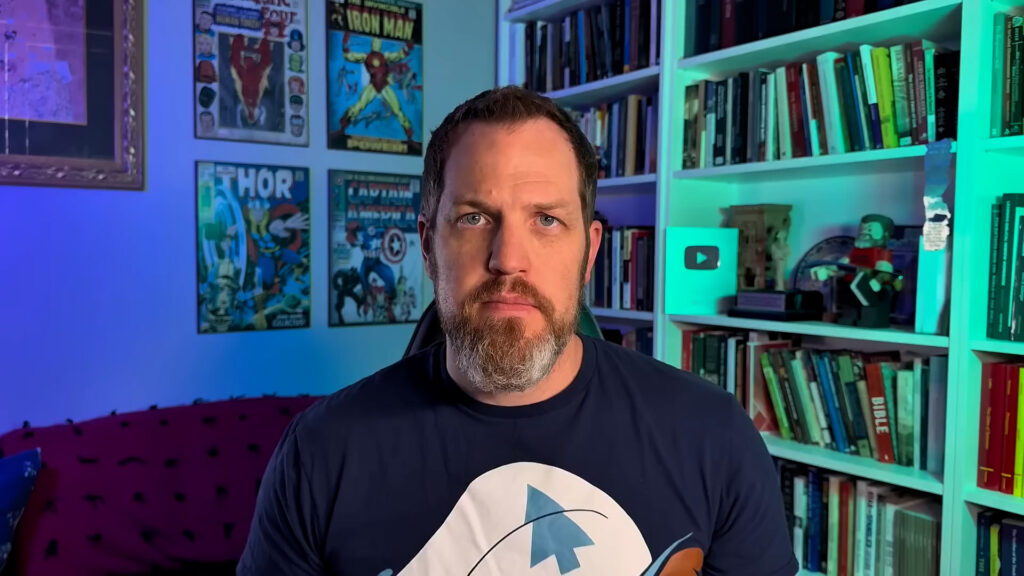
McClellan is now a celeb-scholar whose posts on TikTok and YouTube (among others) feature him — usually in a comic book T-shirt — often critiquing viral clips about the Bible in a kind of “oh snap!” tone. He and his fans emphasize the difference between his academic approach and that of “apologists” like Ackerman, who also argue for the validity of Christianity and sometimes advocate for a specific denomination.
McClellan’s posts cover subjects as diverse as what the story of Sodom and Gomorrah is really about (not homosexuality, he says, but the importance of hospitality), where the “H” in “Jesus H. Christ” comes from, Christian nationalism and even his own faith, the Church of Jesus Christ of Latter-day Saints. He says he gets about 5,000 to 6,000 comments on his posts each day.
Before he turned to religious commentary, McClellan worked as a massage therapist and ran twice as a Democrat for state office in Utah, losing both times. He translated scripture for the church for a decade as well but now works full-time on his social media posts and spin-off work (like books) and says he is doubling his income each year.
The impact of his work, like that of the other influencers, is not strictly academic. Take Gabriel Bennett.
Bennett, 45, grew up in evangelical and charismatic churches. He believed the Earth was just a few thousands of years old and that evolution was iffy. But as he started to confront discrepancies that are part of the Bible, Bennett struggled to see what was true.
While watching some atheist videos one day, he saw McClellan respond to something someone had written. McClellan’s way of critically approaching the Bible, without attacking or even challenging the idea of faith, was affirming for Bennett.
“He seemed to be like: ‘It’s OK to have a foot in both worlds,’” said the Portland, Oregon, cybersecurity professional, who still attends church. “I could look at problems I’ve been worried about [about theology] and be more OK with where I was, and not feel like I have to pick a side.”
Emma, a 26-year-old Rhode Island student, said McClellan and other big-name religion-explainer podcasters transformed her life. Emma grew up in a “militantly” atheistic home and spoke on the condition that her full name not be used because her family would disapprove of her religious exploration. She says the detailed, intellectual approach on McClellan’s site and similar accounts offered her religion she could embrace.
It’s “where I encountered a diversity of religious thought,” she told The Post.
Andrew Mark Henry, who runs a similar channel, Religion for Breakfast (1.2 million subscribers), describes the goal as religious literacy: “not to be a fish swimming through water and not know what water is.”
More trustworthy than a pastor
A teen convert who grew up in New York City area, Ackerman does not hide his evangelistic agenda.
Ackerman believes mainline Christianity — non-evangelical Protestant denominations such as Presbyterian, Lutheran and Episcopal — has become too liberal, too likely to see God and the Bible as metaphors, and too affirming of same-sex and transgender couples. He backs a more conservative version of mainline Christianity. The mainline tradition was the home of most of the country’s founders, and he thinks the United States would be better off if it was majority mainline. Christianity Today in a 2023 profile called him “Gen Z’s Martin Luther.”
Ackerman, who attends the Presbyterian Church’s University of Dubuque Theological Seminary, said a lot of his watchers are young and he doesn’t “want to get people to doubt the Bible … I don’t want to cast doubts on their beliefs.” But he does want to spell out core differences between denominations fairly and neutrally. The differences, in fact, are everything to him, a response to what he sees as consumerish, mushy theology.
That approach very much worked for Brendan Cusack.
A year or so ago, the Florida firefighter, 25, was in a period of spiritual crisis when an algorithm fed him Ackerman’s “12 minutes” video. Cusack had come to feel his longtime nondenominational church was like “fast food,” with more focus on pop music and lights than on having a satisfying explanation for why it rarely offered Communion or whether adult or infant baptism was correct.
“My faith had begun to die out,” Cusack told The Post. Watching Redeemed Zoomer “unlocked the door for me.” Ackerman was his age, and he seemed deeply authentic. The video, Cusack said, “set me on a path of rediscovering what I truly believed and who I should trust.”
Ackerman is wrestling with the reality that people do trust him. He conducted a poll once, and 25,000 responded. Of them, he said, 1,700 “said I made them go from ‘not Christian’ to ‘Christian.’”
He gets 100 questions a day, he says, including from older adults.
“Thirty-year-old women are asking me what they should do about birth control! I’m a 23-year-old guy! Or some 40-year-old guy will ask for help getting through his divorce. I’m like: ‘No! I can pray about it,’” he told The Post. “On the Christian internet, people replace their pastors with their favorite influencers. When they have a moral question, they’ll ask influencers versus their own pastors. I think that’s unhealthy. My first question always is: ‘Have you talked to your pastor?’”
For some, though, influencers like Ackerman are more trustworthy than a cleric.
Francisco, 42, a health care worker who lives in California, struggled much of his life with his parents coming from two different schools of Christianity. Their distinctive faiths were essential to them, he said, but they never could explain why. The kids wound up feeling as if they had to choose one parent or the other. As an adult, Francisco decided not to get married or have kids to avoid such a conflict.
Coming across Ackerman’s site a few years ago, he said, “gave me the information I’d been looking for.” It helped him understand his parents, he said, and “it strengthened my own faith. I can see now why they did what they did.”
Francisco, who spoke on the condition that his full name not be used to avoid hurting his parents, said Ackerman seemed trustworthy because he shared his own path of research and conversion.
“You can’t ask your pastor” the differences between faith groups, he said, “and expect to get a straight, real, unbiased answer.”
The post Religion influencers have become like Yelp for faith seekers appeared first on Washington Post.