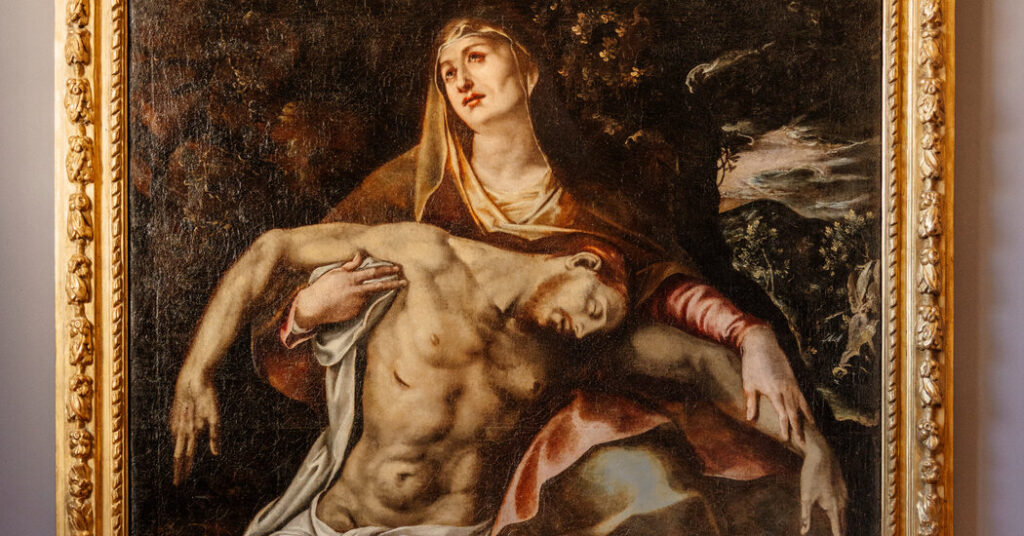
In 2020, an auction house in Genoa, Italy, offered a centuries-old depiction of the Virgin Mary holding the body of Christ for an estimated $2,300 to $3,500. The work, by an anonymous artist, failed to sell.
Four years later, two Brussels collectors bought the Pietà for more than 10 times that price, about $35,000, through the same auctioneer, with a hunch that it might be something far more illustrious.
After technical analysis and art historical study, the unnamed collectors shared what they thought was a major discovery. In a 600-page report, Michel Draguet, a former director of the Royal Museums of Fine Arts of Belgium, suggested that the work was a previously unknown oil on canvas by Michelangelo. The same week, an independent Italian researcher, Valentina Salerno, published an article online attributing a marble bust of Christ in the Basilica of St. Agnes Outside the Walls in Rome to Michelangelo as well.
Is it possible that, so many centuries after the Italian Renaissance artist created his marble David in Florence and the Sistine Chapel ceiling at the Vatican, completely unknown creations are finally coming to light? Did Michelangelo hide some works because they expressed heretical ideas and he was afraid of retaliation from the pope, as Draguet claimed?
It is an exciting prospect, but Michelangelo scholars say the truth is far more mundane: These are unlikely to be real Michelangelos.
“This is what I would call the Dan Brown approach to art history,” said the Renaissance art expert Francesco Caglioti, an art history professor at the Scuola Normale Superiore of Pisa, Italy, referring to the “Da Vinci Code” novelist. “They constantly find something secret hidden under the drapery or under a layer of painting. Every time there’s a thrilling scoop, something for Sherlock Holmes.”
“Art history is not this,” Caglioti said, adding, “It’s a slow process, and attributions are established over decades, not days.”
The stakes are high when new discoveries point to major art historical figures; newly attributed works can reap great profits. A sketch of a foot that was recently attributed to Michelangelo fetched $27.2 million at a Christie’s auction. The painting “Salvator Mundi,” which turned up at a small New Orleans auction and was later attributed to Leonardo da Vinci, sold for a record-breaking $450 million in 2017.
Discovering a Michelangelo oil painting on canvas in 2026 would be remarkable, said Terry van Druten, the chief curator at the Teylers Museum in Haarlem, the Netherlands, who oversaw its recent exhibition “Michelangelo and Men.” There are no other known works by Michelangelo’s hand on canvas, and he famously disliked the medium. He made about five paintings on panel early in his career, and the rest were wall frescoes.
None of the Michelangelo experts interviewed by The New York Times endorsed the attributions of the bust or the painting, which the collectors named “Spirituali Pietà.”
“The painting is completely ridiculous and grotesque,” Caglioti said. “It has nothing, nothing, nothing at all to do with Michelangelo. If we were to attribute this painting to Michelangelo, we would have to attribute to him no less than 5,000 other paintings.”
Matthias Wivel, a Renaissance art expert, the head of research at the Glyptotek museum in Copenhagen and the curator of two recent Michelangelo exhibitions, said he did not see any compelling evidence that the Pietà was original.
“Certainly it is Michelangeloesque,” he said. “But all artists who were working in central Italy after Michelangelo were somehow working in the wake of Michelangelo.”
Caglioti and Wivel had similar assessments of the bust, which had long been credited to an anonymous artist.
Salerno said in an interview that she had set out to write a historical novel about Michelangelo and had discovered new details about the artist’s late life through her research. She abandoned the novel and began a nonfiction work, “Michelangelo, the Last Days,” part of which she published on the website academia.edu. In the article, she argues that the bust was among a cache of Michelangelo works hidden for a time in a secret room in the church.
Wivel said the work simply did not look like a Michelangelo. “It cannot be him, the way it’s finished, the way it expresses,” Wivel said. “It looks like something later, from the 17th century.”
Draguet, the art historian who studied “Spirituali Pietà,” said in an interview in Brussels that the Belgian collectors became particularly intrigued by the artwork after they noticed two markings at the bottom of the canvas. They seemed to be signatures, or monograms similar to the initials that Michelangelo wrote on his letters: a large “M” and “A,” both barely legible within the dark contours at Christ’s feet.
The technical study, conducted by the Royal Institute for Cultural Heritage of Belgium, a leading art research institute, included infrared photography, reflectography, X-radiography and macro X-ray fluorescence. Workers also took small paint samples from three locations on the canvas.
Steven Saverwyns, the director of the institute’s pigment analysis laboratory, said his testing had lasted about two weeks, a relatively short period. “It wasn’t that much time because it had to go to Paris for conservation purposes,” he explained, adding, “Italian painting isn’t our specialty.”
The results of the testing allowed for a large window of time when the painting could have been made, he said, with “a 95 percent possibility that it was between 1520 and 1660, based on the age of the canvas.” Michelangelo lived from 1475 to 1564, and was still working when he died at 88.
Draguet said he had his doubts about the painting at first but thought the technical report was convincing, particularly the confirmation that the monograms were added to the canvas when it was painted, not later. He agreed to study the work, he said, even though his background was in 19th- and 20th-century art, not Renaissance painting.
Some think that the monograms led Draguet in the wrong direction. The artist did not sign most of his work, explained Wivel and Sarah Vowles, a Michelangelo drawings expert at the British Museum in London.
“If they’re inscribed ‘Michelangelo,’ that almost invariably means that the inscription was added by a later owner,” she wrote in an email. “His writing only appears on sheets, which also feature notes or fragments of letters or sonnets.”
Draguet faced obstacles while reconstructing the back story of the painting because the collectors bought the work without a provenance report, a document that lists previous owners, exhibitions and sales. There was no record of the work before 2020.
“It’s also logical that we don’t have information about this work,” he said, “because after 1550, this work was really dangerous for Michelangelo.”
The artist was an adherent of a religious reform movement within the Roman Catholic Church known as the Spirituali, whose evangelical beliefs were at odds with Pope Paul IV. Draguet argues in his study that the Pietà captures Christ between death and Resurrection with no evidence of his torture or crucifixion — an “unorthodox representation” that would have riled the Vatican.
The art historian theorizes in the document that the painting was taken to England by one of Michelangelo’s friends, Cardinal Alessandro Farnese, before disappearing from records for centuries.
Although Draguet did not secure the endorsements of any other art historians or Michelangelo scholars, he said he published his report after two years of research primarily to share it with the public and open discussion. There is no central authority on Michelangelo that makes official decisions about attributions.
Van Druten, of the Teylers Museum, said even art historians could get drawn into the aura of an artist, hoping that their scholarship can somehow connect them to greatness.
“The big artists are always mystifying us, and this somehow makes them divine,” he said. “They seem to be in touch with something that surpasses our own mortality.”
The post ‘New Michelangelos’ and the ‘Dan Brown Approach’ to Art History appeared first on New York Times.