MoMath Brings Prime Numbers to a Prime New Location
After outgrowing its original home, the National Museum of Mathematics has added new exhibits and an art gallery space in what was an empty storefront along the Avenue of the Americas in Manhattan.
March 8, 2026
A museum on East 26th Street in Manhattan moves seven blocks south and one and a half blocks west into a former home improvement store, doubling the space of its previous site.
What happens next?
Unlike a word problem in an algebra textbook, there isn’t a straightforward answer to calculate. Rather, it is the next chapter for the National Museum of Mathematics — informally, MoMath — which just reopened its doors at a new home on the Avenue of the Americas (known to most as Sixth Avenue).
Cindy Lawrence, the museum’s executive director, calls it “MoMath 2.0.”
With the additional square footage, the museum will have 72 exhibits once all of them are installed. That includes 31 brand-new ones, broadening the scope of mathematical fields explored. The second floor includes a gallery space for temporary exhibits and math-inspired art shows.
One of the museum’s hopes is that with a more prominent location in Chelsea, not far from a Trader Joe’s, a Container Store and other shopping destinations, people walking by on the avenue might be lured in by the carnival-like contraptions inside.
Near the front of the museum, Jonathan Schiffman and his daughter Sofia, 5, were playing with tiles that have an odd shape known as an “einstein.” That has nothing to do with Albert Einstein; rather, it is German for “one stone” and refers to a single shape that can fit together perfectly to fully cover a flat surface but never in a repeating pattern.
It was only in 2022 that a hobbyist discovered this shape.
“She loves math,” Mr. Schiffman said of his daughter, “so I think I had a feeling a place like this would be fun for her.”
The same einstein patterns fill the floor there. Other patterns, like an Escheresque “impossible triangle,” are embedded elsewhere in the museum, in floors, ceilings and even bathroom walls.
The elevators have a small mathematical flourish as well. The ground floor is 0, the basement is -1, and the second floor is +1. (It was an ordeal, Ms. Lawrence said, to get fire inspectors to approve the nonstandard floor numbers at the 26th Street location, but this time the inspectors did not object.)
“We tried to build a museum that would have aha moments in every corner,” Ms. Lawrence said.
For the most part, equations and esoteric mathematical notations are in short supply, although those who wish to delve into the details can find them on video displays throughout the museum.
“We try to come up with math concepts that can be appreciated at many levels,” said Manjul Bhargava, a mathematician at Princeton University who has worked with MoMath for years and was recently named the museum’s president. “Even if somebody only spends a couple minutes at an exhibit, they’ll get a sense of a new mathematical concept through play.”
Many of the original exhibits involved geometry — concepts that are often easier to explain. Dr. Bhargava said that the new additions aimed to expand into other areas of mathematics, including probability and basic properties of numbers.
One of the new exhibits, called “Prime Chain,” tackles Goldbach’s conjecture, a longstanding problem in number theory. (A conjecture is something mathematicians think could be true but have not yet proved; once proved, it becomes a theorem.)
This conjecture asserts that every even number greater than 2 can be written as the sum of two prime numbers. (A prime number is a number with exactly two integer divisors. Three is prime because its only divisors are 1 and 3, while 4 is not, because it can be divided by 1, 2 and 4.)
Although the conjecture remains unproven, the exhibit provides a physical manifestation to show that it holds for even numbers up to 1,752.
A long chain of tiles with numbers on them rolls from one spindle and then back up to a second spindle. As one turns a wheel, the chain moves. Some of the tiles are red — those are the prime numbers — and they light up when across from each other. There is always at least one pair that lights up.
“When a number gets to the bottom, like 82, there should be two primes that add up to 82,” Ms. Lawrence said.
In that example, 82 can be written as a sum of two prime numbers in five different ways: 3+79, 11+71, 23+59 and 41+41.
Because the Greeks made some of the earliest discoveries about prime numbers, Tim Nissen, the museum’s designer, envisioned a contraption that looked like an Ionic column in the ancient Greek architectural tradition, with the spindles resembling the scroll-like ornaments at the top of the column.
“The answer comes down from the gods, from up above,” said Mr. Nissen, who described his design philosophy as “whimsy that is not flimsy.”
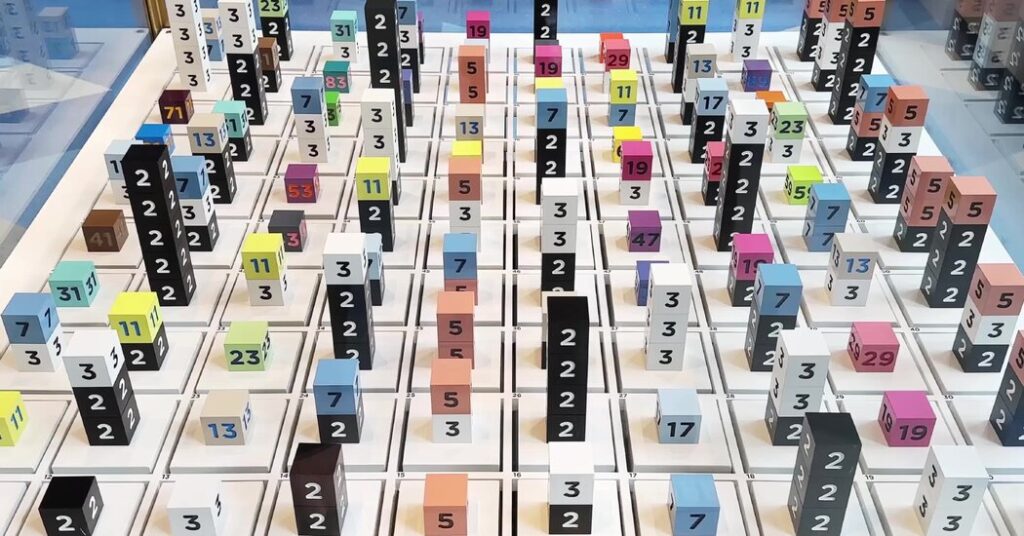
Nearby is another Greek-infused exhibit involving prime numbers that visualizes the sieve of Eratosthenes within a Parthenon-like enclosure. It includes a 10-by-10 grid with numbers 1 to 100, each represented by a stack of cubes representing the divisors. The number 100, broken down to its prime factors, is 2×2×5×5, so there is a tower of two 2s and two 5s on the 100 square. For a prime number like 13, there is only a single cube.
Turning a knob and pushing buttons on a panel makes the towers move up and down on small elevator platforms.
While some visitors see only the chaos of blocks rising and falling, others observe how multiples of certain numbers rise along a diagonal line and explore how Eratosthenes’s algorithm works — eliminating multiples of 2, 3, 5 and 7 to leave just the prime numbers in the up position.
MoMath had to find people who could make exhibits like this one durable enough to survive the roughhousing of middle schoolers.
The number towers were built by Deeplocal, a small company in Pittsburgh. “Everything had to fit into such a tiny space,” said Jeremy Boyle, the engineering lead.
One new exhibit called “Formula Fun” — the museum designers like puns — captured the attention of a 6-year-old boy, Asher.
Three small toy racecars — one red, one yellow, one blue — speed along a short racetrack. The speed of each is determined by different equations — linear, quadratic and exponential — and visitors choose which one they think will win.
It is not always the same car that crosses the finish line first, because the numbers in the equations change each time.
“I voted for Exponential Express!” Asher exclaimed when the yellow car zoomed ahead of the blue car, Linear Lightning, and the red one, Quadratic Quake.
Then he did a victory dance.
The beginnings of MoMath came from the closing of the Goudreau Museum of Mathematics in Art and Science on Long Island in 2006. That left zero math museums in the United States. Glen Whitney, a former math professor turned hedge fund analyst, decided he wanted to create a new math museum — MoMath.
The first few exhibits comprised a traveling show called the Math Midway that made stops at various science museums. The original MoMath opened in December 2012 next to Madison Square Park, and as soon as the first visitors walked in, the founders wondered how quickly they might outgrow the museum’s 19,000 square feet. More than 1.5 million people have visited MoMath since then.
Mr. Whitney left MoMath in 2017. Ms. Lawrence, who started as a volunteer at the very beginning of Math Midway, has been the executive director since 2015.
MoMath had been planning to stay where it was and expand upward onto additional floors. But then the building was sold, and the new owners did not want a math museum there at all.
When the lease of the original site expired in 2024, MoMath moved to a temporary space around the corner on Fifth Avenue. A search for a new permanent home led to the building on the Avenue of the Americas. Completed in 1902, it was originally the Simpson-Crawford department store. The most recent tenant was a Lowe’s home improvement center that closed in 2019. It had been empty since.
Old MoMath favorites, including the square-wheel tricycles that were part of the traveling Math Midway exhibit, have made the move to the new location.
Peter Nydam, one of the museum’s docents, explained to Mr. Schiffman how the square wheels can roll smoothly along a circular path on an undulating flower-like surface. The surface rises and falls to offset the shape of the wheels — a curve known as a catenary — and thus Sofia remained at the same height as she pedaled.
Mr. Schiffman asked whether there could be a surface that worked for triangular wheels.
“I was hoping you would ask that,” Mr. Nydam said.
The wheels did not have to be squares, he explained. It would be possible to fabricate surfaces that work for wheels shaped like most polygons, even irregular ones, as long as all the interior angles are greater than 60 degrees. But that is not possible with a triangle, which has three angles that add up to 180 degrees.
Many adult visitors come in with bad memories of math from childhood, saying they hate math or were never good at it. But Ms. Lawrence notes that no one ever says only artists can enjoy art museums.
“We go to see something beautiful,” she said. “And that’s the message we try to have here.”
Kenneth Chang, a science reporter at The Times, covers NASA and the solar system, and research closer to Earth.
The post MoMath Brings Prime Numbers to a Prime New Location appeared first on New York Times.