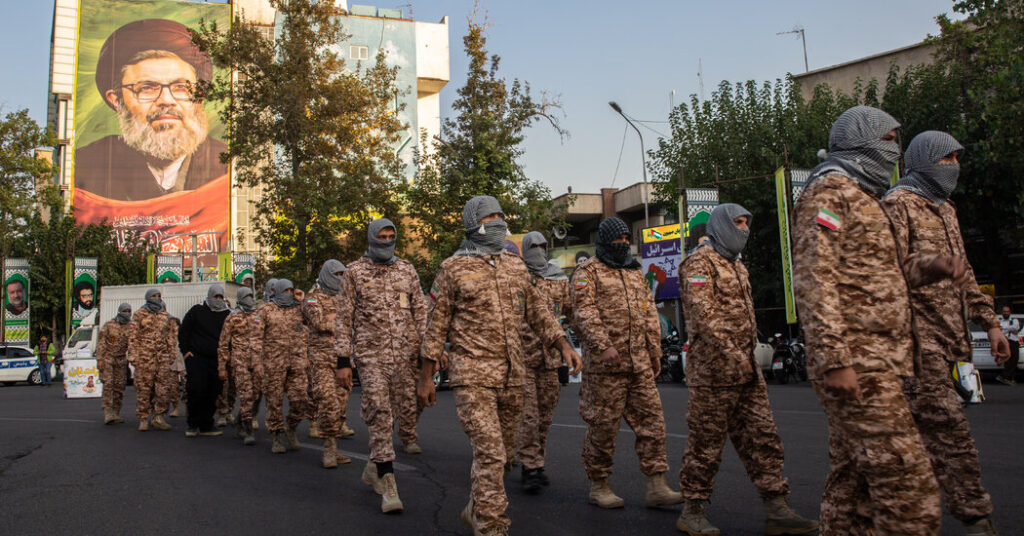
Within hours of the first Israeli and American airstrikes hitting Iran last weekend, militiamen from the Islamic Revolutionary Guards Corps deployed in neighborhoods across Tehran, the capital, and in most urban centers.
Eyewitnesses and the occasional furtive video posted online depicted men in plainclothes, often armed with Kalashnikov assault rifles, manning checkpoints where they searched cars and cellphones, alert for signs of endorsing the war. Black anti-riot vehicles were lined up in places like closed schoolyards that were less likely to be struck by missiles.
“They tried to create the illusion for outsiders that they are in control, and inside to create fear for people so they do not dare come out to the street,” said Saeid Golkar, a political science professor at the University of Tennessee and the author of “Captive Society: The Basij Militia and Social Control in Post-Revolutionary Iran.”
President Trump has suggested that the Guards drop their weapons to buttress popular support for regime change. Analysts consider that scenario highly unlikely. Iran might appear to be a theocracy, and its official ideology is firmly rooted in Shiite Islam, but the Guards constitute the spine of a militarized state. Analysts consider their pervasive military, political and economic clout the main barrier to regime change, or any change, in Iran.
Here is a primer on this powerful group.
What is the I.R.G.C.?
In the early days of the 1979 Islamic Revolution, its founder, Ayatollah Ruhollah Khomeini, did not trust the armed forces, known as Artesh, a Farsi word for army. He was said to have muttered, “Artesh has the Shah in its blood.”
So he organized a parallel armed force, the I.R.G.C., charged specifically with safeguarding the revolution. The core of the group were members of neighborhood committees, often organized around a mosque, that had been established to protect their areas and to liquidate perceived enemies of the revolution.
The eight-year war that started when Iraq invaded in 1980 molded the Guards into a more cohesive force. The Guards took on tasks like building a missile development program virtually from scratch; Washington, its main arms supplier, had severed ties after the revolution.
After the death of Ayatollah Khomeini in 1989, the new supreme leader, Ali Khamenei, turned the Guards into an elite force, marrying his office to its power, while allowing it to expand into politics and the economy.
The Guards established a separate wing to manage reconstruction after the Iraq war. The group still builds roads, dams and other infrastructure. It also became adept at smuggling goods in and out of Iran, including oil, in response to Western economic sanctions imposed after 2002, when Iran’s then secretive nuclear development program was exposed.
Today, the Guards control at least 25 percent of the economy and perhaps twice that amount, said Behnam Ben Taleblu, a senior fellow at the Foundation for Defense of Democracies in Washington.
By toppling Saddam Hussein in 2003, the United States created an opening for the Guards to expand across the Middle East, using its Quds Force to build an axis of mostly Shiite Muslim militias in Lebanon, Syria, Iraq, Yemen and Gaza. The Guards then became a major foreign policy player.
How are the Guards structured?
The Guards number between 125,000 and 180,000 men. Analysts peg the country’s overall security forces at up to 1.5 million, including the police. Not all Guards are armed; some work in fields like construction or cultural programs.
There are four main military branches — ground, naval and aerospace forces along with the Quds Force, which is responsible for foreign operations. In addition, the Guards control various allied organizations including their own intelligence agency, as well as the Basij neighborhood militias.
The Guards follow a so-called “mosaic” strategy that emerged from both seeing the rapid collapse of central authority in Iraq during the U.S. invasion in 2003 and the domestic effort to squash the Green Movement, the nationwide antigovernment protests in 2009. A decentralized command structure was intended to insure that the Guards could maintain domestic control in case the provinces were ever cut off from Tehran, or could overcome any vacuum in the absence of the supreme leader, the ultimate decision maker.
The strategy was further refined last June to strengthen Iran’s defense against an external enemy, analysts said, after Ayatollah Khamenei was a target of a 12-day war waged by Israel and the United States.
“They are acting according to the playbook,” said Hamidreza Azizi, a visiting fellow at the German Institute for International and Security Affairs in Berlin. “The system is functioning without Khamenei.”
While following a central blueprint, regional commanders have autonomy on decisions like when to launch missiles or drones. There are 31 commands, one for each province, with even smaller branches meant to puncture domestic protests in virtually every neighborhood.
The current war, with the leadership in Tehran degraded, “is exactly the type of moment that the mosaic doctrine was meant to respond to,” said Afshon Ostovar, the author of “Wars of Ambition: The United States, Iran and the Struggle for the Middle East.”
Who commands the Guards?
Israeli and American attacks have killed two Guards commanders, one in June and the second on Feb. 28.
A veteran hard-line officer with a reputation for brutality, Brig. Gen. Ahmad Vahidi, was appointed on March 1 to head the Guards. A former minister of the interior and defense, he was a founding commander of the Quds Force in 1988, leading it for eight years.
Mr. Vahidi is suspected of fostering overseas organizations that carried out terrorist attacks at Iran’s behest, including a deadly bombing of a Jewish community center in Buenos Aires in 1994 that killed 85 people. Argentina, accusing Mr. Vahidi of approving the attack carried out by the Lebanese Hezbollah militia, unsuccessfully sought his arrest through Interpol. Iran has repeatedly denied any involvement.
Looking ahead
Mojtaba Khamenei, son of the late supreme leader and his likely heir, enlisted with the Guards during the Iraq war and has maintained particularly strong ties. As his father’s closest aide, he appointed its senior officers for the past two decades, and is now considered their heavy favorite, analysts said.
But the Guards are not monolithic. While some members helped to mow down protesters by the thousands in January, it is also a conscript force, so its foot soldiers mirror Iranian society — some disdain the Islamic system. A core group of 2,000 to 3,000 officers, however, are considered hard-liners whose rank and wealth are tied to the organization. They will fight to the bitter end, analysts said.
Parin Behrooz contributed reporting.
Neil MacFarquhar has been a Times reporter since 1995, writing about a range of topics from war to politics to the arts, both internationally and in the United States.
The post Iran’s Revolutionary Guards: The Spine of a Militarized State appeared first on New York Times.