American intelligence agencies have determined that Iran or potentially another group could retrieve Iran’s primary store of highly enriched uranium even though it was entombed under the country’s nuclear site at Isfahan by U.S. strikes last year, according to multiple officials familiar with the classified reports.
Officials familiar with the intelligence said that Iran can now get to the uranium through a very narrow access point. It is unclear how quickly Iran could move the uranium, which is in gas form and stored in canisters.
U.S. officials have said that American spy agencies have constant surveillance of the Isfahan site and have a high degree of confidence they could detect — and react — to any attempt by the Iranian government or other groups to move it.
That stockpile of uranium would be a key building block if Iran decided to move toward making a nuclear weapon.
With Iran in chaos from the ongoing strikes by the United States and Israel, the fate of the uranium and the options for securing it have become critical issues for the Trump administration.
On Saturday, President Trump was asked by reporters on Air Force One if he would consider sending in ground forces to secure the highly enriched uranium.
“Right now we’re just decimating them, but we haven’t gone after it,” he said. “But something we could do later on. We wouldn’t do it now.”
The United States chose not to try to retrieve the uranium last year after the 12-day war in which Iran’s nuclear sites came under intense bombardment. Mr. Trump determined that doing so at that time would be too dangerous.
Any insertion of ground forces — presumably Special Operations commandos — would be highly risky. U.S. officials said that the air campaign against Iran would need to continue for days to further weaken Iranian defenses before any final decision on the viability of that type of raid.
The option to conduct a raid on nuclear sites was earlier reported by Semafor. The New York Times reported in January that Mr. Trump was considering inserting commando teams into Iran.
On Saturday, Mr. Trump alluded to the risks, suggesting that there was a need to wait to conduct such an operation. “I would say if we ever did that, they would be so decimated that they wouldn’t be able to fight at the ground level,” he said.
This article is based on interviews with U.S. officials and others familiar with intelligence assessments around Iran’s nuclear stockpile. They spoke on the condition of anonymity because of the sensitive intelligence.
In recent weeks, beginning before the current military campaign began, U.S. officials have debated various options to secure the uranium or try to block Iran’s access to it.
As his public comments demonstrated, Mr. Trump has made no decision on sending in the ground forces to secure the uranium, and is considering various options. A senior official said a commando raid was not part of the current plan for the Iran war.
It is also possible that the U.S. government is hoping that the overt threat of a ground operation may force Iran to give up its stockpile as part of a negotiation to end the war.
Iran has about 970 pounds of highly enriched uranium, the bulk of which is at Isfahan, according to American officials. The current stockpile has been enriched to 60 percent and would have to be furthered enriched to 90 percent to make a weapon. But that step is relatively easy if Iran’s centrifuges are operational.
Elbridge Colby, the Pentagon’s top policy official, was asked earlier this week how much government analysts were focused on the highly enriched uranium. He told a Council on Foreign Relations audience, “Without getting into any specifics, obviously we’re always highly focused on that.”
Ahead of the U.S. attacks last June, Iranian officials moved to protect the nuclear sites, pushing dirt into the entrances of underground facilities, including the tunnel network at Isfahan where the uranium was being kept.
When the United States launched the attacks, it used the largest weapon in its conventional arsenal, the Massive Ordnance Penetrator, to strike the underground facilities at Natanz and Fordo. But the U.S. military used Tomahawk cruise missiles to strike the base at Isfahan.
In addition to the uranium stockpile, Isfahan was home to Iran’s test reactor and a facility where uranium gas would be transformed into a dense metal. That process, known as metallization, is a critical step in producing a nuclear weapon.
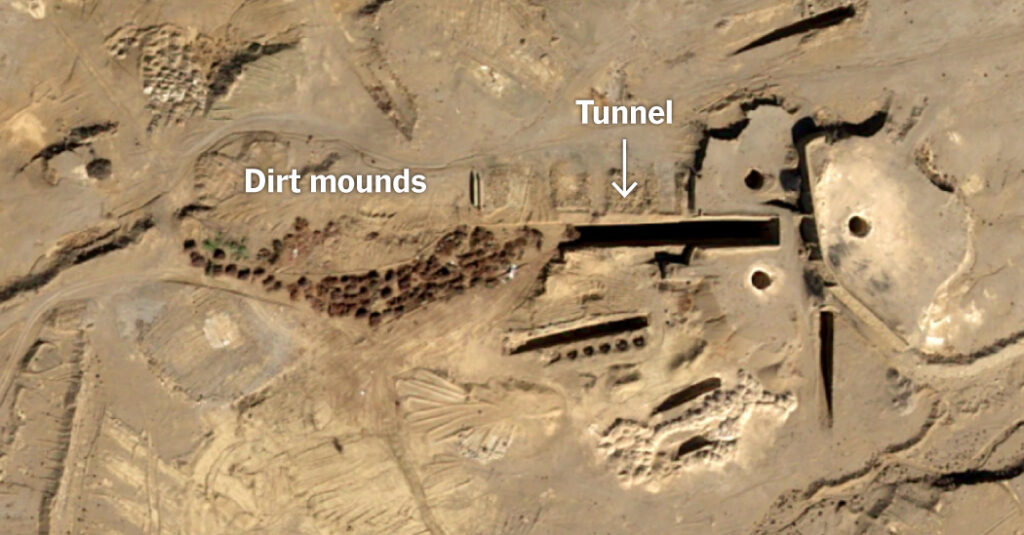
Soon after the strike, high resolution spy satellites detected that Iran had moved excavation equipment to Isfahan, and had begun to access the underground tunnels, according to U.S. officials and others briefed on the intelligence.
The spy satellite images showed Iranians moving both the dirt they placed in the tunnel entrances and debris generated by the Tomahawk strikes, the people said.
An analysis of commercial satellite imagery by The New York Times’s visual investigations team reached similar conclusions, finding evidence of digging in multiple areas of Isfahan.
At one location just north of the main facility, satellite photos show several pieces of excavating equipment moving earth. The images indicate that workers had excavated a pit, placed an unidentified object inside of it under a tarp, then buried it.
At another location northeast of the main facility, there was not much activity until last month, when satellite images showed what appeared to be a crane moving dirt into a truck.
A large amount of earth moving was seen at several of the tunnel entrances in satellite imagery taken in February, including a tunnel on the western side, as seen in a time lapse of commercial satellite imagery.
It is unclear whether the dirt was taken to a dumping site or moved to the tunnel entrances to protect them from future strikes.
Earlier this year, researchers at the Institute for Science and International Security also noticed increased activity on the road leading to the tunnel entrances. They suggested in a report that some tunnel entrances were being buried by soil as a possible preparation for strikes, similar to Iran’s activities ahead of the June 2025 strikes.
Adam Sella contributed research.
Julian E. Barnes covers the U.S. intelligence agencies and international security matters for The Times. He has written about security issues for more than two decades.
The post Iran Could Retrieve Uranium at Site U.S. Bombed Last Year, Officials Say appeared first on New York Times.