Times Insider explains who we are and what we do, and delivers behind-the-scenes insights into how our journalism comes together.
It’s an odd time to be a theater critic. There are fewer of us writing for institutions than ever before — just a handful now across the country. In February, less than a month after I joined The Times, the Washington Post laid off almost every arts writer they had, capping a period of brutal attrition.
I don’t think it’s a coincidence that the theater is moving over rocky ground at the same time. Less public conversation about artists’ work has ugly consequences — there’s less discovery, not to mention less re-discovery, when the records aren’t kept. When we have fewer shared discussions (not to say arguments) over meaning and aesthetics and intention, the work suffers.
Criticism now feels a little bit like being a witness at a siege, when we can already see the tops of the enemy’s ladders peeking over the wall. It’s terrifying … but also, it can be exhilarating. Emergencies do at least clear the mind!
I wrote my very first theater review for The New York Sun back in 2003: They needed critics to cover the New York International Fringe Festival (R.I.P.), a come-one-come-all shoestring outfit featuring hundreds of productions, all made under scrappy conditions. My memory refuses to tell me what that first show was. I do remember it was in a basement, and a sewer pipe burst in the back wall. Everyone in the audience — eight of us, maybe? — simply chose to ignore the geyser onstage. So did the actors.
If I have a philosophy of criticism, it might be the one from that basement: Try to meet the art where it is. There are so many things beyond our control — say, the deterioration of municipal infrastructure under Ludlow Street — but somewhere amid all the hubbub, someone is making something, and you need to pay attention. As its best and truest self, criticism is attention, the kind that might extend over decades or centuries, as we all track an artist or a play or an idea.
The process of falling for theater also takes a long time. My parents are classicists, and one of my earliest memories is of their reading Sophocles and Euripides plays with their colleagues in our den. That pre-language baby memory is really of our laundry basket — and the big crack that ran through it. I learned later (as a toddler?) that a Greek professor playing Athena stood in it during her deus-ex-machina moment and busted the plastic. It makes a big impact on a kid that there are certain sanctioned activities where you are allowed to break stuff. Interesting, I thought, as I mashed potatoes into the carpet.
My life in the theater progressed from high school ballerina to hapless college actor (I once accidentally locked myself in an onstage closet during Neil Simon’s “Rumors” while playing Officer Pudney) to set designer (floors are the most important part of any set) to grad school dramaturg. After I came to New York, and I realized you could see a different show every night, I went into the job that let you do exactly that, which turned out to be criticism.
I was very lucky to freelance at Time Out New York in a golden age of downtown theater, when the spaces up and down the Lower East Side were bursting with adventurous experiment. In that period, the magazine was trying to outdo the Village Voice (R.I.P. x 2) at covering the scene. After Time Out, I was at New York magazine for three years, and in 2022, I went to The New Yorker, before coming here at the beginning of the year.
When it comes to what I’m planning to cover at The Times, I will say I still enjoy a leaky basement as much as a golden Broadway house. I do go to as much as I can; in 2025, a bustling year, I went to around 250 shows. I get a bit anxious if I don’t have a show to see.
The theater in front of us now is grappling with the bizarre challenge of a culture increasingly socially atomized and screen-dazzled. Or is theater actually the cure for those things? I worry less about artificial intelligence than my friends who work in film might, since theater requires bodies, in a place, outside the algorithm. I think the theater, and really all the in-person arts, are on the cusp of a great surge: Live performance comes already prepared for people who are desperate for contact, reality, mess, exchange. Theater is also irreducible, basically unfilmable and relatively unTikTokable.
When you’re watching a show, staged in someone’s closet, sitting cheek by jowl with the other oddballs who have wedged themselves into the same corner, you aren’t worried about whether the oomph has gone out of the field. When a Broadway musical inspires people all over the country to record themselves singing the same number, it seems bizarre to discuss an enthusiasm gap.
I’m thrilled to be writing at The Times, which is both where that enthusiasm is disseminated and where the record is kept. I certainly got my own education in reading its archive of other critics, starting in college: I learned to think about drama as much from Brooks Atkinson and Mel Gussow and Walter Kerr as I ever learned from school.
I can still recite some of Kerr’s 1977 Times review of Andrei Serban’s staging of Anton Chekhov’s “The Cherry Orchard,” which I read way back in the late ’90s.
Here’s Kerr, on the final moment of Irene Worth’s performance, as the down-at-heel aristocrat Ranevskaya says goodbye to her repossessed family estate. In the play, she is taking one last look at her home, but in Serban’s stripped-down production, there is no “house” set. Instead, Worth races around the huge, bare Vivian Beaumont stage. She reaches out for the hand of her friend, who will take her away into her reduced life …
“But,” writes Kerr, “she doesn’t seize that hand. Instead, on impulse, she barely brushes it with her fingers and dances off again on another grand tour, eyes ablaze, lungs filled, heart broken, lips parted in what is very nearly an all‐devouring smile. And then she does it one more triumphant, unbelievable time, a bareback rider on the rim of the world.”
I learned about Chekhov, about theater, about performance, about life from that review. To write in the same place, hearing the distant echo of Kerr’s own footsteps, is a terrifying, giddy honor.
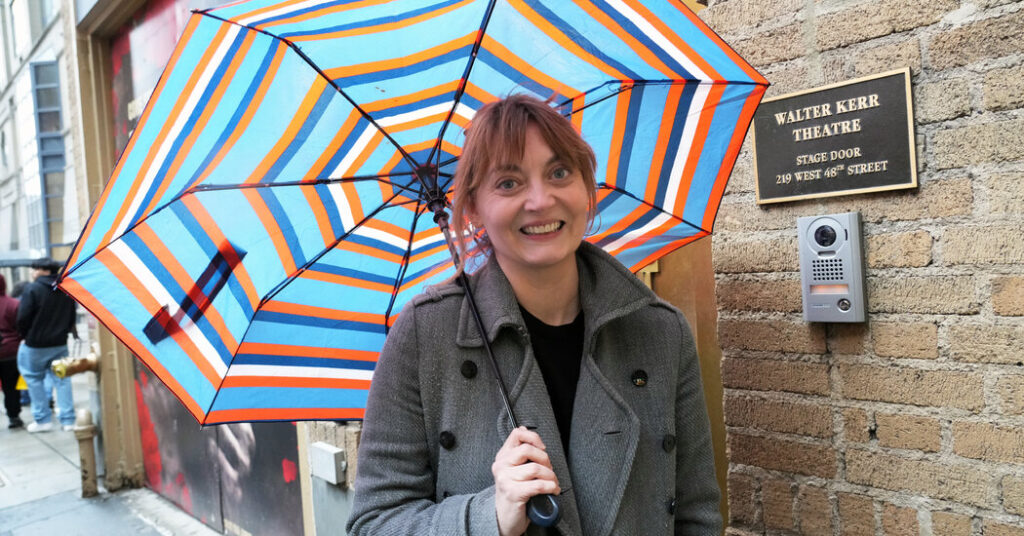
Helen Shaw is the chief theater critic for The Times.
The post In a Screen-Dazzled World, a Theater Critic Has the Antidote appeared first on New York Times.