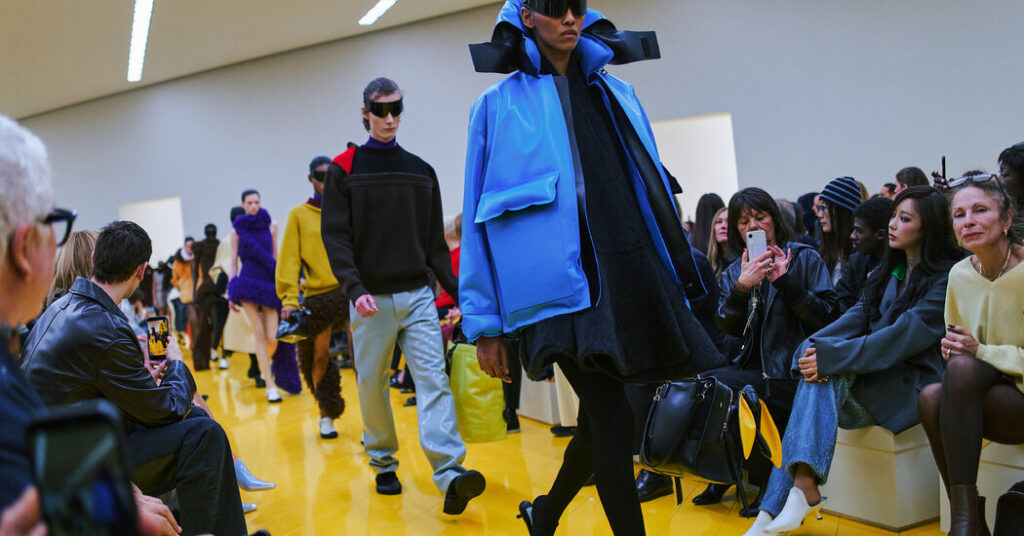
The big stuffed fish perched suggestively on one of the white seating cubes with its fins crossed probably should have been a clue. Or maybe the plush lobster with its claw out as if it were saving a seat for a friend? Definitely the lacquered sunshine-yellow floor and the throbbing techno beat.
Wherever you looked when you walked into the Loewe show, there was a sign: Something unexpected was going on here. What was it?
Fun.
In their second collection, Jack McCollough and Lazaro Hernandez, the American designers who took over Loewe last year after decades at their own brand, Proenza Schouler, stopped taking it all so seriously. In doing so, they answered the question that has been plaguing fashion ever since consumption slowed, geopolitics starting casting its long shadow over spending habits and the luxury pricing backlash began: How do you make people want to start shopping again?
Duh. You give them something to smile about.
Like, for example, a filmy little slip dress rubberized à la water balloon. Shearling jackets that segued from flat to fluffy and came with their own matching mittens, like very fancy poodles. Scarves inflated like little water wings around the face, and coat linings blown up like tiny life rafts (for both men and women — the show introduced Mr. McCollough and Mr. Hernandez’s first men’s wear looks).
Minidresses that mimicked picnic blankets, or the plaid bags from Tati, the once-ubiquitous French discount store. Shaggy coats made from dangling loops of leather and strapless dresses made from shimmying fringe. The colors were Crayola-pure and just this side of Pop Art: bright red and sky blue, tangerine and grape. Everything had the zip and shape of sportswear, but a luxury finish. It was a giggle.
And Mr. McCollough and Mr. Hernandez weren’t the only designers to provide some levity this week. At Schiaparelli, though Daniel Roseberry ultimately overdid the trompe l’oeil punning, shoes with what looked like little taxidermy cat heads on the toes — kitten heels! — offered a moment of haute fashion comedy. (The impossible knits, on the other hand, featuring strips of cable knits on transparent tulle so the sweaters looked as though they were glitching on the naked body, were a little more subtle.)
If that verged on parody, however, Junya Watanabe offered perfectly calibrated satire: a master class in upcycling that involved incorporating anything and everything into 22 very glamorous gowns.
As models tangoed their way across the floor, the audience played guess-the-ingredient, a game that yielded sightings of gloves, snowboard bindings, phone cases, Mylar blankets, stuffed animals (again) and the occasional protractor. One stole was made entirely of soft top hats; one cape out of knee-high leather boots.
Shake-your-head silly, sure, but also ingenious and even artful. At a time when sustainability seems to have fallen completely out of fashion, and the divide between the haves and — well, everyone else — is growing ever-wider, such “assemblages” (Mr. Watanabe’s word) of found objects weren’t just stylish experimentation. They were pointed pieces of social commentary.
That was also what made Mr. McCollough and Mr. Hernandez’s Loewe so successful. Under all the breezy chic, there was substance. Loewe is a leather house, long rooted in that now-hackneyed word so beloved of fashion: craft. (The designer before Mr. McCollough and Mr. Hernandez, Jonathan Anderson, now at Dior, even introduced the Loewe Foundation craft prize during his tenure).
That tends to smack of artisans in the country hand-weaving grass pot holders, but the two designers took that history and asked, “How do we make it completely of the moment?” Or so Mr. Hernandez said backstage after the show.
“How do you modernize this idea,” he went on, “to create things that couldn’t have been made yesterday?” It is the right question, and one more designers should be raising in regard to their own brand’s heritage.
At Loewe, the answer was to merge technology with the work of the hand, so those rubbery little slip dresses turned out to have been 3-D printed and then dipped in latex; the inflatables laser-cut, bonded and sealed with an airtight seam so they could be blown up and deflated at will; and the plush corduroys actually super-shaved shearling.
Just because something seems light, doesn’t mean it isn’t also completely serious. I’d buy that.
Vanessa Friedman has been the fashion director and chief fashion critic for The Times since 2014.
The post I’ll Buy That: The Joy of Having Fun With Fashion appeared first on New York Times.