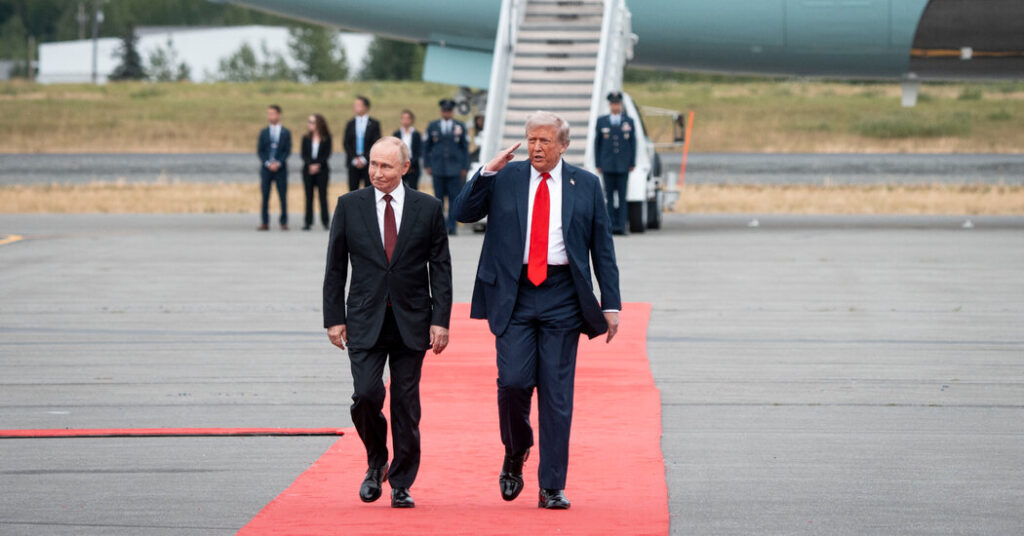
Defense Secretary Pete Hegseth said last Monday that the United States “didn’t start this war, but under President Trump, we are finishing it.”
After he invaded Ukraine in 2022, President Vladimir V. Putin of Russia put it this way: “We didn’t start the so-called war in Ukraine. Rather, we are trying to finish it.”
Mr. Putin’s war was a disastrous ground invasion of a fledgling democracy. Mr. Trump’s war on Iran is a sophisticated bombing campaign against an aggressive theocracy that was killing its own people in the streets. But some similarities are uncanny, starting with the White House and the Kremlin both trying to avoid calling their actions acts of war.
Asked last week if “this is war,” Speaker Mike Johnson responded: “I think it’s an operation.”
“This is a special military operation,” Mr. Johnson’s Russian counterpart, Vyacheslav Volodin, the State Duma speaker, said two months into his country’s invasion, sticking to the Kremlin’s official terminology. “If Russia had started a full-scale war, it would have been over long ago.”
Shifting objectives, an exaggerated threat, an ambiguous mission: The many Russian echoes in the White House’s messaging on Iran underscore the risks of a vaguely defined, open-ended war in which the attacking party pins its hopes on regime change.
“We haven’t even yet started anything in earnest,” Mr. Putin said in July 2022, trying to project defiance after months of fighting.
“We haven’t even started hitting them hard,” Mr. Trump told CNN last Monday.
I was in Moscow when Mr. Putin gave an early morning address to his nation on Feb. 24, 2022, announcing his “special military operation,” a term now so ingrained that its Russian initials, “S.V.O.,” are shorthand for the war against Ukraine.
The speech portrayed decades of grievance with Ukraine and the West as leaving Russia “no other choice” but to attack. One of its most chilling moments was Mr. Putin’s plea to Ukrainian soldiers to “immediately lay down arms and go home,” and his warning that if they did not, “responsibility for the possible bloodshed will lie fully and wholly with the ruling Ukrainian regime.”
So it was startling when Mr. Trump struck similar notes, albeit in a “USA” baseball cap, in his overnight speech declaring “major combat operations” in Iran. Overstating the threat of Iran’s missiles, Mr. Trump spoke of decades of Iranian “bloodshed and mass murder,” and asserted that “we can’t take it anymore.” He said Iranian soldiers needed to “lay down your weapons” or “face certain death.”
I did another double take when Mr. Trump the next day repeated his call for Iranian soldiers to disarm, and urged Iranians to “seize this moment” and topple their government. Mr. Putin, too, tried again on the second day of his war to get Ukrainian soldiers to stop resisting, and to “take power into your own hands.”
Western officials and Russian elites expected the war to be over quickly. Russian officers were told to pack their dress uniforms in anticipation of a quick military parade in Kyiv. But even as Russia was falsely claiming to have established “total air superiority” over Ukraine, its overextended supply lines in the military’s disastrous sprint for Kyiv became easy targets for Ukrainian artillery.
Days turned into weeks, which turned into months, which turned into years. The Ukrainians used ever-more-sophisticated Western weaponry for deadly strikes well behind the front lines, using coordinates provided by the United States.
Along the way, Mr. Putin’s goals narrowed: from regime change — he called it the “denazification” and “demilitarization” of Ukraine — to a focus on capturing all of the eastern Donbas region and keeping Ukraine out of NATO.
Now the toll of Mr. Putin’s war is approaching 500,000 lives. Ukraine’s military did not surrender, and President Volodymyr Zelensky is still in charge in Kyiv, leading what the Kremlin casts as a cabal of neo-Nazis.
Mr. Trump is only a week into his war, but there is no evidence that Iranian officials or soldiers are starting to surrender — maintaining the hold of a regime that Senator Lindsey Graham, Republican of South Carolina and one of Washington’s loudest Iran hawks, refers to as “religious Nazis.”
As the Trump administration has floated shifting timelines for the Iran war, both pro- and anti-Kremlin bloggers from Russia started referring to Mr. Trump’s plan as “Tehran in three days.” It was a reference to “Kyiv in three days,” the ironic shorthand used to describe the Kremlin’s hubris in believing that Ukraine would quickly crumble.
Mr. Putin had appeared to think he could repeat his lightning grab of Crimea in 2014, when he overruled his own advisers. Mr. Trump was riding high this year after he ordered his military to seize President Nicolás Maduro of Venezuela.
Of course, Mr. Trump could still end the Iran war soon and claim success. On Saturday, he said Iran was “being beat to HELL,” and that he was considering “complete destruction and certain death” for more areas of the country.
But Dmytro Kuleba, the Ukrainian foreign minister at the time of Russia’s invasion, said that given the expansive U.S. goals, the Trump administration may be suffering from the same overconfidence that doomed Russia’s initial war plan.
“American commentators are again talking about a ‘short war,’” Mr. Kuleba posted on social media on Friday. “They said the same about Russia’s war against Ukraine. It will be short only if Washington quietly scales down its goals, gives up on regime change in Iran, and sells a much smaller outcome as victory.”
“Breaking a large country,” he added, “is hard even for the United States.”
One striking difference is the poor performance of the Russian military and the sophistication of the U.S. and Israeli air campaign. But analysts say that the value of military firepower is limited when it is not clear what it is supposed to achieve.
And the United States’ objectives keep shifting. Mr. Trump on Friday demanded “unconditional surrender” by Iran, while members of his cabinet have presented various, more limited goals, like destroying Iran’s nuclear program and its missile arsenal.
Michael Kofman, a military analyst focusing on the Russia-Ukraine war at the Carnegie Endowment for International Peace, said that the war reflects “enduring historical lessons.” They include “the need for an alignment between military means and political aims, adjusting plans once initial assumptions are disproven, the need to think through second- and third-order effects.”
Maria Lipman, a visiting professor of international studies at Northwestern University who focuses on Russia, said the echoes she saw in Mr. Trump’s war began with “the very improbability of what is happening.”
Russians largely tuned out the possibility that their president could start an all-out invasion of their neighbor, even as he massed troops. After the initial shock, many came to accept Mr. Putin’s claim that Western aggression against Russia left him no choice but to start his “special military operation.” Hundreds of thousands signed up to join the war, attracted by lucrative signing bonuses.
Hundreds of thousands more fled abroad, including to Dubai, which has been attacked by Iranian drones similar to the ones Russia has used for years against Ukraine.
“By starting a war with Iran, Trump stepped into the unknown,” Ms. Lipman said. “I think that there is more instability in store for the United States and the American people than they realize at this time.”
Oleg Matsnev contributed reporting.
Anton Troianovski writes about American foreign policy and national security for The Times from Washington. He was previously a foreign correspondent based in Moscow and Berlin.
The post How Trump’s War in Iran Has Echoes of Putin and Ukraine appeared first on New York Times.