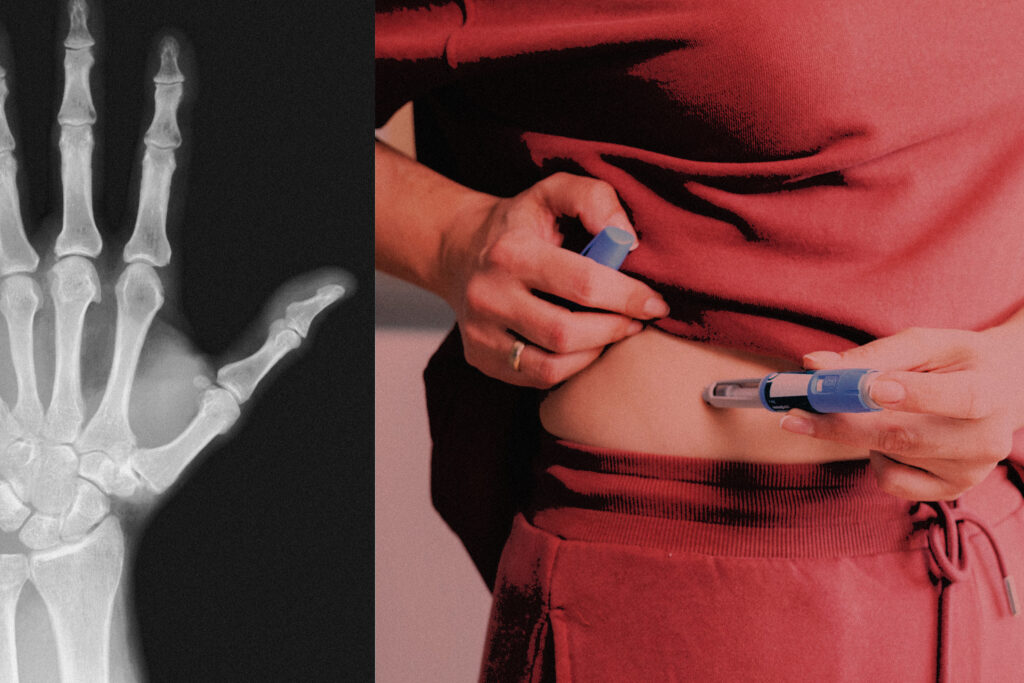
The miracle of rapid weight loss has always come with fine print. Until recently, it read mostly like a list of digestive complaints — stomach aches, constipation — generally unpleasant but tolerable and rarely severe. New research presented this week suggests the drugs may affect something more structural: bone.
In an analysis of nearly 150,000 patients, researchers found that people taking GLP-1 medications faced a significantly higher risk of skeletal disorders.
Over five years, the risk of osteoporosis — a disease that weakens bones and makes them brittle — was nearly 30 percent higher. The risk of gout, a painful inflammatory arthritis which results from needle-like crystals forming in the joints, rose 12 percent. And the risk of osteomalacia, a softening of the bone caused by a low mineral to bone ratio and more rare in the study, increased by more than 150 percent.
“It was a lot more than I expected,” said John Gabriel Horneff, one of the study’s authors and an associate professor of clinical orthopaedic surgery at the University of Pennsylvania.
The data was presented this month at the American Academy of Orthopaedic Surgeons’ annual meeting and drawn from electronic health records contained in a national database.
Clifford Rosen, a professor of medicine at Tufts University who was not involved in the study, said that across the millions of people now taking GLP-1s, the overall population-level risk is small. For individuals, however, even a modest increase can be consequential. In older adults, a fracture can set off a cascade of complications from which some never recover. Postmenopausal women may be especially vulnerable. In the first years after menopause, their fracture risk increases by 1 to 2 percent annually.
“Adding another percent on top of that could be devastating,” said Rosen, who studies GLP-1s and bone health but was not involved in the new research.
The study, which was presented as an abstract and has yet to be peer-reviewed, showed when patients began GLP-1 therapy, but not the dosage or duration of treatment. The researchers controlled for age, sex, race, tobacco use and numerous medical conditions. Like other observational studies, the analysis cannot prove causation; it can only establish an association.
Rose said the findings raise pressing questions: Does bone loss continue as long as weight loss does? Does bone density rebound after the drug is stopped?
Bone, muscle and tendon connections
As GLP-1 use has surged, social media fitness influencers and wellness companies have tended to obsess about muscle loss. But research actually suggests that roughly a quarter of weight loss may come from “lean mass,” a category that includes muscle, water and connective tissue. Bone, tendon, and muscle function as a single structural unit, collectively responsible for supporting the body.
The human skeleton functions as a dynamic system, continuously breaking down and rebuilding. Under normal circumstances, Horneff said, that process occurs at roughly a 50-50 ratio. But what happens to the skeleton when the body shrinks? Early research on GLP-1s and bone health hinted at possible benefit. The new findings suggest otherwise.
In a separate analysis also presented this week at the same conference, Horneff and his colleagues reported that GLP-1 use was also associated with a roughly 50 percent increased risk over five years of several types of tendon ruptures — including those in the pectoralis major (connecting the shoulder to the chest), rotator cuff (stabilizing the shoulder joint) and Achilles (running from the lower leg to the heel).
Horneff said the team began their investigations after comparing notes and finding an unusual anecdotal pattern of injuries. Patients who have pec tendon tears are typically doing something rigorous like a heavy bench press, for example. Instead, Horneff said patients would tell him, “I kind of reached forward and braced myself and had a tear.” For an injury to a rotator cuff, which might result from trauma like falling down the stairs, patients were reporting, “I picked up something heavy.”
One hypothesis on the bone loss connection is that GLP-1s may interfere with hormones essential to bone metabolism. Other explanations point to weight loss itself. Reduced appetite can lead to nutritional deficiencies; without sufficient intake of key minerals, bones may not rebuild efficiently. There is also a simpler, physical explanation.
“If someone has been living their life at 300-plus and all of a sudden they drop a lot of weight quickly, you can imagine that there is probably a sudden shock to your normal bone metabolism. They are not being subject to the same gravitational pull,” Horneff said.
A sudden reduction in mechanical load could disrupt the balance between bone breakdown and rebuilding.
Rosen said the data suggest “the impact on the bone is more extensive than we thought” and noted that pharmaceutical companies are already working on newer versions of the drugs designed to mitigate bone loss.
“The companies have known this. They are not shocked by this discussion. They are developing drugs to combat that loss,” he said.
Of the four newer GLP-1 drugs on the market — Ozempic, Wegovy, Mounjaro and Zepbound— only Wegovy currently mentions a potential fracture risk in its prescribing information.
Rosen said that warning was added after the drug’s initial approval. The current prescribing pamphlet, a 55-page PDF available on the company’s website, includes a note on page 15 under “other adverse reactions.”
In one study involving nearly 5,000 women, fractures occurred in 4.4 percent of patients treated with Wegovy compared with 3.3 percent receiving a placebo; among patients 75 and older, the figures were 2.4 percent versus 0.6 percent. In another trial that included both men and women, fractures occurred in 4.4 percent of patients on Wegovy versus 3.3 percent on placebo.
Spokespeople for Novo Nordisk, which makes Ozempic and Wegovy, and Eli Lilly, which makes Mounjaro and Zepbound, declined to comment on the new study. Novo Nordisk said in a statement that “we prioritize patient safety” and that it collaborates closely with the Food and Drug Administration and other regulatory authorities on monitoring use.
“The known risks associated with use of these medicines are reflected in their current FDA-approved product labeling,” Novo Nordisk said.
Eli Lilly said in a statement that patient safety is its top priority: “Although we did not sponsor and were not involved in the study, we actively engage in monitoring, evaluating, and reporting safety information for all our medicines.”
Risk vs. reward?
Angelo Gaffo, a professor of medicine at the University of Alabama at Birmingham’s division of rheumatology, said the gout findings are puzzling and “a little unexpected.” GLP-1 drugs are generally associated with lowering uric acid — a metabolic waste product and a key driver of gout.
One possible explanation, he said, is that if uric acid levels drop too quickly, that shift could temporarily trigger flares. He questioned whether the elevated risk observed in the study might be short-lived.
“My prediction is that eventually the risk will get better after uric acid is lower for a while and general health will improve,” he said.
Physicians emphasized that the findings should not overshadow the substantial benefits GLP-1 medications can offer. The drugs have been shown to produce significant weight loss, improve blood-sugar control, and reduce the risk of cardiovascular events and kidney and liver disease for many patients. Meanwhile, serious documented side effects such as a stomach paralysis, an eye issue and kidney failure have been very rare.
Rosen and Horneff suggested people at high risk may want to talk to their doctors about getting DEXA bone density scans before or during treatment, and about whether to take calcium and Vitamin D supplements.
Miranda Stiewig-Rapp, assistant professor of endocrinology at UC Davis Health and director of a new obesity clinic, said the message from the study is that patients should pair the drugs with nutrient-rich diets, exercise and careful medical supervision.
“A lot of patients will tell me this is the easy way out we found this silver bullet and can eat whatever we want, and I think that’s a really general misconception,” she said. “What I tell my patients is this helps you stick to the nutrition and lifestyle changes to lose weight. You’re still going to be doing the work.”
The post GLP-1 drugs like Ozempic can raise bone and tendon injury risk, study suggests appeared first on Washington Post.