As Israeli and American strikes pummeled Iran, its powerful friends around the world couldn’t quite agree on how to react.
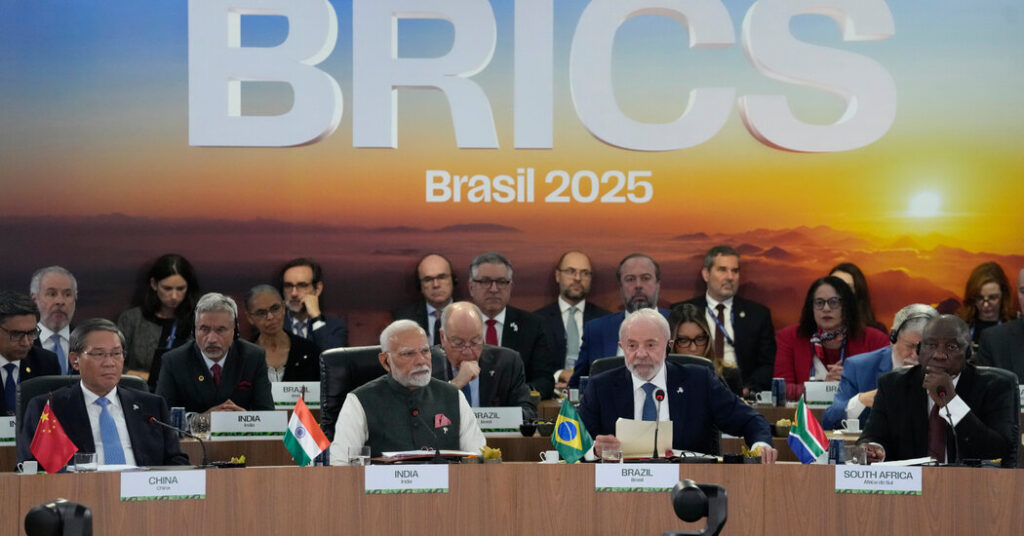
Brazil, China and Russia swiftly condemned the military attack on Iran, which joined them two years ago in the BRICS group of emerging economies.
India, which chairs the bloc’s presidency this year, appeared to take the other side, favoring the United States and Israel by staying quiet about their bombardment, while criticizing Iran’s retaliatory attacks in the region.
South Africa, another member, was more cautious, expressing vague concerns about the conflict without naming any specific country, seemingly keen to avoid the kind of American backlash it recently faced after hosting navy drills with Iran and other BRICS nations.
Notably absent was any joint statement or show of solidarity. It was a clear sign the conflict may be testing the unity of BRICS and forcing it to grapple with an uncomfortable question: Can it really build a new world order, as it aspires to do, without ideological alignment among its members?
Since its birth in 2009, BRICS has aimed to increase the sway of the world’s biggest emerging economies on the global stage. Unlike NATO, where military cooperation is central, the group’s members have made no explicit pledge to defend one another. Instead, the bloc has focused on a largely economic agenda, working to create a joint development bank, boost trade among its members and reduce its dependence on the U.S. dollar.
In recent years though, the group has begun to position itself more forcefully as a counterweight to U.S. hegemony, calling for a reshuffle of global power dynamics that it sees as outdated and favoring the West. In an effort to advance that goal, it expanded to include Iran, Egypt, Ethiopia, Indonesia and the United Arab Emirates.
Still, as the group has rapidly expanded to include members with starkly different viewpoints and geopolitical goals, analysts say it has become more challenging to find a common way forward.
In an awkward twist further undermining the organization, Iranian missiles and drones have struck the Emirates, another member of the bloc. And as the conflict has spilled across the region, it has paralyzed one of the world’s most important trade corridors, threatening the economic interests and the energy security of some of its members.
“The group is not united at all,” said Paulo Nogueira Batista Jr., an economist and former vice president of the BRICS development bank. “And this undermines the idea of joint action.”
When it joined the group, Iran found some relief from global isolation and economic sanctions, while also gaining powerful new friends. But even as Tehran pushed for more military cooperation, the bloc resisted. For Iran, the group mostly remained a way to access oil buyers, according to Renad Mansour, a senior research fellow with the Middle East and North Africa program at Chatham House.
“None of these countries are actually going to join Iran in any war,” Mr. Mansour said. Instead, he said, Tehran is most likely hoping that “the BRICS countries feel the economic impact and then take some kind of action.”
This is not the first time the group has struggled to decide where it stands on a conflict involving one of its own.
When Russia invaded Ukraine in 2022, it couldn’t agree whether that violated international law, eventually settling for a lukewarm joint declaration urging dialogue and condemning Western sanctions.
Last spring, after Israel and the United States launched military strikes on Iran, BRICS issued another modest statement expressing “grave concern,” without outright criticizing Israel or the United States.
But now, as Iran faces a crisis likely to shape its future, the bloc has opted to remain quiet.
“There’s a sense that BRICS is still trying to figure out what its own position is,” said Luiz Augusto de Castro Neves, a former Brazilian ambassador to China who is now president of the Brazil-China Business Council. “Even as it looks for a more clearly defined role on the international stage.”
The tensions over Iran have also cast doubt on whether the bloc can forge economic alliances without politics getting in the way, especially at a time when President Trump has made clear that he is willing to use trade measures like tariffs and sanctions to achieve both economic and political goals.
India, for one, has quietly obeyed American demands to quit buying Iranian oil and had also moved to reduce its imports of Russian crude. Recently, India also appeared to abandon plans for a port project in Iran, seemingly spooked by the threat of U.S. sanctions.
“It’s geopolitics invading trade relations,” Mr. Batista said. “So it’s no longer just a matter of economic cooperation.”
If the group hopes to emerge as a force challenging Western influence, it will need to move beyond an economic alliance, Mr. Mansour said.
“If we’re talking about what the next world order will look like,” he said, “the politics and the military issues will matter at some point. And they can become choke points.”
Alex Travelli contributed reporting from New Delhi, and John Eligon from Johannesburg.
Ana Ionova is a contributor to The Times based in Rio de Janeiro, covering Brazil and neighboring countries.
The post A Loose Band of Emerging Powers Is Divided Over Iran appeared first on New York Times.