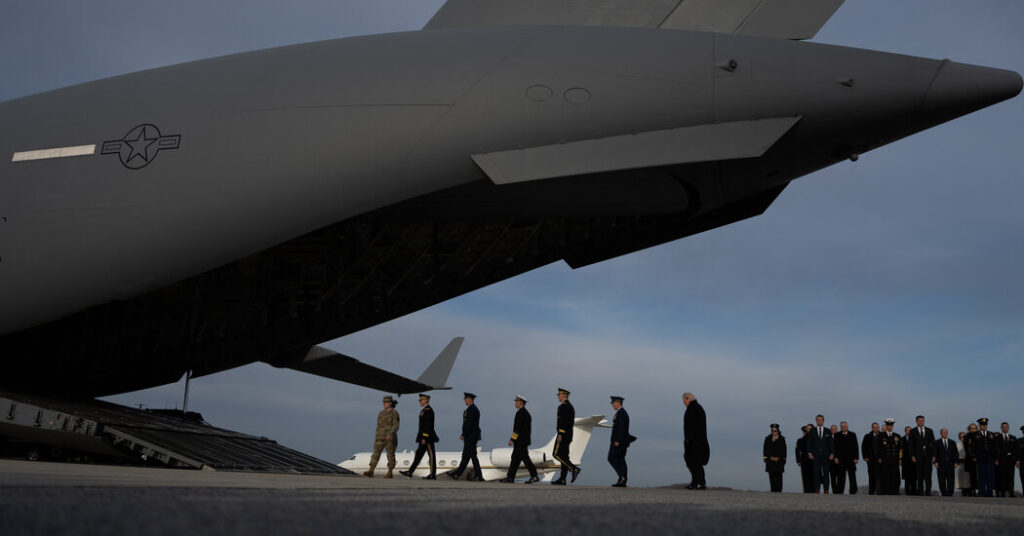
President Trump is scheduled to travel to Dover Air Force Base in Delaware on Saturday to witness the return of the bodies of American service members killed in the U.S.-Israeli war against Iran. He wrote in a social media post Friday that he would be joined by the first lady, Melania Trump, and members of his cabinet.
So far, at least six service members have been killed since the strikes began a week ago. It was not immediately clear if Saturday’s ceremony would mark the return of the bodies of all six.
Several times in his first term, Mr. Trump witnessed the return of fallen service members to Dover in flag-draped coffins. But back then, he was honoring Americans who died in wars that he inherited from other presidents. This time, he will be coming face to face with the deadly consequences of a war in the Middle East that he launched and is presiding over with no clear end in sight.
In recent years, presidents have made a tradition of participating in what is known as a “dignified transfer” ceremony at Dover.
In 2009, President Barack Obama made an unannounced midnight visit to the base to greet a plane returning 18 Americans killed in Afghanistan. At the time, he was weighing whether to send more troops to that country.
President Joseph R. Biden Jr. went in 2021 to watch as a gray C-17 transport plane returned the remains of some of the final Americans to die in the war in Afghanistan. There were 11 Marines, a Navy medic and an Army staff sergeant that time. Mr. Biden was back at Dover in 2024 for a ceremony to honor three service members killed by Iran-backed militias.
Mr. Trump made his first trip to Dover a month into his first term to honor a 36-year-old killed by Al Qaeda militants in Yemen. On another occasion, he brought the actor Jon Voight along to witness the solemn transfer of the bodies of two Army soldiers killed in a helicopter crash in Afghanistan.
Mr. Trump would speak about his visits in his first term as reminders of what he described as the tragic futility of the “endless wars” he had been elected to stop.
He once called the ceremonies at Dover “a very tough experience.” He has spoken at his rallies about the guttural cries of anguish he heard from parents upon seeing their child’s coffin come out of a military cargo plane.
“The hardest thing I have to do, by far,” he said in 2019, “is signing letters to parents of soldiers that have been killed.”
Since his attack on Iran, Mr. Trump has spoken more matter-of-factly about the risks to Americans from an extended military engagement. In a video he posted to social media after the first three service members died, Mr. Trump said, “Sadly, there will likely be more before it ends.” He added, “That’s the way it is. Likely be more. But we’ll do everything possible where that won’t be the case.”
On Monday, the president said he would not rule out sending ground troops to the Middle East to fight Iran. “I don’t have the yips with respect to boots on the ground,” he told the New York Post on Monday. “Like every president says, ‘There will be no boots on the ground.’ I don’t say it.”
A few days later, Time magazine asked him if Americans should worry about retaliatory strikes at home. “I guess,” Mr. Trump said. “But I think they’re worried about that all the time. We think about it all the time. We plan for it. But yeah, you know, we expect some things. Like I said, some people will die. When you go to war, some people will die.”
Shawn McCreesh is a White House reporter for The Times covering the Trump administration.
The post Trump Set to Witness Return of Bodies of U.S. Service Members appeared first on New York Times.