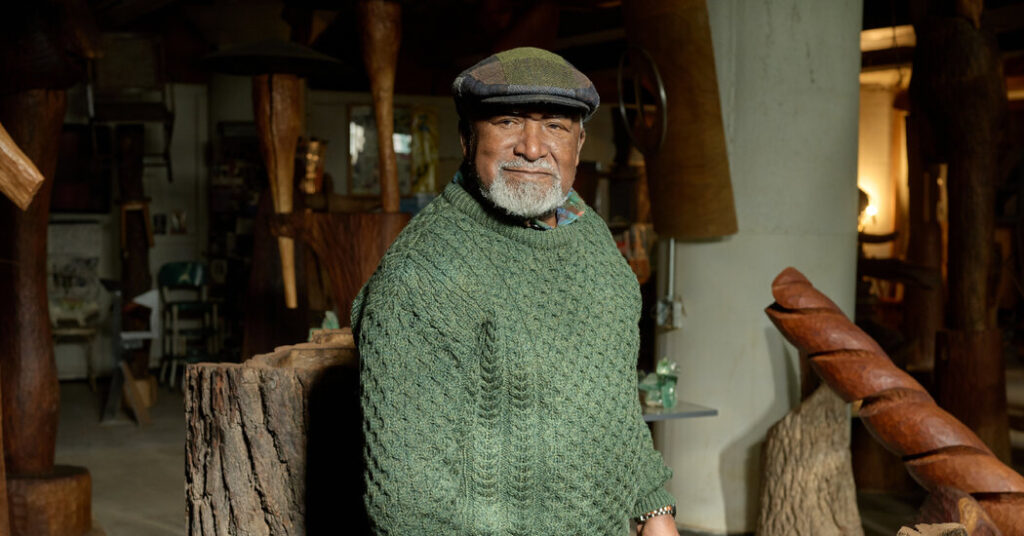
Thaddeus Mosley, a self-taught artist who spent nearly 70 years creating bold wooden sculptures before finally gaining international attention in his early 90s, died on Friday at his home in Pittsburgh. He was 99.
The death was announced by his family in a statement.
In the mid-1950s, struck by the decorative teak birds accompanying a display of Scandinavian furniture in the windows of Kaufmann’s department store in Pittsburgh, Mr. Mosley began making his own birds out of discarded two-by-fours.
The birds, some of which he sold, inspired him to start carving small heads and figures in his basement. Before long, he was collecting trees that the Pittsburgh parks department had discarded, gouging them into textured, biomorphic shapes, and assembling them into segmented abstract sculptures.
Though he was, strictly speaking, self-taught as an artist, he was a thorough and wide-ranging student. His sculptures, which often appear precarious but are always quite stable, show as much concern for pure form as any modernist’s, and reflect the influence of Constantin Brancusi and Isamu Noguchi, two particular heroes, as well as that of pre-modern African tribal sculpture, which Mr. Mosley studied and collected.
With Brancusi, he shared an interest in soaring verticality; with Noguchi, a deep respect for the natural beauty of the material. The African sculptors informed Mr. Mosley’s stylized, plastic imagination and, to some extent, the rhythmic texture of his gouges.
But as he told the professor and artist David Lewis, the author of “Thaddeus Mosley: African-American Sculptor” (1997), “Every artist, in the end, must be self-taught, because everyone must go beyond the lessons of other people.”
The synthesis and reinvention of his influences may be most fluid and remarkable in “Georgia Gate No. 1” (1975). Three narrow pine staves, smoothed and polished to the color of honey and mounted on small blocks of white marble, extend toward the ceiling, the tallest reaching more than 10 feet high.
Each performs its own variation on the vertical: One leans, as if in the wind; a second hunches, as if to be closer to the first; the third bends suddenly, on some mysterious errand of its own. As an abstraction, the piece is serene and beautiful — but it was also inspired by a photo of a Georgia burial ground where the graves of enslaved people were marked with wooden staves.
By the end of the 1950s, Mr. Mosley had begun to show at the Three Rivers Festival in Pittsburgh and was joining local artists’ associations. In the mid-1960s, he found a supporter in Leon A. Arkus, the director of the Carnegie Museum of Art, who gave him a solo show in 1968 and acquired “Georgia Gate No. 1” in 1976. (Mr. Mosley had another solo show at the museum in 1997 and also appeared in several group shows there.)
In the late 1960s, Mr. Mosley fielded a few inquiries from gallerists asking him to move to New York. But they offered no money in advance, and because he had children to support, he didn’t go.
Instead, he spent decades working in his studio every day. He showed his art when he could, in and around Pittsburgh, and occasionally sold a piece, but his real break didn’t come until 2018, at 92, when he was included in the 57th edition of Carnegie International, North America’s longest-running international art show. Once again, commercial galleries began calling.
He chose to show with Karma gallery, which has spaces in Los Angeles and downtown Manhattan, and other opportunities followed rapidly.
In Mr. Mosley’s 10th decade, an exhibition of his work, “Thaddeus Mosley: Forest,” traveled to museums in Los Angeles, Baltimore and Dallas, and he had six solo shows at Karma, including one of iridescent-green found-glass assemblages that was on display in New York at his death. His sculptures appeared in a two-person show at the Seattle Art Museum, alongside work by Alexander Calder, and in the group show “Inheritance” at the Whitney. He showed bronze works in New York, at Rockefeller Center and City Hall Park, and at the Musée National Eugène Delacroix in Paris. And in 2022, he won the Isamu Noguchi Award.
Though racial and economic barriers made life more difficult, they never deterred him. “I knew that I wasn’t going to get the same recognition, have the same opportunity,” he said in an interview. “But I tried, because it’s something I wanted to do, to take advantage of as many possibilities as I could.”
Thaddeus Gilmore Mosley was born in New Castle, Pa., on July 23, 1926. The second youngest of five children and the only boy, he would become the first man in generations, on either side of his family, not to work in a coal mine. His mother, Helen (Fagan) Mosley, was a homemaker; his father, Thaddeus, was a miner, a union organizer and a part-time bootlegger.
The family was poor, especially after his parents split up, but aesthetically minded. His father played the trumpet, and his mother collected antiques and sang in a gospel group, the Mosley Sisters, with three of her daughters. Mr. Mosley himself sang in his high school choir for three years.
Drafted into the Navy at the tail end of World War II, he served in California and the South Pacific. After being discharged, he studied English and journalism at the University of Pittsburgh, where he regularly crossed the street to visit the Carnegie Museum of Art with a friend who studied painting.
The university was the site of one of his more memorable brushes with racial prejudice, when he was called in and questioned by the head of the English department. “We don’t get many colored students majoring in English,” Mr. Mosley remembered him saying, in an interview for this obituary. “Generally they don’t do very well. I’m curious about what made you choose to major in English.”
Mr. Mosley replied coolly that he had excelled in the subject in high school.
“It had never crossed my mind,” he said later, “that writing English would be a strange thing for a Black American to do.”
After graduating, he held various jobs, working as a darkroom technician, a sports reporter for The Pittsburgh Courier and a freelance writer for Ebony and Jet magazines. He also took civil service exams and won a full-time job with the Postal Service. After taking up art, he quit his part-time jobs, but he kept his post office position until he retired, often working nights to leave his daytime hours free for his children and his work in the studio.
Mr. Mosley’s first marriage, to Ruth Ray at the end of his freshman year at Pitt, ended in divorce. He married Yvonne Reed in 1964; they were separated when she died in 2015. He is survived by his longtime companion, Teruyo Seya; six children, Martel Mosley, Rochelle Sisco, Lorna Mosley, Tereneh Idia, Anire Mosley and Khari Mosley, a city councilman in Pittsburgh; eight grandchildren; and two great-grandchildren.
Asked in a 2023 interview how it felt to experience such a late-in-life burst of success, Mr. Mosley acknowledged that he’d been enjoying it, but that it hadn’t affected his art.
“Well, it feels very good,” he said. “I don’t feel that the work has improved, but the situation has tremendously.”
The post Thaddeus Mosley, Sculptor Who Found Fame in His Last Decade, Dies at 99 appeared first on New York Times.