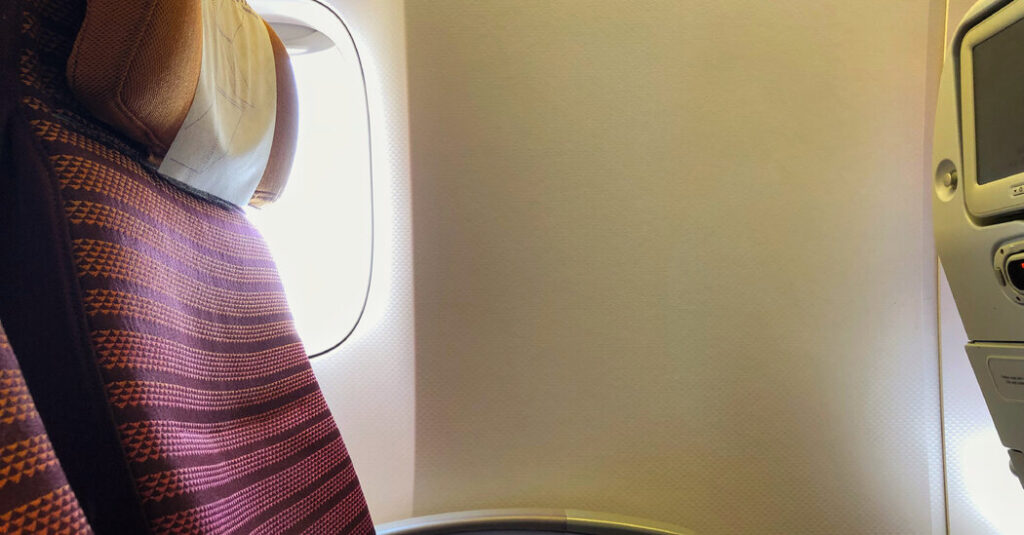
Somewhere over Middle America, Chris Young found him himself staring at a wall.
Last September, as Mr. Young boarded his Alaska Airlines flight from Seattle to Detroit, he was checking seat numbers and already thinking about the view.
Then he saw it.
“Oh no,” he recalled. “There’s the seat that has no window.”
The airline had assigned him the seat. The seat map had a window. The wall beside him did not.
Mr. Young, a comic, 52, from Helene, Mich., could only laugh, he said. No clouds, no wings, no horizon. Just a pale, curved wall where the window might have been.
This was Seat 11A.
“That’s just sort of my luck,” he said. Not every passenger handles the disappointment so gracefully.
On certain Boeing 737 and Airbus A321 aircraft, row 11 on the left side aligns with a cabin air-conditioning duct. The result is a seat sold as a window view that offers, instead, a wall. The discovery tends to arrive after boarding, when little can be done.
Some passengers respond by taking out their phones, documenting the wall and posting it online with a caption that lands somewhere between humor and disbelief
The response from the airlines often varies. In the case of Ryanair, the Irish low-cost carrier that operates many of these planes, the approach is acerbic.
“You must be new here,” the airline once wrote, reposting a photo of a missing window. In another case, a passenger photographed a sliver of daylight barely visible near the seat and thanked the airline for the “lovely window seat.”
Ryanair responded to it, adding an arrow: “This one?”
Over time, Seat 11A became famous. Or infamous, depending on whom you ask. It was a running joke, a kind of corporate wink shared between an airline and the internet. In a year-end social media wrap, Ryanair listed its top five complaints.
All five were Seat 11A, to no one’s surprise.
The airline’s official position has been consistent: It sells seats, not windows. The joke, like the wall, is clean, hard and difficult to argue with.
The seat once made headlines for different reasons. The lone survivor of Air India Flight 171, which killed at least 260 people last year, sat in seat 11A. It left the world’s fliers curious if there was something special about the seat. But experts have said the chief factor was most likely luck, and not the absence of a window.
But not everyone finds it amusing or lucky.
In August, passengers filed proposed class-action lawsuits against Delta Air Lines and United Airlines, asserting that they had paid for window seats on certain aircraft only to discover that there was no window.
The lawsuits argue that the absence was not clearly disclosed during booking.
“When consumers choose to book an airplane seat adjacent to the wall, they expect it to have a window,” a federal complaint filed said.
Both airlines moved to dismiss the claims. United declined to comment, citing the pending lawsuit. Delta did not respond to a request for comment.
The plaintiffs argue they are not asking for much. Just, in this case, a bit of accuracy.
Carter Greenbaum, one of the lawyers representing the passengers, said in a statement that passengers who are willing to pay an upgrade fee for a window seat expect there to be an actual window.
“As airlines continue to upcharge seemingly every conceivable element of the flight experience, passengers who pay often an extra $100 or more to select an undisclosed ‘wall seat’ are understandably outraged,” he said.
Mr. Young, however, shrugged it off. His was a night flight, so he hadn’t missed much in the way of views. Though, admittedly, he likes to watch takeoff and landing.
He settled in and stared at the back of the seat in front of him until he fell asleep.
Mark Walker is a Times reporter who covers breaking news and culture.
The post Seat 11A: The Windowless Inside Joke at 30,000 Feet appeared first on New York Times.