Russia unleashed a deadly barrage of missiles and drones on Ukraine early Saturday, as concerns mount in Kyiv that the conflict in the Middle East is draining the supply of U.S.-made air defenses that it badly needs.
The predawn strikes on Ukraine followed something of a lull in Russian attacks in recent days. Such periods of relative quiet often prompt anxiety among Ukrainians, with expectations that a large assault will soon come.
Ukraine’s Air Force said on Saturday that Russia had launched 480 attack drones and 29 missiles — nearly half of them ballistic — in the wide-ranging barrage. While most were intercepted, the air force said 22 sites were hit.
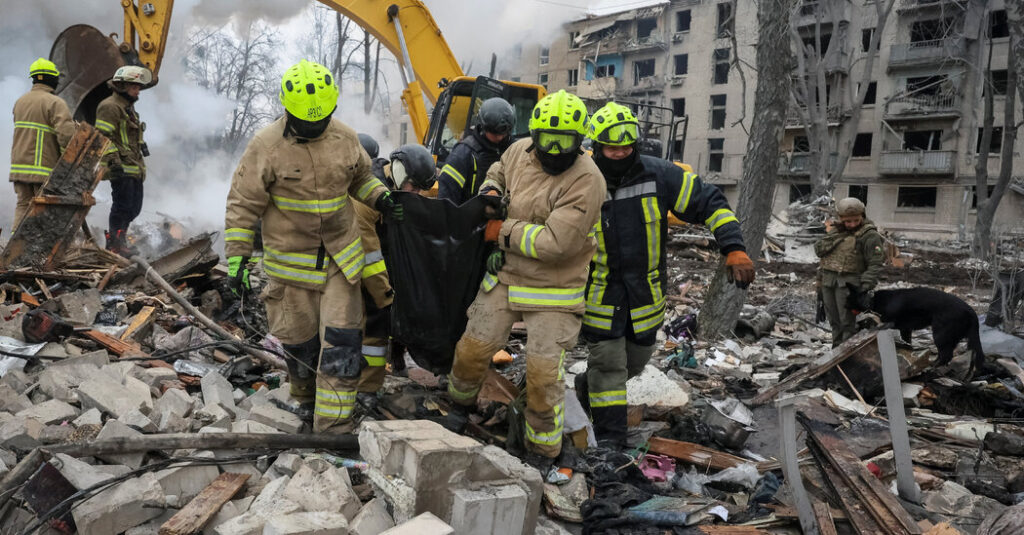
At least eight people were killed and more than a dozen wounded when a ballistic missile slammed into a five-story apartment building in the northeastern city of Kharkiv, according to the local authorities. The mayor, Ihor Terekhov, said that a primary schoolteacher and two children were among the dead.
Officials warned that over a dozen people could be trapped under the rubble as search and rescue efforts continued into the afternoon.
In the capital, Kyiv, air defenses were heard firing and loud explosions echoed through the city. The strikes damaged critical infrastructure, the local authorities said, leaving nearly 2,000 buildings without heat. At least three people were wounded in the assault. Energy and railway infrastructure in several other regions also sustained damage, according to the Ukrainian authorities.
President Volodymyr Zelensky of Ukraine demanded “a response from partners to these savage strikes against life,” as he urged them to keep providing air defenses without interruption.
“Russia has not abandoned its attempts to destroy Ukraine’s residential and critical infrastructure, and therefore support must continue,” Mr. Zelensky wrote on social media.
Over the past week, the U.S.-Israeli bombing of Iran, and Tehran’s retaliatory strikes, have shifted attention away from Russia’s full-scale invasion of Ukraine.
But the fighting in the Middle East is reverberating in Ukraine as well.
Mr. Zelensky has acknowledged that ongoing hostilities in the Middle East could impact the delivery of air defenses to Ukraine from its allies. Persian Gulf countries and American forces have fired large number of costly interceptors to fend off missiles and the relatively inexpensive Shahed drones launched by Tehran. Some, still, have managed to get through.
Mr. Zelensky also has offered Ukraine’s expertise to U.S. and Middle Eastern leaders to help counter the Iranian-designed drones.
Ukraine has four years of hard-fought experience with Shaheds, which Tehran supplied to its ally, Russia, at the outset of the full-scale invasion. Ukraine now produces large numbers of small interceptor drones intended to defend against them. Mr. Zelensky has floated the idea of trading such interceptors for more powerful Patriot missile systems — Ukraine’s primary defense against Russian ballistic missiles.
While Russia’s public response to the U.S.-Israeli attacks on Iran has been somewhat muted — limited mostly to condemnatory statements — U.S. officials say that Moscow has provided intelligence to Iran, including satellite imagery showing the locations of warships and military personnel. Some officials played down the significance of that partnership.
The symbolism of the relationship between Russia and Iran, though, has not been lost on many in Ukraine.
President Vladimir V. Putin of Russia called President Masoud Pezeshkian of Iran late on Friday to express condolences for the death of the supreme leader, Ayatollah Ali Khamenei, in an airstrike last Saturday and for civilian casualties, according to the Kremlin.
Mr. Putin urged “a swift return to the path” of a diplomatic resolution and called for the “immediate cessation of hostilities,” the Kremlin said in a statement.
Hours later, air-raid alarms sounded in Ukraine to warn of incoming Russian missiles and drones.
The post Russia Hits Ukraine With Deadly Barrage of Missiles and Drones appeared first on New York Times.