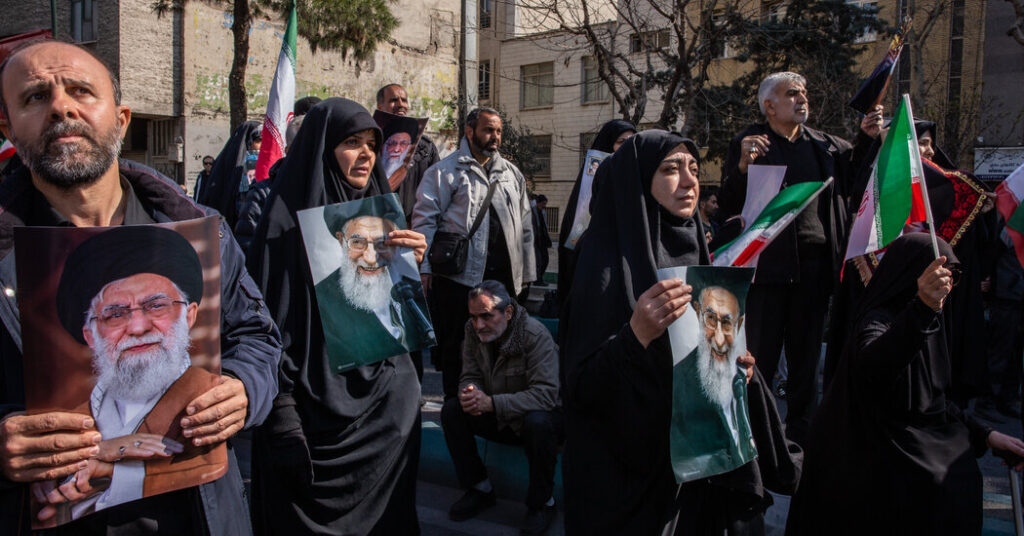
A report by the National Intelligence Council completed before the United States and Israel launched attacks on Iran assessed that even a large-scale military assault on the country would be unlikely to topple its theocratic government, according to U.S. officials briefed on the work.
The N.I.C., which is part of Tulsi Gabbard’s Office of National Intelligence, is in charge of crafting intelligence assessments based on an array of views across the intelligence community. While some of their reports are joint products, others are produced independently, with less coordination.
The council’s document, drafted late last month, builds on work by the C.I.A. that assessed that a complete change of government was unlikely even if Ayatollah Ali Khamenei, the supreme leader, was killed in a U.S.-led military operation. But the actual report was an independent product of the council, the officials said.
Still, there seemed to be wide agreement that the theological government in Iran is deeply entrenched. Intelligence officials have been skeptical that a popular uprising could dislodge the Islamic Revolutionary Guards Corps, the organization that exerts control over much of the security apparatus in Iran as well as large sectors of its economy.
The N.I.C. report was earlier reported by The Washington Post.
Julian E. Barnes covers the U.S. intelligence agencies and international security matters for The Times. He has written about security issues for more than two decades.
The post Recent U.S. Assessment Found an Attack on Iran Unlikely to Result in Regime Change appeared first on New York Times.