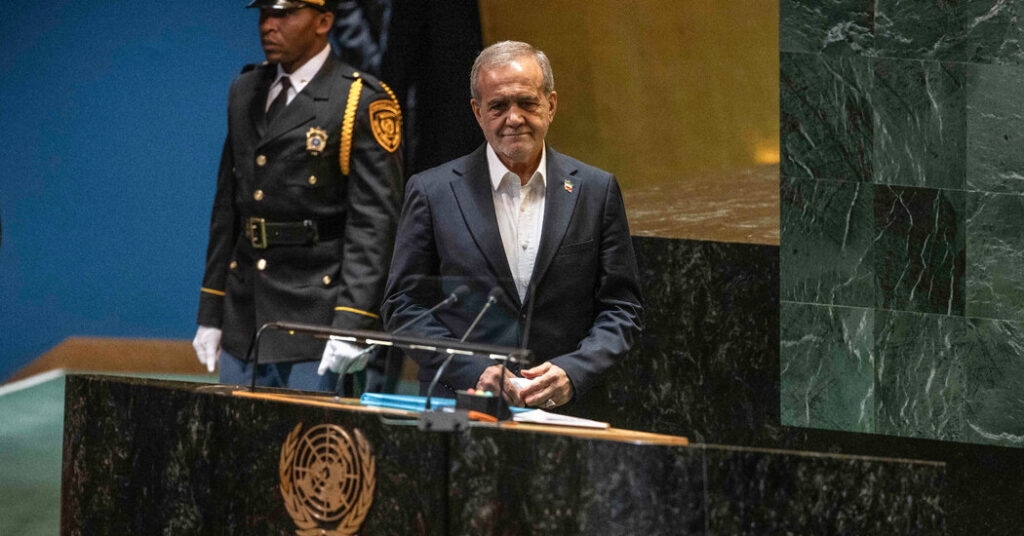
Masoud Pezeshkian, the Iranian president, had just apologized on state television on Saturday morning for waves of Iranian missile strikes that hit Gulf states since last week, when air-raid sirens blared in Qatar and Bahrain — warning of further attacks.
Hours later, following criticism from Iranian hard-liners, Mr. Pezeshkian issued another statement in which he asserted that Iran had not attacked its “friendly and neighboring countries” in this war — this time omitting any apology.
This back-and-forth occurred even as attacks on Gulf countries continued, revealing divides inside Iran’s leadership as the country struggled to respond to the American-Israeli attacks, now entering their second week.
Iran has fired hundreds of missiles and drones at its Arab neighbors in the Persian Gulf since the war began last Saturday, arguing that it was targeting the American military bases located there. Iranian strikes, however, have also damaged civilian sites across the Middle East, including airports and hotels.
In an apparent attempt to mollify the outrage among Gulf states, Mr. Pezeshkian apologized on Saturday morning “on behalf of Iran to the neighboring countries affected” and pledged to stop. But the promise was conditioned on an end to attacks against Iran that originate from their territory, which still hosts U.S. bases, appearing to render the point moot.
Mr. Pezeshkian also suggested that the Iranian military and Islamic Revolutionary Guards Corps had acted independently during the crisis, which began with Israeli attacks that assassinated the country’s supreme leader, Ayatollah Ali Khamenei, and other senior Iranian leaders.
“Because our commanders and our leader lost their lives due to the brutal aggression, our armed forces, when there were no commanders present, acted on their own authority,” Mr. Pezeshkian said.
Those comments raised questions about who exactly was overseeing Iran’s military response. Before his death, Ayatollah Khamenei had begun increasingly handing responsibility to Ali Larijani, one of Iran’s top security officials.
As Iran’s president, Mr. Pezeshkian wielded some authority, but Ayatollah Khamenei held ultimate power. A successor for Ayatollah Khamenei has yet to be chosen.
Mr. Pezeshkian is now a member of a three-member council charged with administering the country until a new supreme leader is selected, but analysts say Iran’s entrenched and powerful security state is likely far more influential.
“Pezeshkian’s comments, which were followed by further strikes on the Gulf, will only reinforce perceptions of his powerlessness within a military dominated system,” said Sanam Vakil, director of the Middle East and North Africa Program at Chatham House, the London-based research institute.
The comments also quickly aroused ire from the Iranian right. Hamid Rasaei, a hard-line member of Parliament, called Mr. Pezeshkian’s stance “weak and unprofessional.”
“Those who should apologize are the countries that have turned their soil into U.S. military bases,” not Iran, Mr. Rasaei wrote on social media.
President Trump was quick to seize on Mr. Pezeshkian’s apology. He called it evidence that the American-Israeli aerial campaign was compelling the Iranian leadership to accept his terms. He vowed that Iran would “be hit very hard” on Saturday.
“Iran, which is being beat to HELL, has apologized and surrendered to its Middle East neighbors, and promised that it will not shoot at them anymore,” Mr. Trump wrote on social media.
It is far from clear that Mr. Pezeshkian has the authority to make such a commitment.
Aaron Boxerman is a Times reporter covering Israel and Gaza. He is based in Jerusalem.
The post Iranian President’s Apology Showcases Leadership Rifts appeared first on New York Times.