A classified report by the National Intelligence Council found that even a large-scale assault on Iran launched by the United States would be unlikely to oust the Islamic republic’s entrenched military and clerical establishment, a sobering assessment as the Trump administration raises the specter of an extended military campaign that officials say has “only just begun.”
The findings, confirmed to The Washington Post by three people familiar with the report’s contents, raise doubts about President Donald Trump’s declared plan to “clean out” Iran’s leadership structure and install a ruler of his choosing.
The report, completed about a week before the United States and Israel initiated the war on Feb. 28, outlined succession scenarios stemming from either a narrowly tailored campaign against Iran’s leaders or a broader assault against its leadership and government institutions, the people familiar with its findings said. In both cases, the intelligence concluded that Iran’s clerical and military establishment would respond to the killing of Supreme Leader Ayatollah Ali Khamenei by following protocols designed to preserve continuity of power, these people said.
The prospect of Iran’s fragmented opposition taking control of the country was described as “unlikely,” said the people, who spoke on the condition of anonymity to discuss a classified report.
The National Intelligence Council, or NIC, is composed of veteran analysts who produce classified assessments meant to represent the collective wisdom of Washington’s 18 intelligence agencies.
The CIA referred questions to the Office of the Director of National Intelligence, which declined to comment. The White House did not say if the president was briefed on this assessment before approving the military operation, which has quickly expanded east to include submarine warfare in the Indian Ocean and west to counter-missile showdowns near NATO member Turkey.
“President Trump and the administration have clearly outlined their goals with regard to Operation Epic Fury: destroy Iran’s ballistic missiles and production capacity, demolish their navy, end their ability to arm proxies, and prevent them from ever obtaining a nuclear weapon,” White House spokeswoman Anna Kelly said in a statement. “The Iranian regime is being absolutely crushed.”
U.S. spy agencies’ doubts about Iran’s opposition seizing power have been referenced in the New York Times and the Wall Street Journal. The NIC’s involvement, and its analyses of the potential outcomes of small- and large-scale offensives, have not been previously reported.
Suzanne Maloney, an Iran scholar and vice president at the Brookings Institution, said the NIC’s prediction that Iran’s institutions will endure stems from its rigorous knowledge of the Islamic republic.
“It sounds like a deeply informed assessment of the Iranian system and the institutions and processes that have been established for many years,” she said.
It does not appear that the intelligence report examined other possible scenarios, including sending U.S. ground troops into Iran or arming the country’s ethnic Kurds to foment a rebellion. It could not be determined whether the large-scale campaign that the classified document examined is identical to the operations now underway.
The Iranian succession process that the report anticipated is now playing out but under duress from the extensive U.S.-Israel bombing campaign from the air and sea.
The replacement of the supreme leader rests with Iran’s powerful clerical body, the Assembly of Experts. But members of the Islamic Revolutionary Guard Corps (IRGC) and others within the country’s security establishment also play an influential role.
There has been intense speculation that the assembly will anoint the late supreme leader’s son, Mojtaba Khamenei, but no official announcement has been made. The IRGC has been pushing Khamanei’s candidacy but has encountered resistance from other power brokers, including Ali Larijani, the secretary of the Supreme National Security Council of Iran, a Western security official said.
As the war enters its second week, Trump continues to demand Iran’s “UNCONDITIONAL SURRENDER,” as he put it in a Truth Social post, and has suggested he should have a role in picking the country’s next leader.
Trump told journalists that the younger Khamenei is “incompetent” and a “lightweight,” and that he doesn’t want Iranian leaders who will simply “rebuild” the country’s nuclear and ballistic missile infrastructure.
“We want them to have a good leader. We have some people who I think would do a good job,” he told NBC News.
Iran’s Parliament speaker, Mohammad Bagher Ghalibaf, rejected the notion that Trump will play any role in appointing Iran’s next leader.
“The fate of dear Iran, which is more precious than life, will be determined solely by the proud Iranian nation, not by [Jeffrey] Epstein’s gang,” Ghalibaf said on X, referring to the late sex offender who was close friends with Trump for several years before they had a falling out.
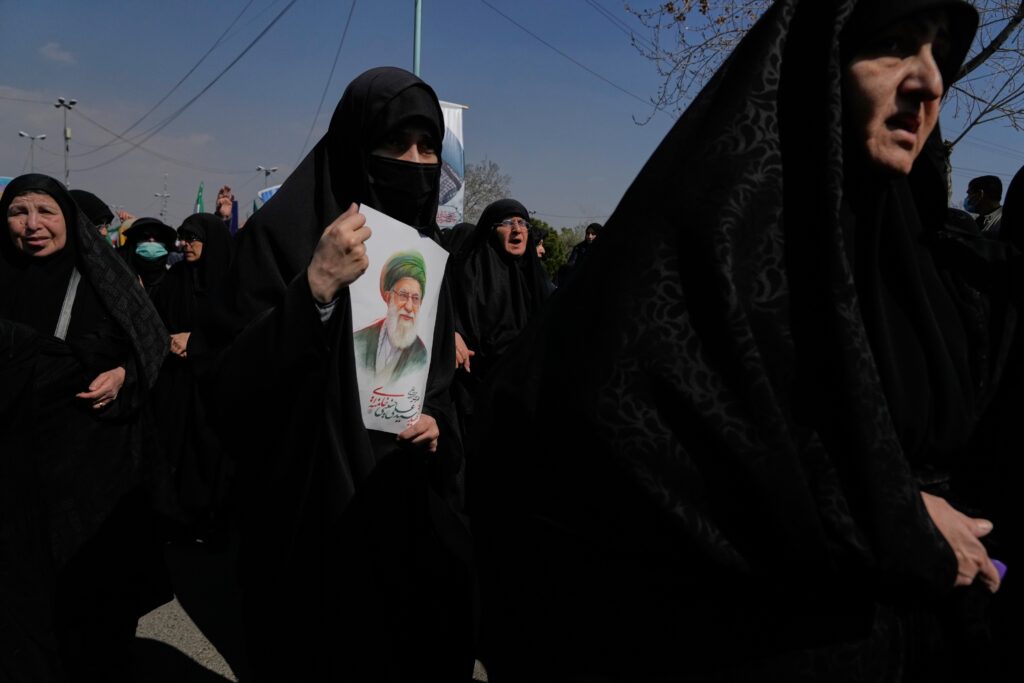
Current and former U.S. officials say they see little sign, at least so far, of a mass popular uprising in Iran or of significant fissures within the government or security forces that will result in a new regime. Iran’s security forces killed thousands of protesters during demonstrations in January fueled by the country’s abysmal economy. The guidance from Trump to the Iranian people has been to shelter in place until the U.S.-Israeli bombing campaign concludes.
With Iran’s clerical and military establishment still in control, experts say Trump’s ability to dictate political outcomes is limited.
“Bending the knee to Trump would go against everything they stand for,” said Holly Dagres, a senior fellow at the Washington Institute for Near East Policy. “The upper echelons of the clerical establishment are ideological, and so their modus operandi is to resist American imperialism.”
Trump could play kingmaker if the regime were to crumble, but the NIC report does not view the establishment’s hold on power as brittle.
“There’s no other force within Iran that can confront the remaining power that the regime has,” said Maloney, of the Brookings Institution. “Even if they’re not able to project that power very effectively against their neighbors, they can certainly dominate inside the country.”
The post Intel report warns large-scale war ‘unlikely’ to oust Iran’s regime appeared first on Washington Post.