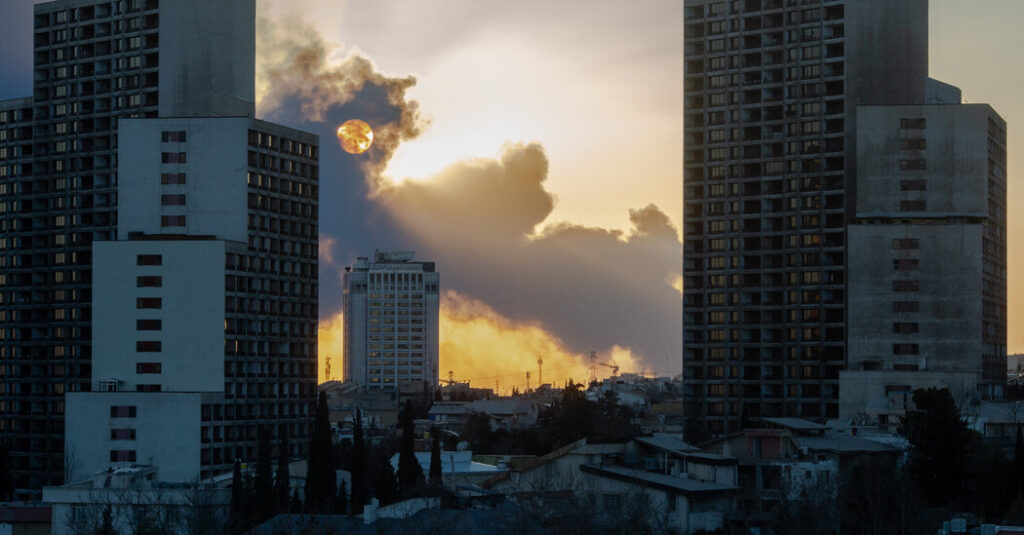
The volley of Israeli missiles that slammed into a government compound in central Tehran last Saturday morning was by any military standard a successful opening strike by the United States and Israel as they went to war with Iran.
The blasts killed Iran’s supreme leader, Ayatollah Ali Khamenei, as well as a cadre of other senior military and intelligence officials. The war’s first salvo left Iran without many of its top commanders to lead the response.
The reckoning, it turned out, was more complicated. The Israeli strike also killed another group of Iranian officials who had been meeting in a different part of the compound. Among them were people the White House had identified as more willing to negotiate than their bosses, and who might help bring a swift end to the conflict, according to American officials.
The strike on the compound in Tehran was emblematic of the muddled reality of the war’s first week: a withering air campaign by American and Israeli forces against an overwhelmed enemy, but few answers about what victory might look like. Iran, its government still in place, has remained defiant and expanded the battlefield across the region, inflicting the first American casualties of the conflict.
Even as senior administration officials in the United States spent the week trying to narrowly cast the war’s goals around denying Iran any chance of gaining a nuclear weapon, President Trump has bounced between wildly divergent explanations for what he hopes to achieve.
In his first message after the war began, Mr. Trump called for a mass uprising in Iran against the country’s leaders. In subsequent days, with little evidence that Iranians were moving to overthrow their own government and with intelligence reports concluding that the clerical regime would likely hold on to power, he indicated he cared little about Iran’s future after the military campaign ends.
Then, on Friday, he said he would be directly involved in choosing Iran’s future leader, and indicated he was committing the United States to Iran’s long term future. And in a bellicose social media statement on Saturday morning, Mr. Trump warned Iran that “areas and groups of people that were not considered for targeting up until this moment in time” might now be targeted by the United States and Israel.
The changing narratives have whipsawed the American public, which polls show broadly opposes the war. At the same time, the spreading violence is triggering rising oil prices and other economic shocks that could bring further election-year political problems for Mr. Trump and the Republican Party at home.
The war’s first week had echoes of the past: For the first time since World War II, an American submarine destroyed an enemy ship using a torpedo. And it provided glimpses of the future: The Pentagon employed artificial intelligence to help pick its targets.
Interviews with dozens of officials in the United States, Israel, Iran and across the Middle East suggest that while American and Israeli military capabilities have proven to be overwhelming during the war’s first seven days, the violence that has metastasized across the region could yield all manner of fraught outcomes.
Thousands of strikes on Iran’s ballistic missile sites, military headquarters and ships transiting the Persian Gulf have impaired Tehran’s ability to expand the war even further. American and Israeli military officials say they are confident that, with Iran’s air defenses mostly battered, they can continue the campaign for weeks with little risk to their pilots.
This week, Pentagon officials told Congress that the first week of the war had cost approximately $6 billion, and Republicans are expecting the administration to seek more funding from Congress for the war.
For their part, Iranian officials have said they are confident that the government can survive the barrage and that, over time, the Americans and Israelis will lose their appetite for a war. They have given a code name to their strategy of raising the costs of the conflict to get the United States and Israel to blink: Operation Madman.
Progress of the Military Campaign
The war began 12 hours earlier than planned, after Israeli and American intelligence agencies received urgent new information: that meetings of the senior military and intelligence officials at the compound in Tehran had been moved from last Saturday evening to Saturday morning — and that Ayatollah Khamenei would be at the compound at the same time.
Israel launched both cruise missiles and supersonic ballistic missiles that arc high into the atmosphere. When they landed, they flattened the compound, which occupied several blocks in central Tehran.
Since then, American and Israeli military officials have said that a punishing air campaign has killed senior members of Iran’s military leadership, sunk much of the Iranian navy, and was wearing down the Iranian government’s ability to mount a potent armed resistance.
The U.S. combat forces in the region have swelled to more than 50,000 troops — including two aircraft carriers and a dozen warships — with dozens of additional bombers and attack planes still flowing in. Approximately $4 billion of the first week’s cost of the war for the United States was spent on munitions, mostly interceptors to shoot down Iranian missiles.
Israel and the United States have divided the campaign based on both geography and types of targets. Israel initially aimed at Iranian clerical and military leaders, including Ayatollah Khamenei, while the American military focused on hitting Iranian air defenses. Then, the air forces of both countries turned their focus to ballistic missile launchers and storage sites — with Israel focusing on the north and America on the south.
There have also been grave mistakes, in particular a Feb. 28 strike that hit an elementary school in the southern Iranian town of Minab. It is the deadliest known episode of civilian casualties during the war thus far — with at least 175 people killed there, according to Iranian health officials and state media, including many schoolchildren. No side has yet taken responsibility, although an analysis by The New York Times shows that the school was most likely hit by an American airstrike.
Israeli and American forces have struck about 4,000 targets, eroding Iran’s capability to launch missiles and drones at Israel, U.S. bases in the Middle East and other allies in the region, officials said. Total deaths in Iran are about 1,000, according to the Iranian Red Crescent Society.
Adm. Brad Cooper, the head of U.S. Central Command, said on Thursday that the number of ballistic missiles that Iran has fired is down 90 percent from the first day of fighting. Iran’s ability to fire one-way attack drones, among its most plentiful and menacing weapons, is also now more constrained, Admiral Cooper said, with drone launches down 83 percent from the first days of the conflict.
Yet Iran still has a formidable arsenal of both. By some estimates that U.S. officials provided to Congress in classified briefings this week, Iran still retains as much as about 50 percent of its missile program, and even more of its drones, one of which killed six U.S. Army reservists in Kuwait last Sunday. U.S. and Israeli officials say they are reducing that remaining Iranian capacity every day.
The destruction of Iran’s air defenses is allowing the Pentagon to adjust its attack strategy by shifting away from missiles, which are expensive and in relatively short supply, and toward cheaper and more plentiful precision-guided gravity bombs delivered by aircraft.
U.S. military commanders say the next several days will be critical to determine whether Iran can maintain a meaningful barrage of retaliatory missile strikes as the American and Israeli militaries target Iran’s arsenal.
“It’s a race,” said Gen. Kenneth F. McKenzie Jr., a former head of U.S. Central Command.
No Endgame
During the first days of the war, both Mr. Trump and Prime Minister Benjamin Netanyahu of Israel suggested that the real change in Iran would come from within, with mass protests on the streets toppling a government made weaker by the military campaign.
That has not yet happened, and Mr. Trump has changed his public position by the day — or the hour — about just how big a role the United States would take in trying to engineer Iran’s political future. On Friday, he said he would be happy if Iran was left with an autocratic, religious leader after the war, as long as the new leadership treated the United States and Israel “fairly.”
Inside the White House, officials had identified some pragmatic Iranian officials who they believed might be convinced to negotiate a relatively quick end to the war if the upper echelon of Iranian leadership were killed. The White House saw the potential Iranian negotiating partners not so much as moderates, but as people who would have a self-interest in remaining in power even if it meant reaching a deal with the United States for the end of hostilities.
Some American intelligence assessments were more hedged, suggesting there were few moderates within the Iranian government capable of exerting power, though they acknowledged there were some who might be more willing to negotiate with the United States.
But, after some of the individuals identified by the White House as potential negotiating partners were killed during the initial attack, and more killed in other strikes on Tehran, the White House began scrambling for a different political endgame.
“The attack was so successful it knocked out most of the candidates” to lead Iran, Mr. Trump said last Sunday. “They’re all dead. Second or third place is dead.”
But for now the basic power structure in Iran remains intact, with the heads of the branches of government and many top political leaders still alive and military commanders replaced. That has left Mr. Trump and his senior aides feeling their way for a path forward.
Now with Mr. Trump on Friday demanding an “unconditional surrender” from Iran, American officials are preparing for a conflict that could last weeks.
The president has asserted he will have a say in who takes over in Iran should the current government collapse, but there is now a struggle to determine who might have both the stature inside the country to lead a postwar Iran willing to work with the United States and the ability to gain the support of the Iranian people.
Intelligence reports have suggested that whatever comes next and whoever takes power, the theocratic structure of the government is likely to endure.
White House officials cautioned that the president could quickly change his mind and declare victory, but American officials noted his insistence on having compliant leaders and the difficulty of achieving that after their targets were killed, which they suggested means he is not ready for an immediate solution.
Anna Kelly, a White House spokeswoman, said, “President Trump and the administration have clearly outlined their goals with regard to Operation Epic Fury: destroy Iran’s ballistic missiles and production capacity, demolish their navy, end their ability to arm proxies and prevent them from ever obtaining a nuclear weapon.”
“Operation Madman”
After the end of the 12-day conflict last June in which the United States and Israel pounded Iranian nuclear sites and killed key figures in the country’s nuclear program, Iranian officials developed a strategy for a second war they considered to be inevitable. It came to be known as “Operation Madman.”
Ayatollah Khamenei’s orders, according to six Iranian officials, were clear: Take steps to set the Middle East aflame if Iran were attacked again and, specifically, if Ayatollah Khamenei himself was killed. He also appointed four layers of succession for military commanders and officials to ensure there would no power vacuum during the war.
The plan was to make a war with Iran extremely costly for not just Israel and the U.S., but also Arab countries, their economies, tourism, global energy, transportation and shipping.
“We know America is extremely worried about a regional war, its economy will be impacted, its allies will be hurt,” said Mahdi Mohammadi, the senior adviser to Iran’s speaker of the parliament, in an audio analysis of the war posted on his social media account.
“Our plan is to expand the war’s reach and expand the time. It’s the biggest blow we can deliver to Trump and we have no other choice.”
The first phase of the plan called for strikes on Israel. The second phase focused on attacking American military bases in Arab countries, and the third phase for escalating even further — attacking civilian sites in Arab countries such as airports, hotels and embassies where Americans might be congregating.
Iran had carried out all three phases of the plan within days of the beginning of the war.
“This is not a knee-jerk reaction, it’s not impulsive,” said Sina Azodi, an expert of Iran’s military and history, and an assistant professor of Middle East politics at George Washington University. “Iran’s military plan has long been developed and thought out to impose as much cost as they can on America’s allies in the region and by extension the United States.”
Widening Violence in the Middle East
In the weeks before the war began, Iran made no secret to its neighbors of what its strategy would be. Iranian officials made frequent visits to their Arab counterparts around the region to warn that, if they came under attack, they would do their best to target U.S. interests wherever those might be — even at the cost of dragging the entire region into the fray.
In neighboring Iraq, militias aligned with Tehran publicly solicited volunteers for “martyrdom” units to help their longtime patron wage “jihad” with attacks on U.S. bases and other U.S. allies or interests across the region.
Arab officials took those warnings seriously, repeatedly lobbying the Trump administration to refrain from an attack.
By firing missiles and drones at Gulf countries, Iran has found an effective way to apply economic pressure on Mr. Trump and other international leaders. The fossil fuel-rich region’s waterways and cities are crucial nodes for global trade, finance, travel and energy production. Iran’s attacks have already choked off the Strait of Hormuz, a key passageway for oil tankers, and shut down major international transit hubs, stranding tourists around the world.
They have also hit oil and gas infrastructure in Saudi Arabia, Qatar, and Bahrain. After a drone attack targeted an energy installation in Qatar — one of the world’s largest exporters of natural gas — the country announced that it was halting production of liquefied natural gas indefinitely. All of these shocks have helped push up the price of energy, including for American consumers at the gasoline pumps. The average price of a gallon of regular gas in the United States rose nearly 27 cents in the first week of the war.
Shortly after a statement on Saturday by Iran’s president, Masoud Pezeshkian, apologizing to Arab countries in the Persian Gulf for shooting scores of missiles and drones at them in retaliatory strikes, Iran’s Revolutionary Guards said in a statement that it had launched another wave of attacks on American and Israeli targets as well as a hotel in Dubai and a port in Bahrain.
Hezbollah, the Lebanon-based militia that has long been Iran’s most powerful proxy army, has also joined in the conflict, firing projectiles into Israel provoking an Israeli military retaliation into Lebanon. There is broad consensus among diplomats and analysts in Beirut that the Revolutionary Guards have taken greater control over Hezbollah since the group’s last conflict with Israel ended in 2024.
“It’s become clear that the Iranian involvement in Hezbollah has become far greater than what we had imagined,” said Maha Yahya, director of the Malcolm H. Kerr Carnegie Middle East Center in Beirut.
That dynamic was laid bare on Monday when Hezbollah fired on Israel in retaliation for the killing of Ayatollah Khamenei — a move that will likely have disastrous repercussions for the group within the country, analysts say.
Its core support base among Shia Muslims in Lebanon is increasingly weary of war, fearful of permanent displacement from the south if Israeli forces launch a wide scale ground invasion, and has shown growing frustration with the group.
Hezbollah’s base “is very tired of these endless wars, they want to just live their lives,” said Ms. Yahya. “But they also feel that they are in an existential position because they are under some sort of existential threat.”
Christina Goldbaum, Vivian Nereim and Helene Cooper contributed reporting.
Mark Mazzetti is an investigative reporter based in Washington, D.C., focusing on national security, intelligence, and foreign affairs. He has written a book about the C.I.A.
The post In War’s First Week, a Punishing Military Campaign With No Coherent Endgame appeared first on New York Times.