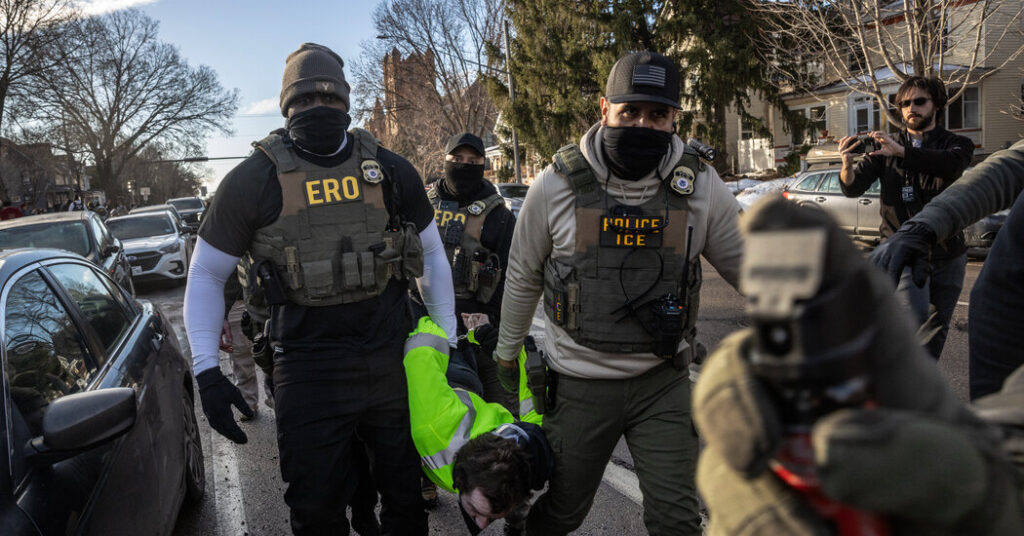
After months of high-profile, militarized immigration raids in major American cities, the Trump administration has scaled back its deportation strategy, leading to a dip in arrests last month, according to three federal officials and internal government data.
In recent weeks, immigration agents have focused on conducting more targeted enforcement operations, rather than indiscriminate street sweeps, said the officials, who spoke on condition of anonymity to discuss internal strategy.
Those arrests have been less visible and chaotic than the campaign that led to violent clashes with protesters — including the fatal shootings of two American citizens in January — and generated intense political blowback against President Trump.
The retreat from some of its most aggressive enforcement efforts underscores the challenges the administration faces in meeting its goal of deporting millions of undocumented immigrants. Although hard-line immigration policies were at the heart of Mr. Trump’s appeal to voters in the last election, many Americans have balked at seeing the crackdown put into practice, forcing the White House to recalibrate its approach.
In February, Immigration and Customs Enforcement officers arrested roughly 11 percent fewer people per day than they had the previous month, according to internal government figures reviewed by The New York Times. The drop was driven in part by ICE arresting fewer immigrants without criminal records, the data show. Overall, arrests have fallen to their lowest levels since September.
The changes have been felt in some of the cities that Mr. Trump’s operations hit hardest.
In Los Angeles, a group that monitors enforcement activity said it had seen a marked decline in sightings of ICE and Border Patrol officers. In Minneapolis, the administration has withdrawn hundreds of federal agents. And in Chicago, immigration officers are no longer stationed at Home Depot parking lots to question and arrest day laborers of Mexican and Central American descent — though locals in all three cities say ICE remains active.
“It’s not at the level that it was prior,” said Andre Vasquez, a City Council member in Chicago. “But they’re not going away.”
On Thursday, Mr. Trump made a major move, ousting Kristi Noem, the homeland security secretary who had become the face of his mass deportation campaign, although he did not voice dissatisfaction with the department’s approach.
Abigail Jackson, a White House spokeswoman, disputed that the Trump administration had adjusted its strategy.
“We continue to carry out targeted enforcement operations for the worst of the worst, but as always, anyone in the country illegally is eligible to be deported,” Ms. Jackson said in a statement. “The entire Trump administration will continue to fulfill the president’s promise to carry out the largest mass deportation operation of criminal illegal aliens in history.”
The Homeland Security Department declined to comment.
Daily ICE arrests remain about four times as high as they were during the last year of the Biden administration, according to a Times analysis of federal data. And more than 40 percent of people arrested by ICE in February had no criminal record — nearly double the rate during the early months of Mr. Trump’s second term, and five times as high as the last year of the Biden administration.
Still, the president signaled a change was imminent in late January when he sent Tom Homan, a White House official, to take charge of immigration operations in Minneapolis. After federal immigration agents there killed Renee Good and Alex Pretti, Mr. Trump heard from a number of allies who told him the images of violent clashes with protesters were taking attention away from his accomplishments, like driving down illegal crossings at the border.
Mr. Trump even acknowledged that his administration could use a “softer touch” when it came to enforcement.
The shift could be temporary. The White House has at times in the last year claimed it was targeting immigrants with criminal backgrounds, only to announce aggressive raids in cities weeks later that engulfed many people without criminal records. There was a marked drop in arrests in July, for example, after high-profile raids in Los Angeles, only for the numbers to increase again in September with the launch of aggressive operations in Chicago.
In addition, bad weather in the Northeast may have contributed to the February slowdown.
Mr. Trump has also not abandoned his heavily restrictionist approach to immigration. Officials are still moving ahead with a number of policies aimed at upending pathways for legal immigration and arresting some refugees lawfully admitted to the United States. The administration has also continued to deport immigrants to countries where they are not from, including in a secret arrangement with Cameroon this year.
Nevertheless, ICE’s enforcement strategy in recent weeks has more closely resembled how the agency operated during previous administrations — before Mr. Trump ordered a surge of immigration officers into cities and states run by Democrats and unleashed the Border Patrol deep into the nation’s interior.
While public anger over an influx of immigrants during the Biden years helped fuel Mr. Trump’s return to office, polls now show that a majority of Americans believe ICE’s tactics have gone too far. Democrats have blocked funding for the Homeland Security Department, demanding reforms. Ahead of the midterm elections, even some Republicans have called for a change.
But ICE’s less aggressive approach could make it even more difficult for Mr. Trump to achieve his campaign promise of deporting millions of people. The agency was already falling well short of the goals set by Stephen Miller, a top aide and the architect of Mr. Trump’s immigration policies. At one point last year, Mr. Miller told top ICE officials that they needed to arrest 3,000 people per day.
In February, ICE arrested an average of about 1,115 people each day, according to the data reviewed by The Times. In December, the month with the highest number of arrests so far, the agency was averaging more than 1,300 per day.
David Lapan, who served as D.H.S.’s press secretary during the first Trump administration, said those figures suggested ICE had cooled its approach somewhat. But Mr. Lapan questioned whether the influential Mr. Miller would tolerate a permanent drawdown in enforcement.
“It does seem like they’re pulling back a bit because of the negative publicity and because of the political impacts,” he said. “But how long do they sustain that, knowing they’re not going to make the numbers they want?”
In Minneapolis, Mr. Homan has adopted a more conciliatory tone than his predecessor, the combative Border Patrol official Gregory Bovino. The administration has reduced the number of federal agents in the city from roughly 3,000 to 650, D.H.S. officials have said.
Fear among immigrants in Minnesota has subsided somewhat as the tempo and visibility of immigration operation ebbed in recent weeks, but fallout from the operation remains.
During the peak of the surge, businesses and residents of Minneapolis experienced an estimated $203 million in lost wages and earnings in a single month, according to an estimate by city officials. The City Council this week voted to extend an eviction moratorium to help residents who lost jobs and income during the crackdown.
Immigration has been a dominant issue in the state legislature in recent weeks as lawmakers debate bills that would impose constraints on federal agents. And the top federal prosecutor in the state was in court this week seeking to persuade two judges to not hold him in contempt over dozens of unheeded judicial orders related to the detention of immigrants.
Immigrant advocates in several cities said they had begun to notice that ICE was operating more quietly — but still operating nonetheless. “I think people don’t realize that they never left Los Angeles and that they maybe diminished the number of agents, but actually not by very much,” said Angelica Salas, the executive director of the Coalition for Humane Immigrant Rights.
Some Republicans working in states with crucial midterm elections this November said they hoped Mr. Trump would lean more on Mr. Homan and his targeted approach.
“I’d unleash Tom Homan and make him totally in charge of the ICE operation,” said Dave Carney, a political strategist for Gov. Greg Abbott of Texas, where there are several competitive congressional races.
Senator Markwayne Mullin, an Oklahoma Republican tapped by Mr. Trump to take over the Homeland Security Department, is seen as an immigration hard-liner. But Mr. Mullin said shortly after Ms. Noem’s firing that there were opportunities to learn from her tenure and “build off things that didn’t quite go as planned.”
While Mr. Trump generally supported the aggressive crackdown pushed by Ms. Noem and Mr. Miller, he has tended to grow uncomfortable over immigration raids at businesses.
In June, the president discouraged arrests at farms, meatpacking plants, restaurants and hotels — all parts of powerful industries that hold sway in Washington. And White House officials told Mr. Bovino that they wanted to see fewer sweeps at commercial sites like Home Depot and more precision against those with criminal backgrounds, according to administration officials.
Mr. Trump also publicly criticized a September raid at a Hyundai plant in Georgia.
“I was very angry about it,” he told The Times.
Reporting was contributed by Orlando Mayorquín in Los Angeles, Ernesto Londoño in Minneapolis and Emily Cochrane in Memphis.
Nicholas Nehamas is a Washington correspondent for The Times, focusing on the Trump administration and its efforts to transform the federal government.
The post How D.H.S. Retreated on Immigration Tactics After Minneapolis appeared first on New York Times.