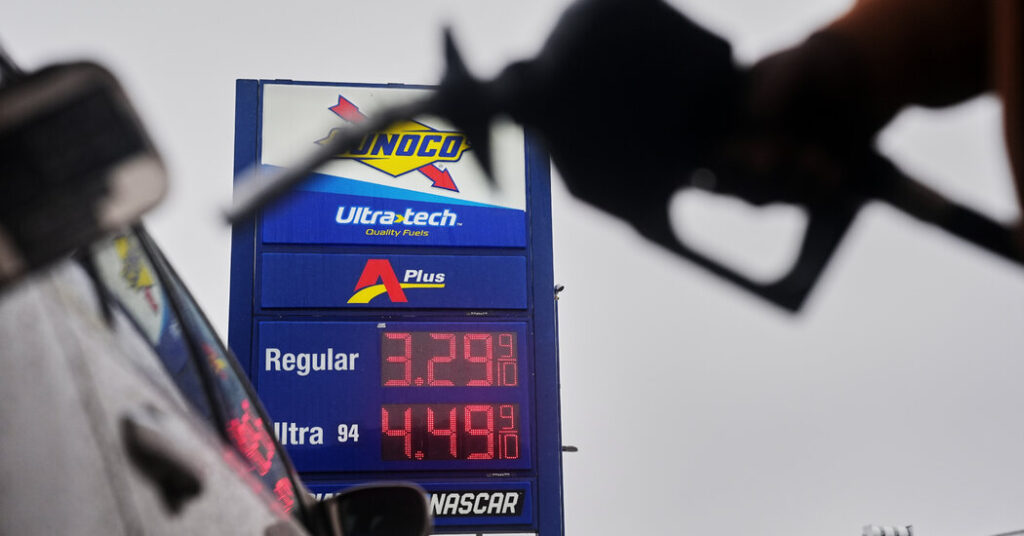
The price of gas in the United States reached an average of $3.41 per gallon on Saturday, a day after crude oil prices soared to levels not seen since 2023 as the spillover from the U.S.-Israeli attacks on Iran continued.
That gain means gasoline has jumped 14 percent in the past week, according to data from the AAA motor club. The prices recorded Saturday were the highest for gasoline since 2024. The suddenly rising energy costs — everything from jet fuel to diesel for trucks and tractors is more expensive — are rooted in supplies of crude oil coming from the Persian Gulf. The tankers that normally carry oil out of the region are not sailing, cutting the world off from about one-fifth of its oil supply.
That’s led to a surge in oil prices globally. By Friday, the U.S. crude benchmark, called West Texas Intermediate, had climbed more than 35 percent for the week, to settle at $90.90 a barrel, with much of that gain coming on Friday alone. The last time crude was trading at those levels, gasoline in the United States was above $3.80 a gallon, the data from AAA shows.
There are already big variations in how much drivers pay. Though oil prices make up the largest share of the cost of gasoline — about 60 percent — taxes, refining margins, and distribution costs can raise prices further. Drivers in California, for example, paid an average of $5.08 a gallon on Saturday, the highest in the country, while those in Kansas paid $2.90, the lowest.
Prices at the pump could steady once oil channels reopen, but the impact on American wallets could extend beyond that time.
“Even if it’s a short-term increase in prices and in two to three months we go back to where we were, you still significantly squeeze people’s budgets, and you significantly impacted the economy,” said Wayne Winegarden, an economist at Pacific Research Institute, a think tank. “That will have long-term implications.”
In an interview on Thursday with Reuters, President Trump suggested that the military operation in Iran was his priority and that he was willing to tolerate a rise in prices. “They’ll drop very rapidly when this is over, and if they rise, they rise, but this is far more important than having gasoline prices go up a little bit,” he said.
Energy experts generally say presidents have little control over the price of oil, but the United States does have its Strategic Petroleum Reserve, which has a storage capacity of 714 million barrels, to turn to in case of shortages. In 2022, as gas prices spiked after Russia’s invasion of Ukraine, President Joseph R. Biden Jr. released millions of barrels from the stockpile to level out commodity prices.
But if any effect is felt, it would likely only be temporary, and the reserve was not designed to be an economic cushion.
If the United States “is being impacted and we don’t have supplies, and the military needs oil, or the government, that’s the purpose of the Strategic Petroleum Reserve, for those types of kind of emergency conditions,” Mr. Winegarden said. “If its purpose is to ameliorate market trends, it’s just insufficient to that job.”
Emmett Lindner is a business reporter for The Times.
The post Gas Prices Continue to Surge in U.S., Rising 14% in a Week appeared first on New York Times.