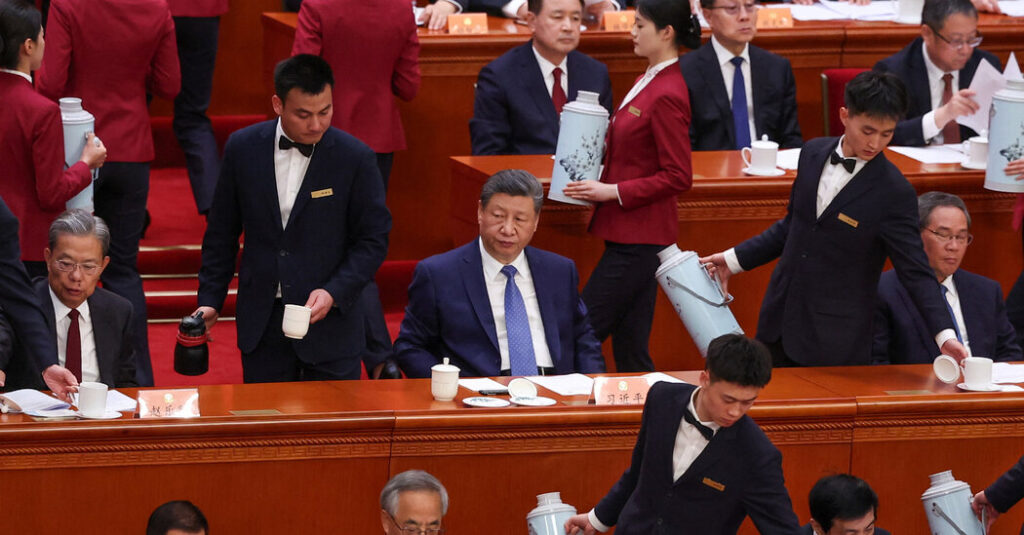
The sudden and furious attacks by U.S. and Israeli forces on Iran this past week, including the killing of the country’s supreme leader, are confirming Xi Jinping’s worldview that hard power is king.
For years, Mr. Xi, China’s top leader, has warned his country about American military hostility and directed his generals to build a world-class army, or what he called a “Great Wall of Steel,” strong enough to deter the United States and ensure peace on Beijing’s terms.
“It is necessary to speak to invaders in the language they know,” Mr. Xi once said. “That is, a war must be fought to deter invasion, and a victory is needed to win peace and respect.”
Mr. Xi’s more than decade-long pursuit of the power to fight fire with fire is now given added urgencybecause of President Trump’s unapologetic use of military force, which is threatening governments and disrupting a global order that China increasingly sees itself as eventually leading.
While Mr. Xi and Mr. Trump are set to meet in several weeks in Beijing to extend a fragile truce after a punishing trade war last year, the specter of brute American force taking down sovereign leaders like Iran’s Ayatollah Ali Khamenei and capturing others like President Nicolás Maduro of Venezuela remains unsettling for China. Both Ayatollah Khamenei and Mr. Maduro were strategic partners to Beijing.
Chinese analysts and officials do not believe the United States would target Mr. Xi in the same way, given China’s status as a nuclear power. But Mr. Trump’s embrace of war as a tool to assert American dominance has nonetheless reaffirmed Beijing’s view that the United States remains China’s most enduring threat.
One influential Chinese political scientist, Zheng Yongnian at the Chinese University of Hong Kong’s campus in Shenzhen, highlighted perceptions in China that the United States was using Israel as a springboard to go to war with Iran. As such, he said, China must prevent geopolitical rivals like Japan and the Philippines — both treaty allies of the United States — from becoming the “Israel of East Asia” and the “Israel of Southeast Asia.”
“We must avoid these nations being led by the nose by the United States to achieve their own objectives,” Mr. Zheng told The Beijing News.
Other analysts, like Shen Dingli, an international relations expert based in Shanghai, said the demonstration of American military might was forcing China to take a “sober look at the balance of power.”
“Beijing now sees more clearly the extent of American capabilities,” Mr. Shen said.
China is watching the conflict not unlike the way it did during the 1991 Persian Gulf War, when the powerful display of advanced U.S. military weaponry was a wake-up call to modernize the People’s Liberation Army.
Already, China’s military posted a graphic on social media this week listing five lessons from the U.S.-Israeli strikes on Iran. Among them were the importance of “superior firepower,” echoing Mr. Xi’s mantra. It also listed the need for “self-reliance,” most likely a reference to China’s bid to reduce its dependence on other countries for critical inputs like energy and defense production.
Top of the list, however, was that China must guard against “the enemy within,” an apparent catchall to describe Beijing’s longstanding fear of foreign spying and any efforts to foment “color revolutions” to overthrow the government. Mr. Xi has built a ruthless security apparatus to guard against such threats, which can be real: Last month, the C.I.A. released a new video aimed at recruiting spies within China’s military, hoping to exploit a sweeping anti-corruption campaign by Mr. Xi that has purged numerous senior commanders.
One of the broadest takeaways being discussed in China is to not be lulled into a false sense of security by entering negotiations with Washington. That the first U.S. and Israeli bombs fell on Iran when the parties were still supposed to be in talks struck Beijing as duplicitous and an abuse of American power.
“The decision to strike while talks were underway conveys a disturbing precedent: Diplomacy is not a forum for sovereign equals but an instrument subject to the whims of the dominant power,” read an editorial in Chinese state media.
Under the Trump administration, Chinese analysts say, the United States has become more unpredictable and more dangerous, forcing China to be increasingly vigilant.
“The strategic takeaway for China is pretty simple,” said Song Zhongping, a former Chinese military officer who is now an independent commentator. “Don’t assume your adversaries will play by the rules. They may strike without warning, and they may do whatever it takes, ignoring both the rules of the game and the rules of war.”
That has implications for how Beijing assesses Washington’s sincerity at a time when Mr. Trump has signaled that he wants to be less confrontational with China. His administration recently delayed announcing a package of arms sales to Taiwan, the self-governed island claimed by Beijing. While that might appear like an olive branch, analysts said Mr. Xi would most likely remain skeptical and undeterred from his military buildup.
“From Beijing’s perspective, the United States may frame its actions as a pursuit of peace, but what it really offers is peace through domination or containment,” said Kirsten Asdal, who leads the China-focused consultancy firm Asdal Advisory Group. “Xi doesn’t want that for China. He wants peace through Chinese victory.”
To accomplish that, Mr. Xi has already created one of the world’s most formidable militaries, one buoyed by a giant navy and advanced weapons like stealth drones and hypersonic missiles that are designed to thwart U.S. attempts to come to Taiwan’s defense if China decides to invade.
China’s chokehold on the mining and processing of critical minerals used to manufacture a spectrum of modern technologies, from cellphones to precision-guided missiles, has also supercharged Beijing’s leverage in the world, getting Mr. Trump to back down on his tariffs.
And on Thursday, China’s national legislature released the country’s next five-year plan, which included pouring resources into artificial intelligence, quantum computing and other strategic technologies to further resist U.S. pressure.
Those efforts underscore the view in China that Mr. Xi and Mr. Trump speak the same language when it comes to valuing hard power, but that their means of achieving and wielding it are vastly different.
Beijing has used America’s military actions as a way to cast itself by contrast as a peaceful nation that champions global stability — despite ample evidence to the contrary, such as China’s aggressive military behavior in the Taiwan Strait and the South China Sea.
For China, “strength is for self-defense and stability, not expansion,” said Wang Dong, executive director of the Institute for Global Cooperation and Understanding at Peking University.
When the United States seeks strength, he continued, it does so with “disproportionate raw hard power” that ultimately cannot guarantee any of its goals, such as the emergence of a friendly and peaceful government in Iran.
“What we are witnessing,” Mr. Wang said, “is the last-ditch efforts of a fading U.S.-led order.”
Western analysts are more skeptical about China’s professed modesty, saying Beijing, too, is likely to decide that it needs a larger military presence overseas and will risk becoming engaged in foreign entanglements.
“China,” said Jude Blanchette, director of the RAND China Research Center, “will feel the same tractor beam that pulls all great powers toward building capabilities that can reach further from home.”
Ruoxin Zhang contributed research from Beijing.
David Pierson covers Chinese foreign policy and China’s economic and cultural engagement with the world. He has been a journalist for more than two decades.
The post For Xi, Trump’s Embrace of War Proves China Needs More Power appeared first on New York Times.