A week into the American-Israeli military campaign against Iran, Europe’s leaders remain united in their misgivings about an operation they never asked for. But the reality is, they are being dragged into it more by the day, and that is causing political and diplomatic headaches from London to Berlin.
The tensions are visible in the growing gap between the words of European leaders and the orders they are giving their military commanders to send warships, planes and other combat equipment into the Middle East.
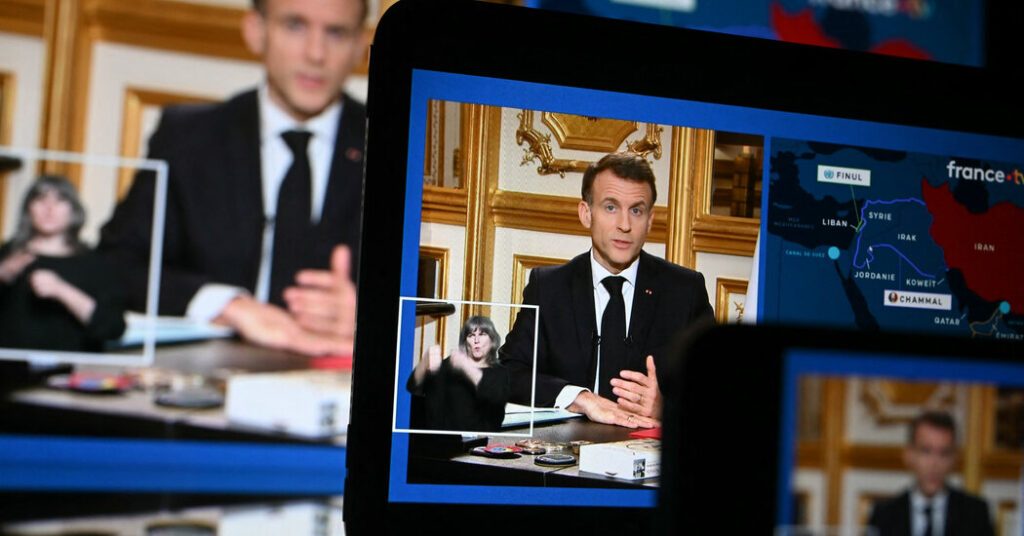
“We are not at war,” President Emmanuel Macron of France said on social media Thursday. “We don’t want to go to war,” Prime Minister Giorgia Meloni of Italy told broadcasters the same day. “We are not joining the U.S. and Israeli offensive strikes,” Prime Minister Keir Starmer of Britain said in Parliament on Monday.
Europe is caught in a deepening dilemma. On the one hand, its leaders need to protect their citizens stranded in the region, honor defense pacts with Arab states and, in some cases, allow the United States to use their military bases to avoid antagonizing President Trump.
On the other, they need to avoid too overt a show of support for American actions, to avert a military backlash from Iran as well as electoral consequences from their restive publics, which are anxious to avoid the quagmire of another Middle East war.
Mr. Macron, for example, was responding to a young woman on Instagram, who pleaded with him to steer clear of the war so she could live in peace. “I understand your concern,” he said, “but I want to be very clear, you are not going to war at all.”
Yet France scrambled Rafale fighter jets over the United Arab Emirates after a drone attack hit a French naval base in Abu Dhabi. And Mr. Macron has ordered the aircraft carrier Charles de Gaulle to the eastern Mediterranean Sea, where it could take part in a French-led effort to keep open strategic shipping lanes.
In Italy, Ms. Meloni agreed to deploy air-defense forces to Persian Gulf countries to defend them from Iranian missiles and drones. Italy has also allowed American planes to use its bases, though Ms. Meloni emphasized that it was for logistical support, not offensive operations.
Even that limited support has put Ms. Meloni in a tricky position with Italian voters. Mr. Trump, with whom she had carefully cultivated a relationship, is deeply unpopular in Italy. Her solicitous approach could now threaten her government, which faces a referendum on judicial reform later this month that it could lose.
The episode has also sowed doubts about how good the relationship between Ms. Meloni and Mr. Trump really is. He did not give Italy a heads-up about the attack, and there is little evidence Ms. Meloni has had any influence over him since then.
In Britain, Mr. Starmer is weathering criticism from allies, who worry that he is leaning too far in the direction of supporting the operation, and jibes from Mr. Trump, who said the prime minister was “no Winston Churchill” after Britain refused to let the United States use its bases for the initial assault on Iran. The chill has not lifted, even after Mr. Starmer dispatched Typhoon jets, ships and counter-drone systems.
It fell to the German chancellor, Friedrich Merz, to sum up Europe’s predicament after he sat next to Mr. Trump in the Oval Office on Tuesday, listening to the president’s bullish briefing on the military campaign.
“We don’t know if the plan will work and whether the military strikes from abroad will enable political change from within,” Mr. Merz said. “This plan is not without risk, and we too would have to bear its consequences.”
Despite expressing those doubts, Mr. Merz has faced a backlash at home, partly because he offered no defense when Mr. Trump criticized Mr. Starmer and Prime Minister Pedro Sánchez of Spain, both of whom had denied U.S. planes access to their countries’ bases. Mr. Merz said later that he stuck up for them over lunch with Mr. Trump.
For Europe’s leaders, there is no perfect way to thread the needle between assuaging Mr. Trump and limiting domestic outcry. A week into the war, Britain has now quietly provided the United States with significant military support. But that has failed to insulate Mr. Starmer from Mr. Trump’s ire, perhaps because the prime minister, likely wary of criticism at home, has not matched that private support with public endorsement.
“We’ve done far more than the Germans, though Merz got a shout-out in the Oval Office,” said Peter Ricketts, a former British national security adviser. “These leaders are all walking a tightrope, and the tightrope is even higher for Starmer.”
Mr. Ricketts said Europe’s leaders needed to be realistic about their ability to alter the trajectory of the war. Mr. Trump did not consult them about it beforehand, and in any event, he has not been consistent about its goals. Mr. Ricketts said the president was more likely to be guided by factors like oil prices, the financial markets and the sentiment within his own political base.
Sidelined in the main theater of combat, some countries are focusing on areas where they have particular interests. France has tried to keep Lebanon, a former French protectorate, from being drawn further into the war since the Iran-backed militant group Hezbollah fired rockets from there into Israel, drawing a furious Israeli retaliation.
On Thursday, France said it would supply Lebanese armed forces with armored transport vehicles to help combat Hezbollah. Mr. Macron raised the issue of Lebanon in a phone call with Mr. Trump and pushed for a truce in calls with regional leaders, including Prime Minister Benjamin Netanyahu of Israel.
“Everything must be done to prevent this country, which is close to France, from being dragged into war once again,” Mr. Macron said on social media.
France’s influence over Israel, analysts said, is hardly greater than that over the United States. But they said that should not stop Mr. Macron and other European leaders from voicing their views about the direction of the military campaign, even if that causes tension with Mr. Trump.
“They need to do that because they’re elected politicians,” said Mark Leonard, director of the European Council on Foreign Relations, a research group based in London. “Pretending that you have no control over things is not something that will go over well with the European public. They’re already restive and frustrated.”
While European leaders had little voice at the beginning of the war, analysts said they may feel more emboldened as it goes on. That is because Europe would be more directly affected than the United States by the fallout from a splintered Iran.
“If you had real collapse, fragmentation, refugee flows from Iran, that would have a huge impact on Europe,” said Thomas Wright, a senior fellow at the Brookings Institution who was senior director for strategic planning at the National Security Council during the Biden administration. “Will they engage with the administration to heighten Trump’s awareness of that scenario, and to avoid it?”
Jim Tankersley contributed reporting from Berlin and Daphné Anglès from Paris.
Mark Landler is the Paris bureau chief of The Times, covering France, as well as American foreign policy in Europe and the Middle East. He has been a journalist for more than three decades.
The post Europe Didn’t Want War With Iran. But So Far, It Can’t Stay Out of It. appeared first on New York Times.