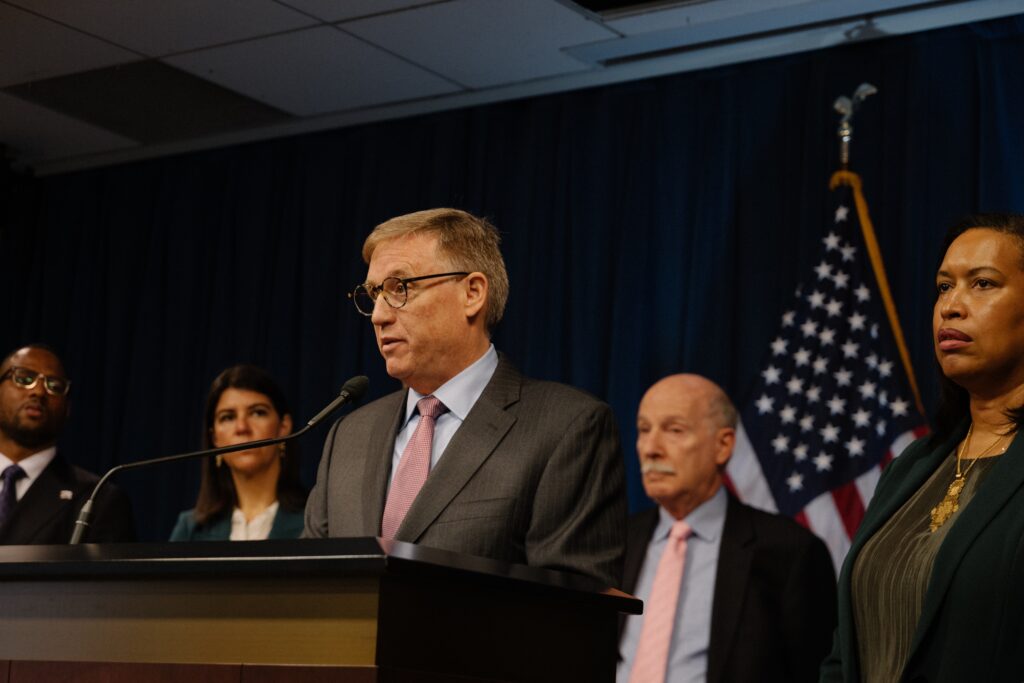
A political fight is brewing among D.C. leaders over the fate of $180 million in the city budget weeks after Congress voted to block changes to the local tax policy and as Mayor Muriel E. Bowser (D) prepares her spending proposal.
The city’s attorney general has said federal lawmakers’ attempt to force D.C. to align with President Donald Trump’s tax plan was legally toothless. And on Wednesday, chief tax collector Glen Lee also said that D.C.’s tax season will proceed uninterrupted, as if the congressional action had never happened.
Still, there was a catch: While Lee is keeping D.C.’s tax policy divorced from Trump’s One Big Beautiful Bill, he decided he will not allow the city to spend the roughly $180 million in revenue that lawmakers were expecting to gain from opting out of various deductions within it — seeing it as too risky in part because of possible litigation.
D.C. Council Chairman Phil Mendelson (D) initially expressed relief that tax season would proceed as normal in a brief and polite statement on social media. “I appreciate that the CFO has brought certainty for District taxpayers,” he said.
But in an interview, Mendelson, who in the past week accused Lee of “hoarding cash,” was still harboring resentment toward his decision to block the council from spending the tax revenue gained by decoupling from the Trump plan. He said he planned to do something about it — but declined to say exactly what.
“As far as I’m concerned, the issue of Glen locking the money up is something that we will deal with,” Mendelson told The Washington Post. “I have no intention of leaving money unnecessarily on the table.”
The vague threat sets up a battle likely to play out during D.C.’s upcoming budget season. And it means Lee, despite being a mild-mannered bureaucrat who takes pains to insulate himself from political headwinds, could face political pressure to release the funds from multiple corners, including lawmakers and advocates for social services. On the other side, Republicans in Congress and other critics of the decision to break with Trump’s tax policy could take further action against the city.
Still, it’s unclear if there is anything that Mendelson, or Bowser, could do to change Lee’s mind.
Lee declined an interview request through a spokesman. A spokeswoman for Bowser — who was displeased with Lee last week as he signaled he would withhold the funds — said the administration was still reviewing the matter and working on a response to Lee.
The D.C. Council in November voted on emergency and temporary legislation to decouple the local tax code from Trump’s federal tax bill in an effort to free up hundreds of millions in tax dollars — some of which lawmakers opted to direct toward new tax breaks for lower-income working families, including a local child tax credit and an expanded earned income tax credit.
Council member Zachary Parker (D-Ward 5), who championed the local child tax credit last year, said that because of ongoing budget uncertainty, he would have to fight to get other funding for the proposal. Meanwhile, the CFO’s office said the earned income tax credit would remain funded this fiscal year using $17 million gained from the November tax bill.
Parker declined to opine much on Lee’s decision to withhold the $180 million, saying the mayor and Mendelson had made their feelings clear. But he said, “I think that’s going to be a conversation and fight we have this budget season.”
The District was not alone in divorcing from the Trump bill — a dozen states did so in some form. But the city, lacking statehood, was in a different position because Congress has the power to block the council’s legislation. Republican lawmakers, who have sought to intervene in other D.C. policies, passed a disapproval resolution against the tax changes in February.
Lee had warned that the congressional action could force him to suspend tax filing season to change the rules for D.C. taxpayers midstream. Confronting the ensuing administrative chaos, he requested a legal opinion from city Attorney General Brian Schwalb (D).
In the Feb. 24 opinion, Schwalb said Congress missed a critical deadline to block the city’s legislation, and that federal lawmakers also failed to make their disapproval resolution apply retroactively. He told Lee that the city should proceed with its tax season normally.
Days later, Lee released a revenue estimate that did not include any of the revenue that city lawmakers expected to gain from the tax decoupling, despite Schwalb’s opinion that the policy was unaffected by Congress.
Bowser sought “prompt clarification” from Lee, as the revenue estimate is a critical document for the mayor’s approximately $22 billion budget proposal. She thought that if Lee agreed with the attorney general’s opinion, it would allow her to use the $180 million on city programs and services.
In a letter on Wednesday, Lee stood firm. He could not make the money available to spend, he said.
“There is considerable risk and uncertainty, from litigation or other actions, to the revenues associated with the District’s decoupling legislation,” he wrote.
The decision drew mixed reactions from outside the Wilson Building.
DC Fiscal Policy Institute executive director Erica Williams called it “great news” that tax season would not be delayed. But she said she hoped D.C. officials could agree to spend the $180 million. “It seems this is a moment where the Mayor, Attorney General, CFO, and Council could come together and get on the same page about what has to happen to end the manufactured crisis created by Congress,” she said in a statement.
Ed Lazere, a longtime advocate in D.C.’s progressive circles and director of legislative advocacy at the United Planning Organization, said he found the CFO’s move inexplicable. He said the money, while a small fraction of D.C.’s budget, could still do a lot, such as bring back health insurance for many of the tens of thousands of residents who saw cuts to their coverage this year.
“To basically allow us to raise this revenue and not spend it at a time when the city’s finances are tight and we’ve had the worst safety net cuts in a generation — it doesn’t make any fiscal sense, and it doesn’t make any budget sense and it doesn’t make any moral sense,” Lazere said.
Yesim Sayin, an economist serving as executive director of the D.C. Policy Center who previously worked in the CFO’s office, said she could understand why city officials might be angered to lose access to the money. The congressional resolution, and Lee’s decision to withhold the revenue, she said, ultimately “nullifies” the D.C. Council’s intent to use the tax revenue to soften the budget blow.
Still, she said she could also understand Lee’s prudence. He appeared to be withholding the revenue out of an abundance of caution in case the District is sued by a taxpayer or other Hill-aligned entity over its defiance of Congress — which could add more uncertainty to whether the city could ultimately spend the $180 million, she said. The CFO’s foremost priority is to balance the budget, she said: “That’s sacrosanct.”
“The CFO of this city has a very clear charter,” she said. “It’s to shepherd the finances and reduce the fiscal risks as much as possible. And if that is the guiding principle, this decision fits squarely into that principle.”
Lee’s February revenue estimate also painted a gloomy picture of where he saw the District’s economy headed.
While he revised earlier predictions slightly to reflect higher individual income tax collections and projected wage increases, Lee said the city would probably enter a “moderate recession” this year, driven in large part by federal job losses that hit D.C. uniquely hard as “the most government-dependent economy in the United States.”
The city saw a net loss of nearly 29,000 jobs last year, Lee wrote, about 24,400 of which were a result of the Trump administration’s moves to slash the federal workforce. Changes in federal spending also had ripple effects: As government spending on federal contracts decreased, businesses in the city that were reliant on those contracts also suffered, Lee wrote.
The downward spiral is informing Bowser as she formulates her budget, due April 1 — her final proposal after deciding not to seek a fourth term. She warned the council last month that the city would need $1.1 billion more in revenue to keep programs and services running as they are right now.
The post D.C.’s most apolitical official is on the hot seat — with $180M on the line appeared first on Washington Post.