Each new week or month seems to bring a new “gate.” The recent Olympic Games opened with “crotchgate,” a pseudoscandal involving the suits worn by Norwegian skiers. Last year, a camera caught two middle-aged co-workers embracing at a concert in Massachusetts, giving the world Coldplaygate. There have also been Nipplegate and Slapgate, to say nothing of the fever dream that was Pizzagate.
But there is only one Watergate, the Nixon-era political scandal that has made the “-gate” suffix a widely recognized sign that something has gone wrong and that heads are probably going to roll. That maelstrom originated in 1972 at the Watergate Complex in Washington, when henchmen associated with the re-election campaign of former President Richard M. Nixon broke into the headquarters of the Democratic National Committee, setting off a chain of events that led to the most precipitous presidential downfall in American history.
Watergate — the political drama, the building, the ever-evolving meme — could soon have a brick-and-mortar museum in Washington, where national crisis has become an all-but-daily occurrence. At least the difficult work of branding has already been done for Keith M. Krom, a former corporate lawyer and the Watergate Museum’s founder.
When people hear the word “Watergate,” he said, “they may not understand what’s referenced or what the history is, but they know the name Watergate. People know something important happened. They just don’t know what that is. And that’s what we hope to answer.”
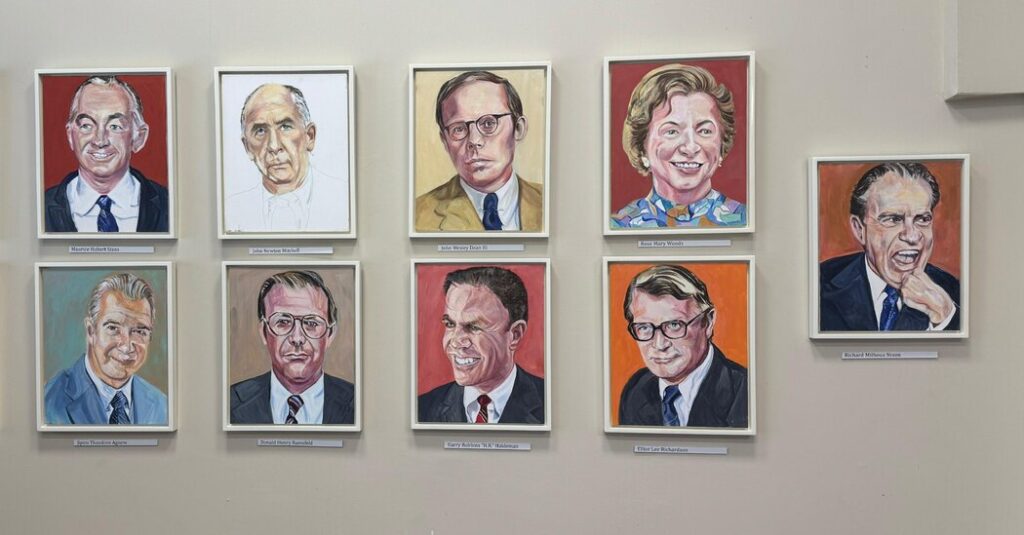
A pop-up version of the museum opened late last year in an empty commercial space in the Watergate’s underground shopping arcade, with an exhibition featuring 81 portraits. The depictions included the actor Paul Newman, whose political activism earned him a place on Nixon’s “Enemies List,” and Nixon himself, laughing like someone who knows that, in a few decades, his transgressions will look positively quaint.
Krom, 61, said that the permanent museum will not try to force any political narratives or views on visitors. Still, with much of Washington in thrall of a twice-impeached president frequently accused of retaliating against political opponents and acting outside the scope of the law, the connections are not exactly difficult to excavate.
“Watergate is a timeless metaphor for the need to continuously defend our Constitution,” said Laurie Munn, who painted the colorful and expressive works now on display. The portraits recall the intense physical scrutiny the painter Alice Neel applied to her subjects (Munn considered Neel a mentor and friend): the special prosecutor Archibald Cox Jr.’s double chin; the piercing blue eyes of John D. Ehrlichman, a top Nixon adviser.
But there is also, as in Andy Warhol’s art, an awareness of how completely celebrity has suffused American public life. Dick Cheney, then a little-known but fast-rising staff member in the administration, offers his trademark smirk, which would become a TV news mainstay 30 years later. Jane Fonda, also a Nixon “enemy,” glares from her famous 1970 mug shot after a Cleveland arrest.
Krom had planned to close the pop-up at the end of 2025 but has extended the show through April. He is also planning to install a new exhibit in the coming weeks, of courtroom sketches from the Watergate trial, as well as accompanying front pages from The New York Times and The Washington Post.
His goal is to raise a few million dollars for a permanent space for the museum in late spring or early summer, after a consultancy, the Design Minds — which has worked on the Museum of Jewish Heritage in Manhattan, multiple National Park Service sites and the presidential libraries of Dwight D. Eisenhower and Woodrow Wilson — completes a feasibility study.
“If done well, it could be a very good idea,” Julian E. Zelizer, a professor of political history at Princeton University, said of a permanent museum in the Watergate. (He is not involved with the project.) “Having a museum that focuses on this watershed moment, the specific story of the break-in and all that it entailed, could be a useful educational tool for visitors at a time that the country continues to wrestle with many of the same problems that were front and center in 1974.”
Munn, 78, is also planning to soon install a portrait of Representative Barbara Jordan of Texas, who delivered a famous speech on her faith in the U.S. Constitution in 1974. Ms. Jordan will be one of relatively few Black figures in the portrait series, along with Representative Shirley Chisholm of Brooklyn, another Nixon foe, and Frank Wills, the security guard who discovered the Democratic National Committee break-in. Munn painted the Jordan portrait while on a Turks and Caicos vacation.
Now a resident of Tarrytown, N.Y., Munn grew up in Orange County, a conservative stronghold in Southern California. “I saw portraits of Nixon hanging above mantels in my friends’ homes,” she said. She started painting serialized portraits after finding a discarded New Jersey high school yearbook while walking through Manhattan’s Chelsea neighborhood in 1980.
Munn eventually painted every member of that graduating class, 220 students, and has also completed a series of all the U.S. presidents, as well as their wives. “A series illustrates that an important historical event involves more than a single person,” she said.
Munn is not the first painter to find inspiration in Watergate. “Watergate Diptych,” a 1973 painting by Sylvia Sleigh in the collection of the Whitney Museum of American Art, shows two scenes from Watergate-related congressional hearings. Miles Burkholder Carpenter created “Water Gate,” which the Smithsonian American Art Museum now owns, in 1974. The intricate sculpture-as-toy, which includes moving parts, shows Nixon holding his tax returns, also a subject of scandal.
Then there’s the building itself, the most famous American project by the modernist Italian architect Luigi Moretti. Sinuous and solid, the complex occupies 10 acres and rises like a battlement on the banks of the Potomac. Completed in 1971, the Watergate, at 14 stories tall, towered over what was then still a low-slung waterfront. Some found it out of character and out of scale: “a common corruption of modernism masquerading as pretentious posh,” the New York Times architecture critic Ada Louise Huxtable wrote in 1973.
Krom would beg to differ. A native of Connecticut, he moved to Washington with his family in 2010. A self-described “political nerd,” he was instantly attracted to the famous complex on Virginia Avenue. “I was trying to convince my family that we should look at the Watergate,” he said. “It just wasn’t practical with the ages of our kids at the time.”
But then the kids left for college. After looking at 10 units in the Watergate, Krom and his wife happily settled on a duplex with river views.
With its six buildings, including offices, a hotel and three residential towers, the Watergate was to be a self-contained city, of the kind that were popular with postwar urbanists. The feeling of living in a giant concrete warren may be off-putting to some, but it delights Krom. “I love the architecture,” he said, adding that he finds a new attraction each time he walks around.
To him, the building and the scandal are inextricably linked. And the tourists he sees snapping photos in front of the Watergate Hotel, or pointing out the complex’s buildings, are a natural audience for his museum. He is currently eyeing ground-floor space in the office buildings.
First, of course, there is the question of money. Krom believes he needs to raise $3.5 million for the museum to take off. As a private institution, the Watergate Museum would not benefit from federal largess; but it also would not be subject to the intense pressure the Trump administration has applied to the Smithsonian Institution, which it has accused of being “woke.”
“It’s a serious endeavor,” said Timothy Naftali, a scholar at the School of International and Public Affairs at Columbia who designed the Watergate exhibition at the Nixon Presidential Library and Museum and is on an advisory board for Krom’s project. He envisions a place where people can get a “basic set of facts” about one of the most consequential episodes in American political history. “Our public institutions should be the first stop.” But, Naftali added, “if they’re failing us, then private museums can supplement.”
Krom intends to mount exhibitions by teaming up with presidential libraries and Washington institutions like the National Archives. There could be some acknowledgment of other “gates,” too. If there’s a restaurant on site, it will not be serving the pistachio-forward Watergate salad, Krom said. But it may pour Nixon’s beloved martinis.
Krom will have guidance from Richard Ben-Veniste and Jill Wine-Banks, both of whom were Watergate prosecutors.
“Why do we need a Holocaust museum? So that it doesn’t happen again,” Wine-Banks said. The lone female lawyer on the Watergate prosecution team, she skillfully cross-examined Nixon’s secretary Rose Mary Woods. Many news reports focused not on Wine-Banks’s legal skills but her looks, leading to the nickname “miniskirt prosecutor.” But though much has changed, much hasn’t. And for all the “-gates” that modern culture throws our way, there’s nothing quite like the original article.
“It’s still a good story,” Wine-Banks said.
The post A Washington Museum Zeros In on Presidential Scandal. From 50 Years Ago. appeared first on New York Times.