On Friday afternoon, an eclectic mix of athletes, conference commissioners, television executives and former football coaches are scheduled to file into the White House, summoned to help President Donald Trump tackle what he views as a pressing national problem.
Not the conflict flaring in Iran, the turmoil inside the Department of Homeland Security or the looming midterm elections. Trump is expected to convene golf star Tiger Woods, leaders from the Power Four conferences, media executives from ESPN and Fox and high-profile former coaches to probe what ails college sports — and how to fix it.
The gathering, billed as the “College Sports Roundtable,” comes at a moment of profound uncertainty for the NCAA and its members. Court rulings have weakened the association’s authority; name, image and likeness (NIL) deals have transformed recruiting and compensation; and schools are bracing for a revenue-sharing era that could further professionalize the college game.
Despite years of congressional hearings, lawmakers have yet to establish a national framework to stabilize the system. And while some fans revel in their teams’ sudden rise — Indiana University’s college football championship provides a prime example — many fret about the end of traditional conferences, growing professionalization and problems facing smaller sports.
It is unclear how substantive the session will be or whether it produces concrete proposals.
Not everyone with a stake in the future of college sports will be in the room. Given the participants, the discussion is likely to focus primarily on major football programs, with Olympic sports and women’s athletics unlikely to command much attention, said Robert Kelchen, a professor of higher education policy at the University of Tennessee.
But the White House placing its fingerprints on the future of college sports carries weight in itself.
“It’s always different when it involves the White House,” Kelchen said.
White House officials said Thursday that Trump, who issued an executive order last year intended to protect college sports, had been urged to get involved by outside groups worried about the direction of college sports and clamoring for a solution.
“Part of leadership is thinking outside the box and having innovative methods and getting involved to try to solve things that no one else seems to be able to,” said one senior White House official, speaking on the condition of anonymity to discuss internal deliberations. The official noted Theodore Roosevelt’s efforts to encourage college football teams in 1905 to adopt helmets and new safety rules — a move widely hailed for protecting players and helping save the sport.
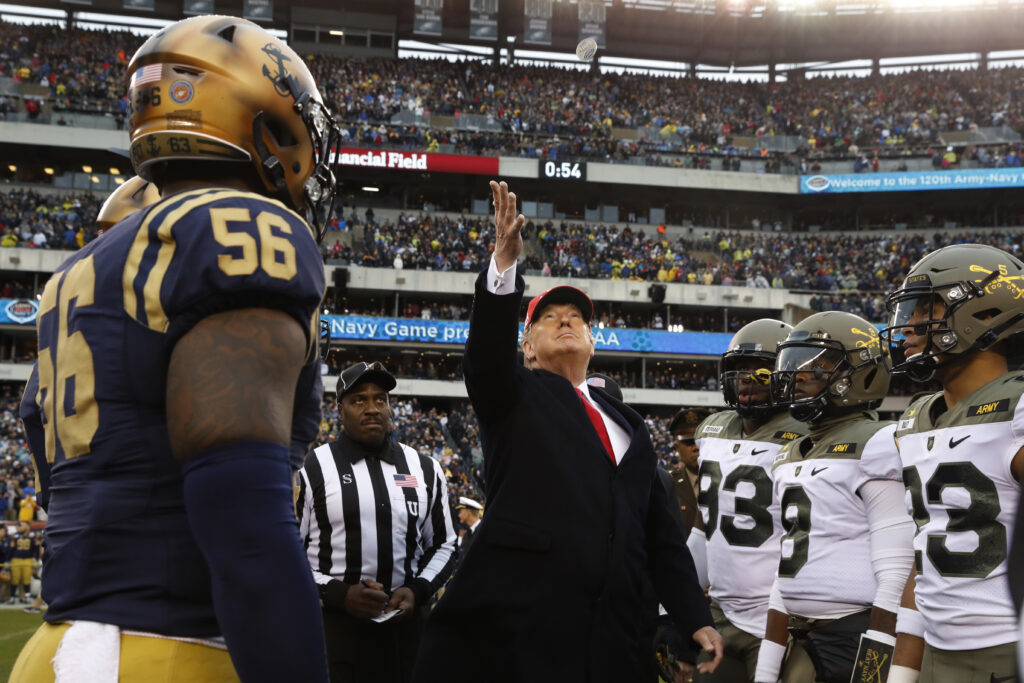
For Trump, this is familiar territory. Most presidents treat sports as ceremony, but he has treated it as leverage — weighing in on league rules and coaching hires, stepping into billion-dollar negotiations involving Saudi capital, floating executive action to protect traditional games and using championship teams as symbols of national momentum.
Supporters say the focus on college athletics is both politically and substantively strategic. Harrison Fields, who served as White House principal deputy press secretary last year, said Trump’s focus on college sports spoke to a “unique and growing segment of his coalition” — including the many Americans trying to make sense of the NIL deals that are reshaping college football and basketball, in particular.
“This is another 80/20 issue the President is leveraging to his advantage, using the weight of the presidency to pursue change through the levers of the administration,” Fields said.
Trump supports congressional efforts to establish a national framework for NIL, Fields added, saying that would be “a piece of low-hanging fruit for bipartisan cooperation and a meaningful win for America’s student-athletes.”
All presidents mix sports and politics— from celebrating championship teams to attending high-profile events, White House historians said. Trump stands out for his efforts to cultivate athletes, intercede in sporting disputes and even weigh in on teams’ personnel moves. The timing, however, is puzzling, some said.
“Presidents have conducted other business even when wars are happening. But this promotion of a college sports summit certainly doesn’t seem a priority at a fraught moment when the Middle East is in an explosive situation—and U.S. actions are at the center of this situation,” Julian Zelizer, a professor of political history at Princeton University. “Nor is college sports the kind of priority domestic issue, like inflation, that matters most to voters right now.”
Friday’s meeting is expected to bring together some of the most powerful figures in the college sports ecosystem. Invitations were sent to more than three dozen figures from across the sports world, including the commissioners of the ACC, Big Ten, Big 12 and SEC — the conferences that control the bulk of football revenue — along with university leaders and media executives from ESPN and Fox Sports, whose broadcast contracts underpin the sport’s financial structure.
The guest list underscores where the economic power in college sports resides — football-heavy conferences, television partners and brand-name programs. At issue is not simply NIL — though that marketplace has upended recruiting and compensation — but whether the current model is sustainable.
No current athletes are expected to attend, nor are formal representatives of athlete-led NIL collectives. Casey Floyd, co-founder of NOCAP Sports, a sports marketing company that works on NIL matters for athletes, schools and business, called the entire exercise “political theater.”
“There’s no experts in the room. There’s no athletes,” Floyd said. “You basically have a bunch of celebrities and former coaches and athletes that are talking about their opinion without any factual or legal basis.”
Floyd said athletes — whom he described as “the labor force underwriting the whole system” — need independent representation and a formal seat at the table.
White House officials said they were realistic about Friday’s session, which they framed as a jumping-off point for future deliberations.
If there is a through line in Trump’s expanding involvement in sports, it is his self-image as a dealmaker uniquely positioned to cut through stalemate — a self-stylized negotiator-in-chief.
Last year, as negotiations dragged on between the PGA Tour and Saudi Arabia’s Public Investment Fund over a potential partnership that could reunify men’s professional golf, Trump hosted key figures at the White House for hours of talks.
Trump had expressed confidence in his ability to close the gap, saying on a podcast that it would take him “the better part of 15 minutes” to get a deal done.
No deal has been consummated, and it’s not clear whether Trump is still playing a role in discussions between the two sides.
Trump has long viewed global sporting events as intertwined with his presidential legacy, particularly with this summer’s men’s World Cup and the 2028 Los Angeles Olympics on the horizon.
The gestures have been both symbolic and substantive. Trump became the first sitting U.S. president to attend a Super Bowl and has appeared at the Daytona 500 and UFC events. He plans to stage a UFC card on White House grounds and an IndyCar race on the National Mall as part of the nation’s 250th anniversary celebration.
He misses few opportunities to tie together sports drama and presidential theater. During his State of the Union address, Trump welcomed the Olympic gold-winning U.S. men’s hockey team to the House chamber, introducing them as proof that “our country is winning again.”
And Thursday, Lionel Messi and members of Major League Soccer champion Inter Miami visited the White House, another high-profile crossover between global sport and presidential ceremony.
The sports world has elevated Trump, too. He has forged a visible partnership with FIFA President Gianni Infantino, whose organization is preparing to stage the men’s World Cup in North America. At the World Cup draw in December, Infantino presented Trump with FIFA’s inaugural “peace” award — a consolation for missing out on a Nobel Peace Prize.
As Friday’s roundtable convenes under the White House seal, it serves as another reminder that in Trump’s presidency, sports is not merely spectacle but a recurring arena for attention, influence and legacy-building.
The post White House seeks to put a Trump-style stamp on college sports appeared first on Washington Post.