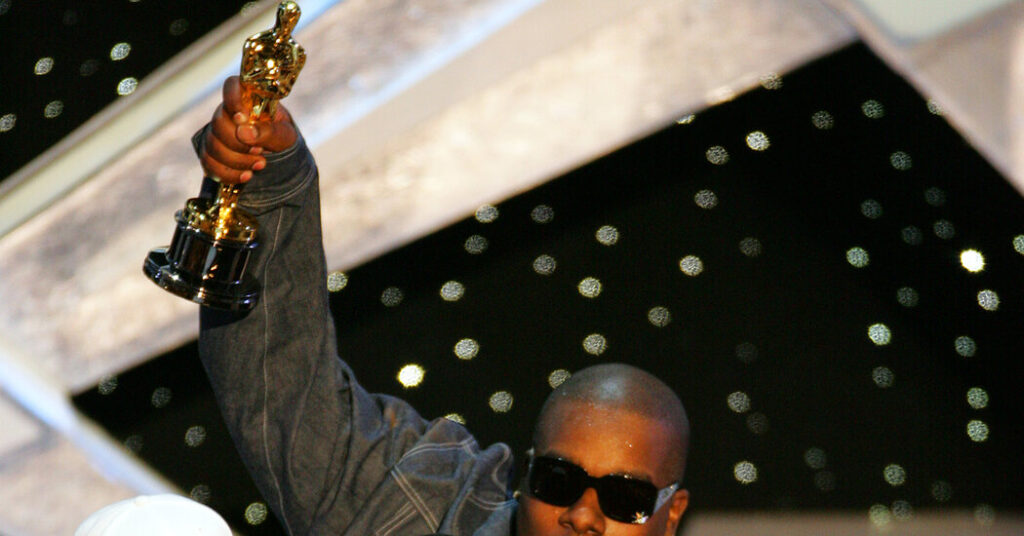
Three 6 Mafia are still partying 20 years later.
It was the 2006 Oscars ceremony when the group went from underground horrorcore Memphis act to winners on one of the biggest stages in entertainment, becoming the first hip-hop group to score an Academy Award for best original song. Their victory for “It’s Hard Out Here for a Pimp” from the movie “Hustle & Flow” endures as one of the most memorable moments in modern Oscars history.
The award, traditionally reserved for orchestral ballads and sanitized anthems, served as a coronation for hip-hop and shined an international spotlight on Memphis’s vibrant hip-hop scene, with the group’s bass-heavy production style still reverberating in the music that tops today’s charts and streaming playlists.
“It announced that hip-hop is in the building,” said Juicy J, a founding member of the group. “It’s not just the music. It’s the acting. It’s the directing. It’s the producing. It gave a lot of hope for hip-hop. Three 6 Mafia went into the Oscars and gave the whole hip-hop community hope that you can do other things outside of the music.”
Before its Oscars victory, Three 6 Mafia wasn’t obscure but it was far from a household name. That’s why DJ Paul, another founding member — he and Juicy J have been friends since they were teenagers — decided to name the group’s 2005 album, “Most Known Unknown.” The group had regional success, but still had not burst through the mainstream despite 15 years of work. Around that time, the filmmaker Craig Brewer decided to make a movie based on Memphis’s underground hip-hop scene. John Singleton, by then a noted director, signed on as a producer to help Brewer get his film made.
Singleton had worked with Three 6 Mafia for the soundtrack of the 2001 drama “Baby Boy.” He reached out again for “Hustle & Flow,” and explained the concept of the movie.
“The first thing after they translated it to me was the name of the song needs to be ‘It’s Hard Out Here for a Pimp,’” said Frayser Boy, who was affiliated with the group. “And John snapped his finger and he loved the title just right off the bat. And once I realized he loved the title, I just wrote around that and everything he was saying the movie was about and put it in both verses. It took me about 45 minutes to write the whole song.”
After scoring a nomination, the group agreed to perform the song at the ceremony. There were some questions as to how it would go over. “To wit, will the academy have enough seat-fillers on hand to cover the exodus of all of the senior members in the room who will be fleeing the first-ever rap performance at the Oscars?” David Carr of The New York Times wrote in the lead-up to the event. “And just how will the song — the title is tame compared with some of the lyrics — be modified to be ready for prime time?”
The group was used to performing after consuming alcohol. This time, they agreed to go out sober, but DJ Paul proposed doing a shot of vodka he had taken from the hotel. Juicy J took a swig in between doing push-ups to get ready: “I was nervous as hell. I ain’t going to lie.”
DJ Paul, Juicy J, Crunchy Black, a member of the group at the time, and the actress Taraji P. Henson, who starred in the film, performed at the Kodak Theatre on a set transformed into a street backdrop with neon lights, graffiti and a trash-can fire. Lyrics were lightly altered — “hoes” became “girls,” for instance.
After the performance — which was greeted with energized applause and no noticeable pockets of empty seats — the members were ushered to the side of the stage as presenting for best original song immediately followed. Three 6 Mafia’s competition was “In the Deep” from the movie “Crash” by Kathleen York and Michael Becker and Dolly Parton’s “Travelin’ Thru” from “Transamerica.” Queen Latifah, a hip-hop pioneer and the award’s presenter, could barely bottle her glee when she gasped, “Oh my God,” before announcing Three 6 Mafia had won.
“It just felt that somehow Memphis had infiltrated Hollywood,” said Brewer, who was watching from the audience. “It just felt like the outsiders, the little guys got a win,” he added. “And it even meant more to Memphis. We were up against Dolly Parton that year. She was who we all adore, but there’s always a little bit of a Memphis-Nashville rivalry.”
DJ Paul, Juicy J, Frayser Boy, Crunchy Black and Henson accepted the award, forgetting the names of the people that their management had instructed them to thank in the rush of excitement. During the acceptance speech, DJ Paul memorably thanked George Clooney, who he had sat next to at an Oscars luncheon. DJ Paul had told Clooney that his own tattoos were inspired by the ones his character had in “From Dusk Till Dawn.”
The rest of the night continued as a triumph for the group. At one point, DJ Paul checked his phone to find hundreds of missed messages. He called his mother back as he got onto an elevator to attend the Governor’s Ball and noticed John Travolta next to him. He passed his phone to his mother, a huge Travolta fan.
At another party later, the group encountered Salma Hayek. Their excitement deflated, however, when the actress voiced her disapproval over their shiny jewelry and asked if they had thought about those who had suffered to excavate it. “She got mad at me,” DJ Paul said. “She got mad at all of us.”
There was one party Three 6 Mafia could not get into. Singleton was friends with Prince and drove the group to the Purple One’s home, where he was hosting his annual Oscar night party.
A bodyguard outside Prince’s home informed them that Prince had denied entry to the group.
“He actually said no,” Juicy J said. “That’s cool. I mean it was messed up we didn’t get into his party, but I was just amazed Prince even said anything.”
Later, when the group returned home, they found a message from Parton saying that she was happy the award had still made its way back to Tennessee.
The Three 6 Mafia victory was not the first time hip-hop had won at the Academy Awards. Eminem won best original song in 2003 for “Lose Yourself.” But he skipped the awards show, whereas Three 6 Mafia’s presence was felt throughout the ceremony. “I think it’s just got a little easier out there for a pimp,” the host Jon Stewart said after Three 6 Mafia’s win.
In the years since, the Oscars have made more room for hip-hop: Common and John Legend won best original song for “Glory” from the film “Selma.” And the Roots’ Questlove won best documentary feature in 2022 for “Summer of Soul (…Or, When the Revolution Could Not Be Televised).”
Juicy J found new levels of fame in the early 2010s with anthems like “Bandz a Make Her Dance” and a collaboration with Katy Perry. DJ Paul has continued producing for stars like Drake, won multiple Grammys, has become a pioneer in the phonk genre and is set to release his first solo album in seven years on a very appropriate date, March 6.
“I’m still partying,” Juicy J said.
“It was a blessing,” DJ Paul said of that night 20 years ago. “I can’t think of where life would be right now without it.”
Jonathan Abrams is a Times reporter who writes about the intersections of sports and culture and the changing cultural scenes in the South.
The post When Hip-Hop’s Wildest Oscar Win Brought Memphis to Hollywood appeared first on New York Times.