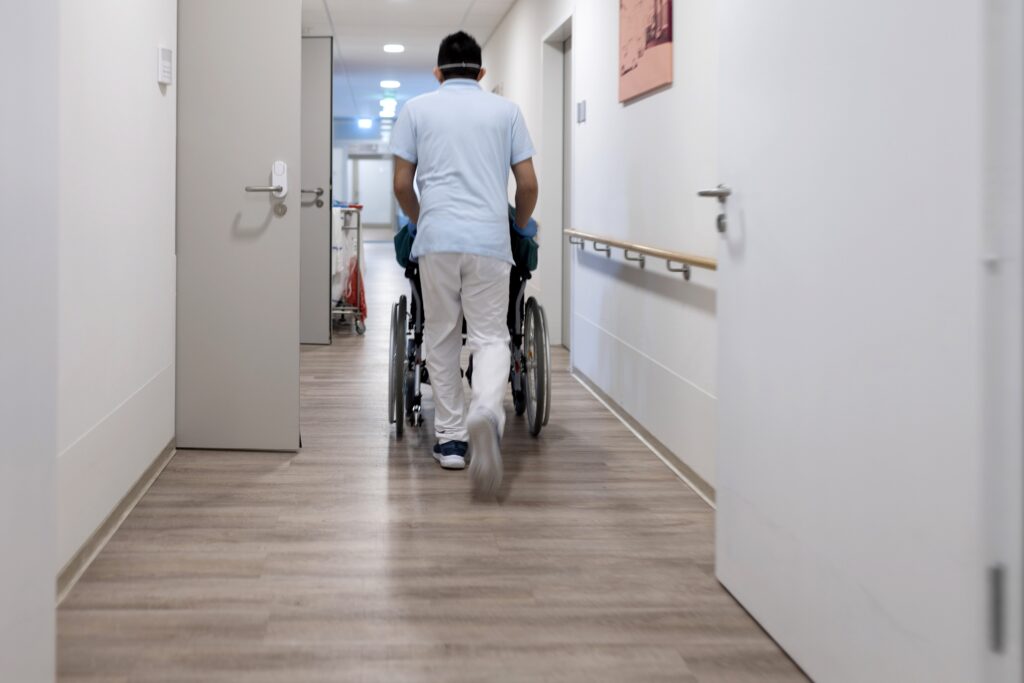
A man upset over the death of his wife kept a blanket over his head in his Minnesota nursing home. Staff gave him a powerful antipsychotic drug. Another man, in a Philadelphia facility, yelled during two evening shifts. He also got an antipsychotic.
And in Michigan, a man was left sitting in his own waste for hours because he was so overmedicated with one of the drugs, he couldn’t hit a call button to summon staff for help.
That sampling of alleged abuses reported in a Minnesota state inspection report, a Justice Department lawsuit and a complaint to a Michigan state ombudsman help explain why the federal government for the last decade has penalized nursing homes over the use of powerful antipsychotic drugs to control the behavior of residents with dementia.
But now, President Donald Trump’s administration is reviewing whether to loosen restrictions on these medications, saying it wants to recognize benefits when the drugs are used appropriately. The move comes after a sustained lobbying campaign by groups backed by the manufacturers of antipsychotics.
Such “chemical restraints” render residents docile, often to the point of deep sedation, lightening the load on nursing home operators. In some cases the drugs can benefit patients, but they increase risk of falls, strokes and death, and their overuse is seen as inhumane.
Industry-backed groups contend nursing homes are being unfairly targeted for legitimate use of the drugs. Under the current system, all antipsychotic use lowers an individual facility’s star ratings on the government’s Nursing Home Care Compare website. Greater numbers of patients taking the drugs can lead to a worse rating.
The administration’s latest move reignites a debate that experts say can be confusing for the families, who often are desperate for solutions when their elderly parent is prone to violent outbursts.
“We don’t want to go backwards in how we treat residents in nursing homes,” said Sam Brooks, public policy director at the advocacy group National Consumer Voice for Quality Long-Term Care. “What we have often seen is to make up for the inadequate staffing, some facilities use drugging, chemical restraints.”
Most antipsychotics — such as the generic versions of Seroquel, Risperdal and Zyprexa, which are commonly used in nursing homes — are intended for people with mental health conditions such as schizophrenia, bipolar disorder and major depression.
For families and nursing home operators, however, there are sometimes no alternatives for a resident who has not been diagnosed with these conditions but is violent and could harm staff, other residents and themselves. Doctors prescribe them for people with dementia under guidelines for “off-label” prescribing, which is common in health care when drugs show benefit for unapproved uses.
Without the drugs, these patients are put in a precarious position and run the risk of being removed from their nursing home, said Sue Peschin, chief executive of the Alliance for Aging Research, one of the two main lobbying groups leading a coalition seeking to eliminate or modify the antipsychotic reporting measure.
The government’s star-rating system has “placed relentless downward pressure on facilities to continue to reduce antipsychotic use … and some patients are going to go without the specific medication that they need,” Peschin said.
Black-box warnings
Antipsychotics carry “black-box” warnings from the Food and Drug Administration stating they should not be used on elderly patients with dementia-related psychosis because of the health risks. Critical studies and reports have found the mental health drugs are nonetheless widely used to help manage disruptive behavior among people with Alzheimer’s disease and other forms of dementia.
Two years ago — in a move that drew criticismfrom consumer advocates — the FDA complicated the picture when it approved use of an antipsychotic drug, Rexulti, to treat agitation in patients with Alzheimer’s disease. Agitation associated with Alzheimer’s dementia (AAD) and dementia-related psychosis are different conditions. The clinical trial that showed benefit was limited to Alzheimer’s patients with agitation; Rexulti also has a black-box warning stating it should not be used on dementia patients with psychosis.
Rexulti’s manufacturer, Otsuka, which partners with another drug company, Lundbeck, in co-marketing the pill, is among companies that financially support the groups seeking to relax the nursing home rating rules. Asked if it supports a rule change, Otsuka said only that health care providers and patients “should have access to appropriate medications for their conditions, so that they may make informed treatment choices.”
Amy Stewart, chief nursing officer for the American Association of Post-Acute Care Nursing, said her experience with her own father convinced her antipsychotics are important for certain dementia cases. She appears in a video on the Alliance for Aging Research website that was created with support from Otsuka, Rexulti’s manufacturer.
Her father’s Alzheimer’s caused him to berate and lunge toward her son, who was about 12 at the time, because he was wearing his cap backward, she said in an interview. A retired truck driver, he eventually moved into a Michigan nursing home but was repeatedly hospitalized after bouts of aggression when his antipsychotic medications were reduced. She feared he would be evicted without the medication.
“This is what my dad wanted: to be on these meds,” she said. “He did not want to beat people up. He would have been mortified to know that he did these things.”
In nonbinding reports last month accompanying a spending bill, the Senate and the House instructed the Centers for Medicare and Medicaid Services to distinguish between appropriate and inappropriate antipsychotic prescribing in nursing homes. CMS, led by Administrator Mehmet Oz, said in an email that the agency is reexamining the policy “with the goal of supporting clinically indicated use while continuing to discourage inappropriate prescribing.”
It added that the work began before Congress requested it.
Patient advocates who are critical of nursing home conditions said the potential relaxation of antipsychotic rules is part of a pattern of bowing to industry demands. Last year, the Trump administration rescinded a minimum-staffing rule for nursing homes established under President Joe Biden, and in December, it indefinitely postponed a deadline for operators to report details of their ownership.
‘Much easier to give people a drug’
While dementia care experts say use of the drugs should be rare, the government says about 17 percent of “long-stay” nursing home residents receive them. Long-stay is defined as those residing more than 100 days, or 36 percent of the 1.3 million people in nursing homes, according to industry estimates.
The share of long-stay residents on the drugs is down a third since 2011, the result of a concerted industry and government campaign to reduce prescribing through the government’s rating system and other efforts. Patient advocates say the trend proves the system is working, even while use of the drugs is still too high.
The standard of care for an unruly dementia patient is to first attempt “non-pharmacological” interventions like gentle conversations, redirection, music, pet therapy and group activities to help people feel less agitated, according to experts. Staff also should determine if the resident is in pain, is constipated or has a urinary tract infection — any of which can cause outbursts and aggressive behavior.
But those steps require considerable staff time and individual attention. Nursing homes often do not have enough nurses and aides to manage that level of need, which leads to overreliance on drugs that make patients “zombielike,” said Michael Steinman, a doctor who specializes in geriatrics and internal medicine at the University of California at San Francisco medical school.
“It’s such a reflex when there’s behavior problems. It’s so much easier to give people a drug,” said Steinman, who also co-chaired a panel that developed the American Geriatrics Society’s guidelines for alternative approaches to drugs.
“There are definitely people who need antipsychotics. Their behavior can’t be managed in other ways, and it poses threats to safety and well-being,” he added. “But it’s substantially less than the number of people getting them currently.”
Poorly trained staff members, said experts, make matters worse by provoking negative behavior.
“Sometimes in nursing homes, nurses aides don’t explain what they are doing and they just grab somebody and take them to a shower, and [the resident] reacts because they didn’t know someone was about to take their shirt off,” said Laura Mosqueda, a professor of family medicine and geriatrics at the University of Southern California Keck School of Medicine and senior adviser to the National Center on Elder Abuse.
CMS began requiring nursing homes to self-report their use of antipsychotics in 2012 in response to complaints and investigations that showed that the drugs were being used inhumanely.
Prescribing did decline, but problems continued. A 2021 report by the Office of Inspector General for the Department of Health and Human Services said nursing homes did not appear to be reporting all use of antipsychotics. An examination of separate Medicare Part D drug insurance claims data showed 12,000 cases of nursing home residents who were given antipsychotics but did not appear in the self-reported data from nursing homes.
The OIG also identified a potentially deceptive practice regarding diagnosis. It found that one-third of residents whom nursing homes reported as having schizophrenia — which allows their prescriptions to be excluded from the Nursing Home Compare antipsychotic measure — did not have any evidence of a schizophrenia diagnosis in Medicare claims. That fueled concerns that facilities were falsely reporting schizophrenia cases to protect their star ratings.
The industry-supported groups acknowledge there may be some nursing home operators who give the drugs to patients inappropriately, but they say those are exceptions.
The post What families need to know about antipsychotic drug use in nursing homes appeared first on Washington Post.