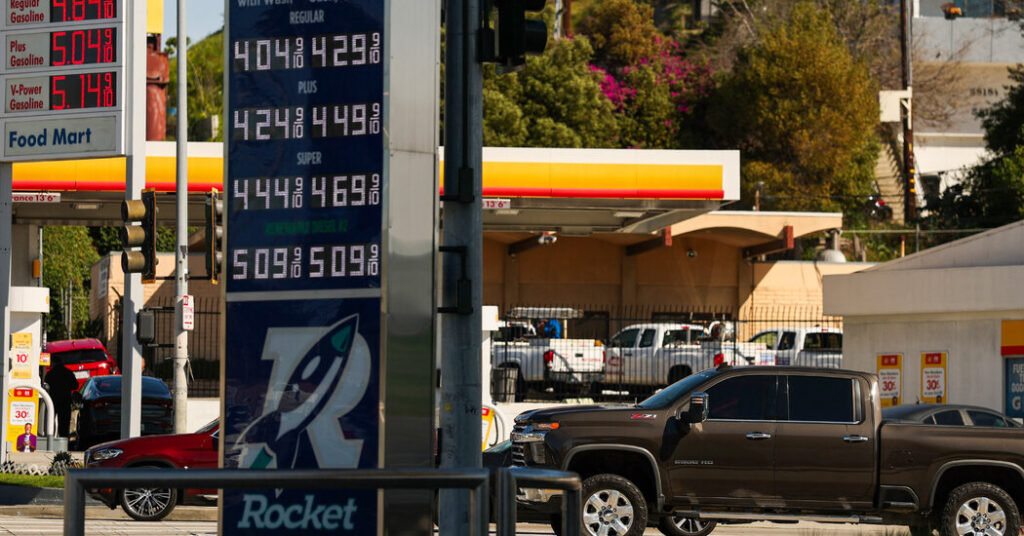
Gasoline prices in the United States jumped seven cents to $3.32 a gallon, on average, on Friday, the latest in a series of price increases in the week since the start of the war led by the United States and Israel against Iran.
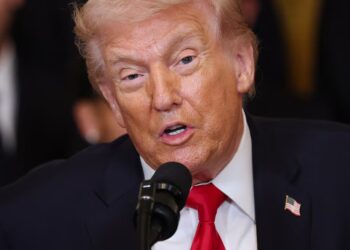
That was the highest since September 2024, according to the AAA motor club, and could become a political problem for President Trump, who has frequently boasted about how gasoline prices have fallen during his second term, and exaggerated the extent of the decline. After the recent gains, prices are now higher than when this term began.
The price of gas has risen by 34 cents, or about 11 percent, over the past week.
Energy prices have jumped as oil and gas shipments out of the Persian Gulf were choked off by the fighting, as well as Iranian threats to oil tankers looking to traverse the narrow waterway that serves as the gulf’s exit. By Friday, domestic crude oil futures had gained more than 20 percent since the conflict began on Feb. 28, an increase that oil refiners have passed on to consumers at the pump, or to businesses in the form of increased diesel costs. Rising energy prices could also affect everything from the cost of an airline ticket to home heating.
The price of diesel has risen even faster than regular gasoline. A gallon of diesel in the United States cost, on average, $4.33 a gallon on Friday, the data from AAA showed. That’s the highest since November 2023. This could directly affect the cost of shipping goods, pressuring businesses to raise prices or let higher transport costs eat into their profits.
As the war drags on, industries like food, chemicals and electronics could also be affected, said Vidya Mani, a visiting professor at Cornell University whose research focuses on supply chains.
“You would think in North America, or anywhere, they’re insulated, but we are dependent on goods that come from these places,” she said. “You’re going to see spikes come up, each one will feed into another. That is something neither are we looking at nor prepared for.”
After Russia invaded Ukraine in 2022, for example, rising oil prices caused jet fuel prices to spike, a chain effect that left travelers paying a lot more for plane tickets.
The increases at the pump — one of the most visible economic barometers for Americans — came as the country prepares for midterm elections. Costs are front of mind for many voters, and Mr. Trump has often promised to get gasoline prices lower, or exaggerated how far they’ve fallen.
In the run-up to the 2024 election, Mr. Trump said during a speech to the Economic Club of New York, “We’re going down and getting gasoline below $2 a gallon, bring down the price of everything from electricity rates to groceries.”
In August, his press secretary Karoline Leavitt claimed credit for the administration as energy costs declined: “This administration continues to be wholeheartedly committed to putting more money back into the American people’s pockets,” she said.
And in November, Mr. Trump went as far as to claim that the cost per gallon was at a level far below the actual price: “Gasoline is way down,” he said. “I think you’ll be seeing $2 gasoline, but we’re now at $2.50, $2.45, some are lower than that.”
(Gasoline hasn’t been that cheap since 2021, according to data from AAA.)
Energy experts generally say presidents have little control over the price of oil. Gas prices tend to take days or weeks to react to moves in oil prices, which are driven by global supply and demand dynamics. The speed of the rise this week had to do with how pivotal the region is to the global energy supply.
“Even if the oil is not coming from Iran, the inability of oil tankers to get insurance to go through that region can stop the flow of oil, or slow down the flow of oil,” said Josh Rhodes, a research scientist at the Webber Energy Group at the University of Texas at Austin. “It’s really just about Iran having an outsized impact on how much oil can flow.”
Emmett Lindner is a business reporter for The Times.
The post U.S. Gas Prices, Up 11% in a Week, Pile Pressure on Trump appeared first on New York Times.