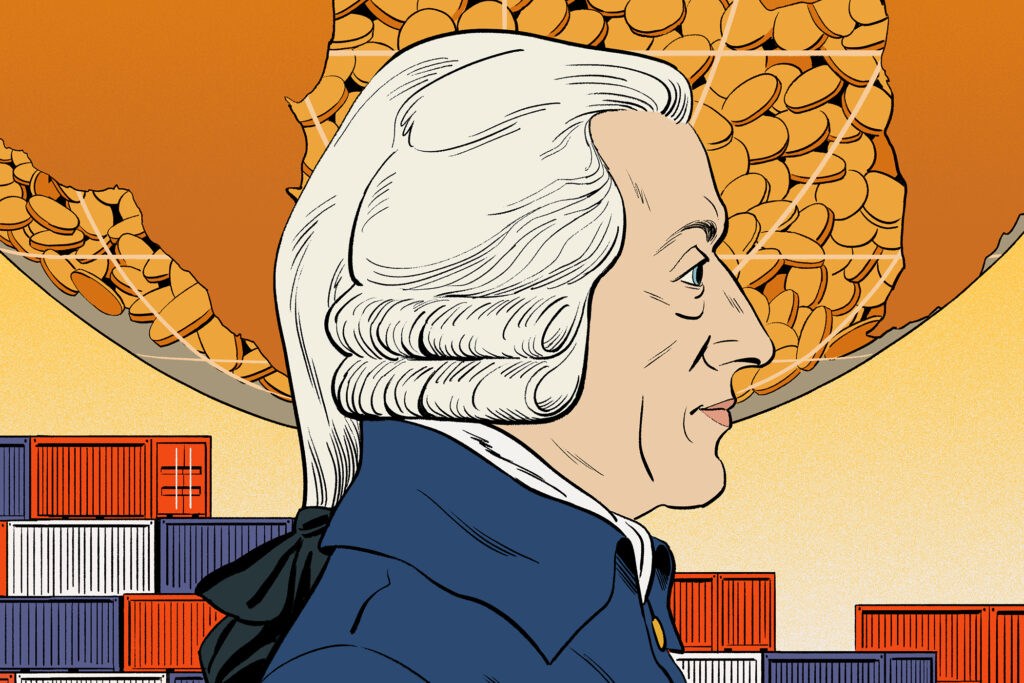
Jesse Norman is the author of “Adam Smith: Father of Economics.” His new book on Adam Smith will be published later this year.
On March 9, 1776, four months before the American colonies broke with Britain over the issue of taxation, a little-known Scottish thinker published a long, dense book with an unpromising title: “An Inquiry into the Nature and Causes of the Wealth of Nations.”
Two hundred and fifty years later, Adam Smith is, by any objective measure, easily the most widely cited and widely quoted economist who ever lived. Astonishingly, his work still frames the central questions we face, not just about free markets, trade and capitalism, but about the nature of human society, and even what it is to be human at all.
Smith was born in 1723 in Kirkcaldy, Scotland, educated at the universities of Glasgow and Oxford, and initially made his name not as an economist but as a moral philosopher. His first published book, “The Theory of Moral Sentiments,” offered a radical theory of how we form moral judgments: radical, because it derived the creation of moral values not from scripture or divine grace, but from human sympathy and mutual regard.
“The Wealth of Nations,” as his second major work came to be known, was an extension of that project. The book is not, as sometimes believed, a hymn to greed, a paean to market fundamentalism and red-in-tooth-and-claw capitalism. It was an attempt to understand how a commercial society could generate prosperity without collapsing into corruption.
This 250th anniversary is not a moment for hagiography. It is an opportunity to recover a way of thinking that is directly relevant, indeed urgent, to the economic, social and political challenges we face today.
Smith offers not policy prescriptions for modern trade disputes or tech battles, but a framework for understanding what is at stake in a world of economic nationalism, artificial intelligence and the concentration of corporate power.
Begin with trade. In his own time, Smith’s great target was mercantilism, or what he called “the mercantile system”: the idea that wealth consists of hoarded bullion, and that trade is a zero-sum contest. Governments granted monopolies, imposed tariffs and manipulated commerce in the purported pursuit of national strength. Producers were widely protected, consumers often ignored altogether.
Against this, Smith argued that wealth lies in a nation’s productive capacity, not in the accumulation of treasure. The free exchange of goods and services through trade enlarges the market, deepens specialization and raises living standards through competition. It is cooperative, not combative. Imports are not humiliations; they are benefits to consumers and inputs to producers.
Two and a half centuries on, in the United States — the nation founded on the experiment of a large, competitive commercial republic — the language of mercantilism is back. Trade deficits are denounced as evidence of weakness. Tariffs are presented as patriotic necessity. Supply chains are repatriated as though geography were a substitute for competiveness.
A Smithian lens clarifies the stakes. The central question is not whether tariffs or other government interventions are ever justified — Smith himself allowed that national defense could warrant exceptions. It is whether trade policy strengthens or weakens the competitive foundations of prosperity.
But there is a further point that modern debates often obscure: Tariffs are a form of domestic taxation. They are collected at the border, but they are paid at home, by importers, by producers and ultimately by consumers. They raise revenue not from foreign governments but from domestic citizens.
The Supreme Court’s recent ruling in Learning Resources Inc. v. Trump, reaffirming that Congress cannot casually delegate core taxing authority to the executive branch, was a welcome reminder of the founding constitutional principle that taxation is a domestic power, subject to legal and political constraint.
Whatever the merits of particular cases, the underlying logic is clear: Revenue measures are not acts of foreign policy theater. They are exercises of internal fiscal authority.
When tariffs are dressed up as instruments of national rivalry, the distributional reality is obscured. A duty imposed on imported steel may be framed as a blow against a rival nation. In practice, it functions as a tax on domestic manufacturers who use steel — and on the households who buy their products.
Smith would have recognized the pattern. Concentrated interests mobilize for protection; dispersed consumers pay quietly. The beneficiaries are visible and organized. The costs are diffuse and politically muffled. What begins as a supposed emergency measure can harden into permanent privilege.
The deeper risk is not simply higher prices. It is institutional drift. If trade policy becomes a vehicle for insulating incumbents from competition, productivity suffers. Investment tilts toward lobbying rather than innovation. The rhetoric is nationalist; the reality is parochial.
The natural companion of this drift is crony capitalism. Smith’s justified reputation as a staunch defender of open markets often causes commentators to forget his suspicion of merchants. “People of the same trade seldom meet together,” he wrote, “… but the conversation ends in a conspiracy against the public.” He was acutely aware of the temptation to secure advantage not through excellence but through influence.
In the 18th century, that meant chartered monopolies and exclusive trading rights. Today, it means regulatory capture, targeted subsidies, tax preferences and implicit guarantees. Industries cultivate relationships with policymakers; firms leverage scale to shape the rules under which they compete. The language remains pro-market. The practice often is not.
A Smithian focus compels us to distinguish between profits earned through innovation and those secured through access. Are companies succeeding because they are better, or because they are better connected? Are barriers to entry the result of genuine efficiency, or of regulatory complexity designed to deter rivals?
The stakes are moral as well as economic. To Smith, justice is the “main pillar” of society. Markets depend on the perception that rules are general, predictable and fairly enforced. When that perception weakens, trust erodes. Citizens come to see success as a function of privilege rather than contribution. Those who are thus privileged come to identify their success not with luck or lobbying, but with their superior merit.
That erosion fuels political backlash. Trade wars, populist insurgencies and calls for sweeping state intervention do not arise in a vacuum. They are often reactions to a sense that the commercial order has been bent toward insiders.
Technology creates different, but related, pressures. Smith celebrated the productivity gains of the division of labor, and showed through the example of the pin factory how specialization multiplies output.
Yet Smith also warned that extreme specialization could deform the human character. A worker confined to a few repetitive tasks might become “as stupid and ignorant as it is possible for a human creature to become.”
That was not hyperbole. It was a warning about the narrowing effects of mechanized routine. His answer was not to halt progress, but to counterbalance it — through education and civic participation. A commercial society required citizens capable of judgment.
In the age of artificial intelligence, the issue is not only manual repetition but cognitive delegation. Algorithms sort résumés, assess credit risk, select missile targets and drive cars. Financial markets operate at speeds no human can track. Machine-learning systems produce explanations that can appear more comprehensive and internally coherent than those of any individual.
The gains in efficiency are undeniable. But a Smithian framework directs attention to agency. What happens to the practice of judgment when it is increasingly outsourced?
Smith’s moral philosophy revolved around what he called the “impartial spectator,” the internalized voice through which we each evaluate our conduct. Moral life depends on sympathy: the capacity to imagine ourselves in the position of others, to experience approval and disapproval.
Artificial intelligence systems can simulate justification. They can reference patterns across vast datasets. But they do not feel responsibility. If institutions gradually shift authority from human deliberation to algorithmic outputs — because those outputs are so much cheaper, faster or statistically superior — the habits of accountability, and the demands we make for them, may weaken.
The danger is subtle. It is not that machines will suddenly rule us. It is that we will grow accustomed to deferring to them. Convenience can become capitulation.
A Smithian focus therefore broadens the AI debate. The question is not merely how many jobs will be displaced, or how to regulate data. It is whether commercial society can integrate powerful new technologies without hollowing out the moral capacities on which it rests.
Mercantilism, crony capitalism, the malign effects of heedlessly deployed technologies. Inequality ties these three strands together.
Smith was not naive about inequalities of outcome. He understood that differences of talent and fortune would produce disparities. But he was alert to the moral psychology of wealth. We tend to admire the rich and powerful and to neglect the poor. That bias, he suggested, corrupts our moral sentiments.
In a digital age of billionaire founders and viral celebrity, that tendency is amplified. Economic success becomes conflated with virtue. At the same time, communities left behind by globalization or automation may experience stagnation and insecurity.
A Smithian approach does not reduce this to envy. It asks whether opportunity remains open. Are markets genuinely competitive? Is education effective and accessible? Can newcomers challenge incumbents? Do institutions preserve social mobility and human possibility — or do they entrench hierarchy?
Commercial society depends on legitimacy — on a broadly shared belief that someone’s gain reflects their contribution or capital or brains, not their position in society. When that belief falters, economic disputes tend to harden into cultural conflict.
The state is neither automatic enemy nor savior. In his own day, Smith assigned it essential roles: defense, justice, public works, education. Markets require infrastructure and law. But he was wary of discretionary power deployed in favor of particular interests.
Today, the modern state is far larger and more entangled with the economy than anything Smith knew. It regulates finance, underwrites social insurance, funds research and responds to crises at scale. A Smithian framework does not demand that it retreat from all these functions. But it does demand that it exercise them with discipline.
Are interventions correcting genuine market failures, or distributing the economic proceeds of oligopoly? Does industrial policy foster competition and capability, or entrench incumbents? Are tariffs instruments of security, or taxes disguised as patriotism?
Two hundred and fifty years after “The Wealth of Nations,” these questions more than retain their force.
Perhaps Smith’s deepest insight is that a commercial society is a moral achievement. It channels self-interest into productive activity through competition under the rule of law. It lifts living standards by expanding exchange. But it is fragile. It depends on justice, on open rivalry and on citizens capable of judgment.
Trade wars that mask domestic taxation, corporate arrangements that favor insiders and technologies that displace deliberation all test those foundations. The choice is not between markets and morals. It is between markets embedded in a framework of justice, and markets hollowed out by privilege and passivity.
The anniversary of Smith’s great work is a reminder that capitalism is not self-executing. It requires constant scrutiny and renewal. To adapt Benjamin Franklin’s famous line about the new American republic, “You have a capitalist system, if you can keep it.”
The question is not what Smith would say now. It is whether we are prepared to take seriously what he has already taught us about our world.
The post ‘The Wealth of Nations’ at 250: Needed now more than ever appeared first on Washington Post.