The United States has been chasing the rhetorical goal of energy independence — the ability to produce enough domestic energy to be essentially free of dependence on imports — since the energy crisis of the 1970s exposed the country’s reliance on Mideast oil. President Donald Trump has put his own spin on the idea, pushing beyond independence to “energy dominance.”
If you look just at oil extraction, the US seems to have succeeded. Thanks to the fracking revolution, it is now the largest oil producer in the world, and it exports more petroleum and other liquid fuels than it imports. The US is, in fact, a dominant player in the global energy market.
But as the US and Israel’s attacks on Iran this week have revealed, being dominant in energy isn’t the same thing as being independent. What you’re paying at the pump now is directly connected to what’s happening 6,000 miles away. Because of attacks on shipping and oil infrastructure, gasoline prices are rising across the country, reaching an average of $3.25. The last time prices jumped this high this fast was in March 2022, when Russia launched its full invasion of Ukraine. Even Trump was forced to awkwardly acknowledge the reality.
“So if we have a little high oil prices for a little while, but as soon as this ends, those prices are going to drop, I believe lower than even before,” Trump told reporters on Tuesday. Trump has also tasked his Cabinet to look for any way they can to keep gasoline prices down.
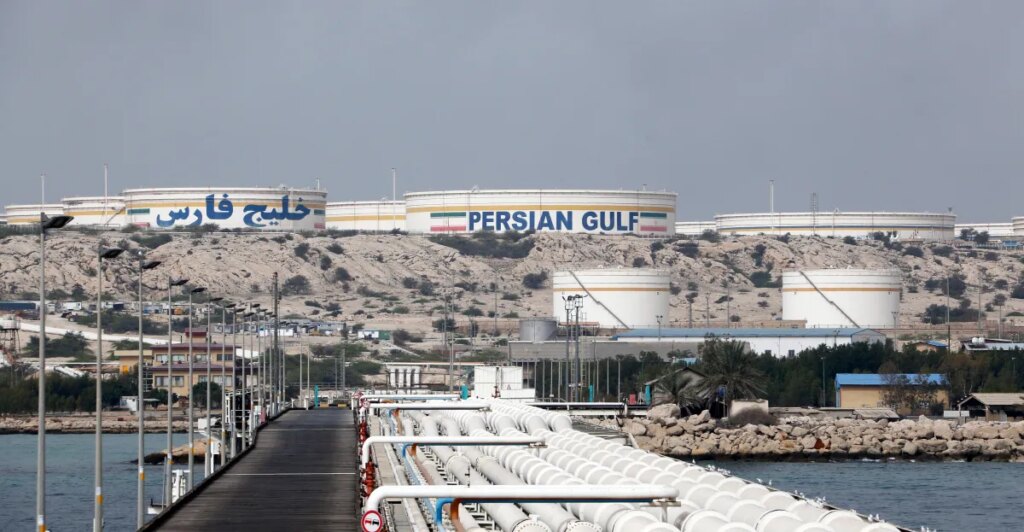
One sign of the rising danger is that Trump also said on his social media platform that the US would offer political risk insurance for shipping through the Strait of Hormuz and possibly naval escorts, particularly for oil tankers, after transits drastically slowed. Twenty percent of the world’s petroleum consumption and 20 percent of natural gas flows through the Strait of Hormuz. Iran itself is the world’s fifth-largest oil producer, and its oil facilities are under attack. It’s now launching its own strikes on oil tankers. We’ve seen shocks to the global oil and gas sector before, but this is the big one.
“We’re living through the geopolitical nightmare for markets,” said Sam Ori, executive director of the Energy Policy Institute at the University of Chicago. “This is the crisis that has kept people up at night.”
And with the route throttled, Americans are likely to see even higher gasoline prices in the weeks to come. For most Americans, gasoline is their single-highest energy expense, averaging $2,930 per household in 2024. Adjusting for inflation, the US has been blessed with fairly steady gasoline prices over the decades, so a big, sudden price spike will hit households hard.
All of which raises the question: If the US is producing more oil than ever, how are we still vulnerable to supply shocks occurring half a world away?
Why we may never achieve “energy independence”
It sounds straightforward in its wording, but energy independence has always been an ill-defined, unachievable goal, no matter how many presidents invoke it. Depending on who you ask, it means reaching self-sufficiency in energy production or immunity from foreign turmoil. But even if the US sourced every drop of oil we use from within our borders, we would still be vulnerable to international price shocks for one simple fact: Oil is a globally traded commodity. Its price is set not by how much the US extracts at home, but by the international laws of supply and demand.
“A disruption in the flow of oil anywhere affects prices everywhere,” Ori said. “No matter how much oil you produce, no country is insulated from the volatility of the global oil market.”
Then what about Trump’s favorite term: “energy dominance”? This is similarly vague, somewhere in between deregulating the domestic energy sector to encourage more oil and gas extraction and a strategic doctrine to wield energy exports, particularly natural gas, for diplomatic leverage. The vast quantities of oil and gas the US has unlocked with the shale boom “changes how geopolitical oil price shocks abroad are transmitted to the U.S. economy, but not the fact that they will have an impact,” said Lutz Kilian, director of the Center for Energy and the Economy at the Federal Reserve Bank of Dallas, in an email.
While the US is the biggest oil producer, it’s still less than a quarter of the global total. We can’t drill our way to meaningfully cheaper gasoline and can’t make up for what’s lost when the Strait of Hormuz gets blocked. “If the Strait is not operational, there is no way in hell the US can replace that,” said Samantha Gross, director of the Energy Security and Climate Initiative at the Brookings Institution.
But markets are only one factor hobbling energy independence. For one thing, not all oil coming out of the ground is the same, and crude oil has to be refined before it’s of any use. US refineries along the Gulf Coast are mostly set up to process heavier oils we import rather than the lighter oil we extract domestically, mainly through fracking. That lighter crude tends to be more valuable to export than consume at home. The US is set up to be a giant, well-oiled cog in a global machine rather than a stand-alone contraption.
If a foreign oil supplier gets cut off, the US has more oil reserves it can tap, but it can take months to years to ramp up production. The US does have the Strategic Petroleum Reserve, the world’s largest supply of emergency crude oil. The Biden administration tapped it to keep gasoline prices down after Russia launched its full invasion of Ukraine. But the reserve is only meant to replace oil imports for 90 days, and it’s currently at less than 60 percent capacity.
“Every president gets crap when they use it because folks come out and say, ‘Oh, that was political, and he’s just trying to lower gasoline prices.’ Well, yeah,” Gross said. “Although it is kind of odd to release SPR oil for a conflict we caused.”
And while the US is the world’s largest oil producer, it’s also the world’s largest consumer — with appetites only set to grow as more Americans take to the roads and skies while fuel efficiency regulations get weaker.
The net result is that the shale boom has changed “how geopolitical oil price shocks abroad are transmitted to the U.S. economy, but not the fact that they will have an impact,” said Lutz Kilian, in an email. “Energy independence is not possible except in autarky,” an imagined scenario where the US is completely self-sufficient while also isolated from global trade.
So is energy independence a worthwhile goal, even in theory?
“No, it’s not,” Ori said. “I don’t think ‘energy independence’ is a useful concept at all.”
It may not sound as good, but a better goalpost than “energy independence” is “energy security,” ensuring an uninterrupted flow of hydrocarbons and electrons at an affordable price. And that requires both strong domestic production and secure sources from abroad. “To really maximize energy security, you want to minimize the way that volatility can affect your economy,” Ori said. That means building durable relationships with trading partners. It also means reducing our dependence on all oil, mainly in the transportation sector.
Unlike past crises, the oil price spikes from the US attacks on Iran are a problem of our own making. At the same time, the Trump administration is rolling back fuel economy regulations for cars and trucks and repealing incentives for electric vehicles that would have otherwise helped limit demand. But Trump is instead working to increase fossil fuel production and consumption on all fronts.
Just how bad will things get? Global oil markets are currently well supplied, so there’s a lot of crude already on the move or in storage that’s cushioning the blow. Future prices will depend on how long war-driven disruptions go on and how much alternative capacity emerges. There are other shipping routes for oil and pipelines across countries like Saudi Arabia that could absorb some of the capacity. Kilian said that higher fuel prices could also have a muted effect on inflation. “The effect of a one-time energy price shock on U.S. headline inflation tends to be short-lived, even when the energy price remains elevated,” he wrote.
But we’re in an unprecedented situation, and we have yet to see the full economic and energy impacts of the war. It’s clear that record oil production can’t shield against supply disruption, and the next conflagration may not be on the US’s terms. When that happens, we will need some help from our friends, or we will all pay for it.
The post The false promise of energy independence appeared first on Vox.