Five years ago, the designer Pieter Mulier did something everyone said couldn’t be done.
He took on the house of Azzedine Alaïa; one of the last great 20th-century couturiers, inventor of the bandage dress, defier of almost every fashion rule, a man who lived and worked in a building he almost never left and showed his clothes only when he thought they were ready — at least until he died in 2017. For more than three years no one had dared to step into his place. Alaïa was less a fashion label than the expression of one man’s genius, went the thinking. It would be impossible to replicate the magic.
But here’s the thing: It turned out Mr. Mulier could perform some alchemy of his own. On Wednesday night, in what was his own final Alaïa show (he is leaving to take the reins of Versace), just how much of a transformation he has wrought on Alaïa during his five-year tenure became clear.
Not only did he create his own design vocabulary for the house, one that acknowledged its original aesthetic while also supplanting it, he turned Alaïa from a passion project into a Brand.
One with a hit shoe: the Mary Jane ballet flat, in multiple fishnet and crystal-studded iterations. And a hit bag: the Teckel, a geometric dachshund of an over-the-shoulder purse.
One with celebrity fans like Rihanna (whom Mr. Mulier dressed for her Super Bowl show in 2023) and Addison Rae (whom he dressed for this year’s Grammys). One that outgrew its original warren of ateliers, and got a sprawling new showroom and studio, like any modern fashion company, from its parent group, Richemont.
Along the way some of the specialness that once defined Alaïa, the centering of women rather than a designer’s abstract idea of women, may have been lost. But it probably had to happen (at least for Alaïa to continue to exist). And there’s no arguing with the result(s), or the fact that Mr. Mulier put his more conventional version of a brand back in the center of the fashion conversation. How he did it was laid out on his runway.
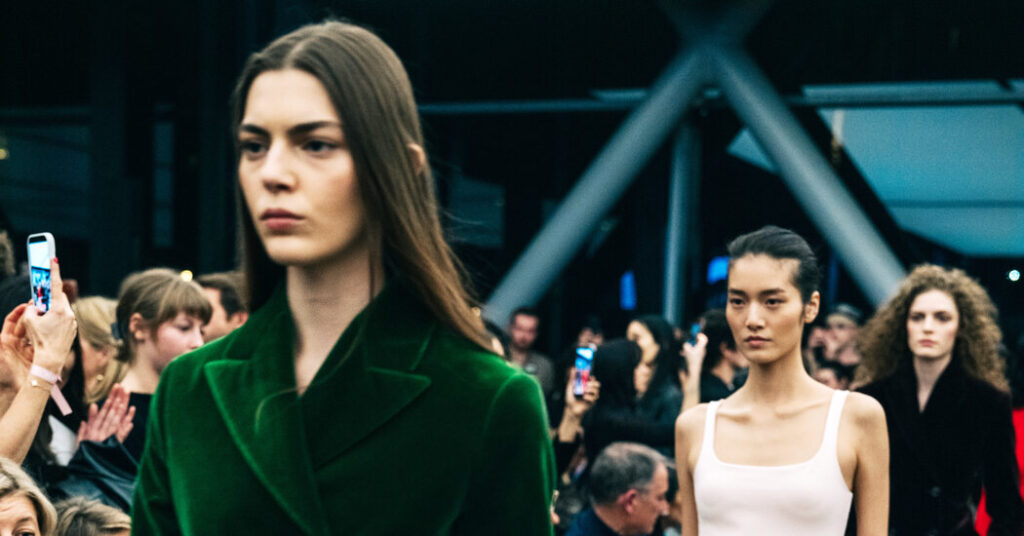
It started with materiality and bodycon (his version of), in the form of stretchy tank dresses in cotton knit and velour, as plain as possible, with merely a seam etching the curve of the hip or a knit band circling the pelvis for emphasis. Also, precise velvet pantsuits in wine-rich shades and velvet tunics over leggings.
Later came some of the many-tiered and ruffled skirts cut to brush the foot at the front and rise to the top of thighs at the side and stay short at the back that were a little rah-rah, a little 18th-century, that were one of Mr. Mulier’s most recent, and confusing, innovations. Especially when they turned trompe l’oeil, with the bottom tier split into quasi-harem pants that tied at the ankle to keep them in place. The better, perhaps, to keep one’s tail from getting caught between one’s legs?
(Whatever the reason, they never made as much sense as the snap-band tops Mr. Mulier once created for the house that curved around the torso with no fastenings or even obvious way to stay on, and were a technical and visual feat.)
But forget the skirts — most of all there were coats. Pretty much perfect coats. Coats in wool and glossy ponyskin seamed to trace the contours of the body, with tiny rounded shoulders and a bit of a princess flare. Coats in cherry red or mustard cut like a trapeze, swinging out at the thighs. A strict schoolgirl’s coat with a proper collar in russet croc, and a long double-breasted tuxedo coat in supple black leather.
Coats that gave meaning to what Mr. Mulier said backstage, when, as he was being mobbed by a sea of emoting fans, a reporter asked what he had learned during his time at Alaïa.
“I learned precision,” Mr. Mulier said. “I learned editing. And I learned that real luxury is not what we all think.”
It is not, he implied, beading or embroidery or big sound-and-light shows. “It’s not even the fabric anymore,” he said. “It’s just the fit.”
He’s right, and it’s a lesson more of fashion should absorb. But now that Mr. Mulier has made Alaïa a normal part of the fashion system, now that his team (which he immortalized in a book of 141 portraits by the photographer Keizo Kitajima) has been left to carry on while Richemont decides what to do next, whether that clarity and those coats will be enough to sustain Alaïa’s momentum is another question.
Vanessa Friedman has been the fashion director and chief fashion critic for The Times since 2014.
The post Saying Goodbye With the Perfect Coat appeared first on New York Times.