CERTAIN MOMENTS are worth paying attention to because they reveal something essential about a person. They act as windows into an individual’s psychological state, their ethics, the orders of their loves and their hates. Such occasions are crystallizing.
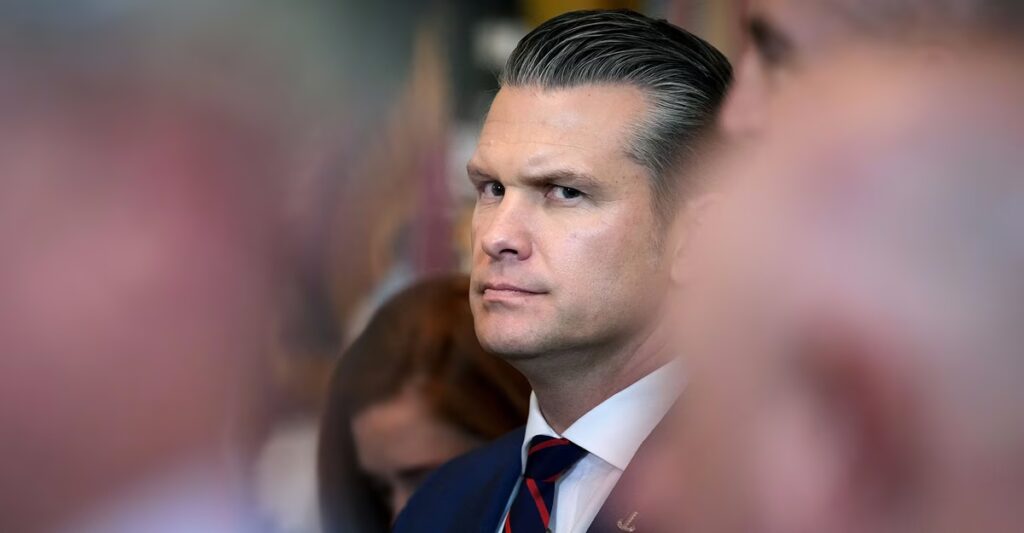
That’s been true of Secretary of Defense Pete Hegseth’s Pentagon briefings since the war against Iran began. We haven’t learned anything we didn’t already know about Hegseth in these briefings. But the press conferences have reminded the world why he is exactly the wrong person to hold the position he does.
Wednesday’s briefing, for example, featured the usual Hegseth hubris, strutting, and cockiness. “I stand before you today with one unmistakable message about Operation Epic Fury: America is winning decisively, devastatingly, and without mercy,” he said. He declared that, four days into the mission, Iran is “toast, and they know it. Or at least soon enough they will know it.” He compared the Persian nation’s predicament to that of a football team: “They don’t know what plays to call, let alone how to get in the huddle and call those plays.” There was not even a hint of the challenges that might lie ahead in the conflict with Iran, a nation of 90 million people that borders seven countries—challenges that might include internal fragmentation and chaos, a dangerous insurgency, humanitarian crises, regional destabilization, and global economic disruption.
[Tom Nichols: Pete Hegseth treats fallen American soldier as a PR problem]
Now, it may be that none of this comes to pass. The joint American-Israeli air campaign has been stunningly effective. A peaceful, enlightened, democratic, pro-American regime may emerge. And even if Iran turns out to fall far short of that ideal, it could still be that the next regime is better than the previous, wicked one. So the world may be better off as a result of this war. Or it may not. It’s simply too early to tell. Wars that begin well don’t always end well, and they often produce unintended consequences.
Hegseth displayed the prickliness and defensiveness we’ve come to expect, along with his resentment against “fake news.” Hegseth complained that the war-related death of six Americans was front-page news. The press, he claimed, “only wants to make the president look bad.” There were also the requisite shots at Democrats, who he said are “rooting against the country.”
But what was most striking about Hegseth’s press conference was his emotional affect, his delight in celebrating mercilessness, his talk of death and destruction raining down from the skies, his glee in “punching them while they’re down, which is exactly how it should be.”
We have seen this manosphere affect before from the defense secretary. At a press briefing on Monday, he mocked “our traditional allies who wring their hands and clutch their pearls, hemming and hawing about the use of force.” In this war, there would be “no stupid rules of engagement, no nation-building quagmire, no democracy-building exercise, no politically correct wars,” he vowed. “We fight to win.” He added, “We are not defenders anymore. We are warriors, trained to kill the enemy and break their will. History is watching. Be the force you swore an oath to be—focused, disciplined, lethal, and unbreakable.”
This is all part of a pattern. Last September, Hegseth summoned generals and admirals from around the globe and delivered a 45-minute lecture to them.
“This administration has done a great deal since day one to remove the social justice, politically correct, toxic ideological garbage that had infected our department,” Hegseth said. “No more identity months, DEI offices, or dudes in dresses. No more climate-change worship. No more division, distraction of gender delusions. No more debris. As I’ve said before and will say, we are done with that shit.”
Earlier that month, at an event in which President Trump signed an executive order directing the Department of Defense to be known as the Department of War, Hegseth said America was going to “restore the warrior ethos.” The aim is for “maximum lethality, not tepid legality. Violent effect, not politically correct.” (This rhetorical car crash led the comedian Seth Meyers to refer to Hegseth as “the secretary of white rapping.”)
THERE’S A CALLOW, performative, light-as-air quality about Hegseth. Only a deeply unserious person would, while serving as secretary of defense, post an image on social media of Franklin the Turtle targeting narco-terrorists with the caption “For your Christmas wish list …” The Pentagon’s inspector general found that Hegseth put U.S. personnel and their mission at risk when he used the Signal messaging app to convey sensitive information about a military strike, including, inadvertently, to The Atlantic’s editor in chief, Jeffrey Goldberg.
Jeffrey Goldberg: The Trump administration accidentally texted me its war plans
The secretary of defense also appears to be a restless, troubled soul; he refers to his “somewhat difficult past.” He has faced allegations of financial mismanagement, alcohol abuse, and sexual misconduct, all of which he denies.
Hegseth has gone from womanizing and admitting to affairs to associating with Douglas Wilson, a Christian-nationalist pastor who calls himself a paleo-Confederate, believes in patriarchy, has made the case against women’s suffrage, and has written that “the sexual act cannot be made into an egalitarian pleasuring party. A man penetrates, conquers, colonizes, plants. A woman receives, surrenders, accepts.” (Hegseth is now part of the Communion of Reformed Evangelical Churches, which was co-founded by Wilson.)
Hegseth carries resentment toward the military based on his own unhappy experience with it, saying the military “spit me out.” During Trump’s first term, Hegseth lobbied for pardons for three members of the military who were facing charges related to, or had been convicted of, war crimes. He defended Blackwater contractors convicted of murdering Iraqi civilians. He has called for changes in how the military approaches allegations of hazing and harassment. The defense secretary wants drill sergeants to be able to “put their hands on recruits,” and he wants to bring back “shark attacks” during basic training, allowing drill sergeants to swarm around recruits. “Basic training is being restored to what it should be—scary, tough, and disciplined,” he said.
Hegseth tries so hard—too hard—to project a tough-guy persona, as if a lot of unresolved issues, a lot of brokenness, is playing itself out in his life. He seems to be trying to prove a great deal, to himself and to others. There’s a certain poignancy in that. But there’s a danger in that, too, when the person in question happens to be the secretary of defense.
AMERICA’S “SECRETARY OF WAR” doesn’t approach matters of war and peace, of life and death, with even the slightest bit of reverence or humility. All of his instincts are toward aggression; he appears to relish the destruction and death that he can now unleash.
We need people in government and in the military who can lead the nation to victory in times of war, but that is quite different than having people in leadership who indulge in bloodlust or who are wrestling with inner demons.
Dwight D. Eisenhower was the supreme commander of the Allied Expeditionary Force in World War II. Having seen the violence of war, he had a great aversion to it. He was deeply moved by the sacrifices of soldiers, whom he cared for and loved. Eisenhower had a profound understanding of the human cost of conflict; as president, he exercised immense caution in using military force.
“I hate war as only a soldier who has lived it can,” Eisenhower said, “only as one who has seen its brutality, its futility, its stupidity.”
And then there is Abraham Lincoln. The man who led America through the gruesome and bloody Civil War was both a complicated and deeply impressive human being: magnanimous and generous, compassionate and incorruptible, seemingly free of personal pettiness and malice. Some believed he was too sympathetic to be a great leader. He turned out to be our greatest leader.
In his spectacular biography of America’s 16th president, originally published in 1916, Lord Charnwood said of Lincoln, “For perhaps not many conquerors, and certainly few successful statesmen, have escaped the tendency of power to harden or at least to narrow their human sympathies; but in this man a natural wealth of tender compassion became richer and more tender while in the stress of deadly conflict he developed an astounding strength.”
Eisenhower and Lincoln were rarities; it would be unfair to judge the rest of us against their lives. But their standards—the virtues they revered, the human sympathies they never allowed to narrow—are ones we need to celebrate and to guard against those who would subvert them. Eisenhower and Lincoln were great warriors, and they were reluctant warriors. War weighed on them both, and it very nearly overwhelmed Lincoln. Yet he found a way to channel his pain into empathy. Neither he nor Eisenhower delighted in the suffering of others, even their enemies. And they showed that human beings can maintain their humanity even while sending young people into battle to fight and to kill, and sometimes to fight and to die. That cannot be said of everyone in power, and lately it seems like it can be said of hardly anyone in power.
The post Pete Hegseth’s Troubled Soul appeared first on The Atlantic.