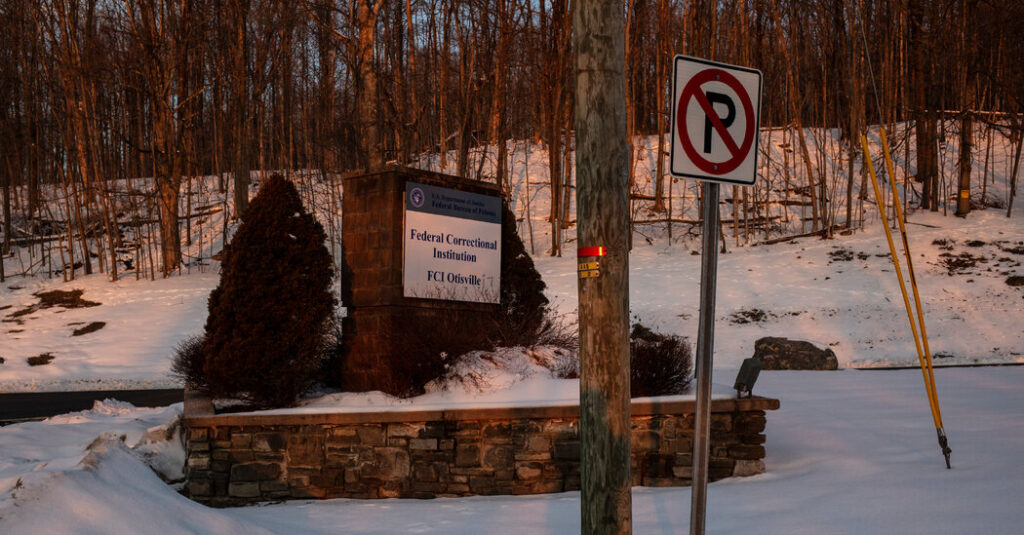
One evening last November, word spread around the federal prison camp in Otisville, N.Y., that an inmate who had spent heavily to pursue clemency had hit pay dirt, winning a pardon from President Trump and walking free.
His release intensified an ongoing debate for those who were left behind. Whom could they pay to achieve the same result?
There was a lot to parse in the clemency campaign of Joseph Schwartz. He had served only three months of a three-year sentence for tax crimes related to a nursing-home empire that had collapsed amid allegations of endangering the residents and defrauding his employees.
Mr. Schwartz had not been shy about sharing the strategy behind his clemency campaign with other inmates, so they knew he had paid multiple people to try to get the job done, according to two people familiar with conversations at Otisville.
Nearly a million dollars went to right-wing operatives who claimed to have worked with Laura Loomer, a social media provocateur who has the ear of Mr. Trump, to advocate for Mr. Schwartz’s release. Another $100,000 or more was paid to a lobbyist who had a different set of connections to Mr. Trump — pro-Israel evangelicals.
Thousands more went to lawyers who had personal relationships with Alice Marie Johnson, Mr. Trump’s “pardon czar,” and David Warrington, the White House counsel, according to four people familiar with the effort.
Mr. Schwartz’s supporters employed various techniques and arguments for his relief. Those included stating publicly and in private petitions and conversations that his sentence was too severe, noting that he had paid his full $5 million in federal restitution and emphasizing his religious faith and health problems.
It was not entirely clear which effort did the trick.
But the costly campaign offers rare visibility into the lucrative pardon industry that has emerged around Mr. Trump.
It is based in part on the proposition that paying the right person to deliver a message tailored to Mr. Trump’s politics or grievances is more important than demonstrating remorse or a low likelihood of recidivism.
A growing number of practitioners promise access in this murky enterprise, but some also may exaggerate their effectiveness to elicit payments from clients desperate to avoid incarceration. Pardon seekers routinely offer to pay as much as $1 million or more, often with bonus payments triggered by a successful outcome, according to lobbying filings and people familiar with the fees.
This transactional approach to clemency has been welcomed by white-collar offenders like those serving time at the Otisville camp, a minimum-security facility about 75 miles northwest of Manhattan.
Many of its inmates cheered Mr. Trump’s election, seeing him as a kindred spirit who shares their grievances about the unfairness of financial crime prosecutions like the one that led to his own conviction, according to four people familiar with conversations at Otisville.
Over the course of his first term and the first year of his second, Mr. Trump has granted pardons or commutations to at least nine inmates who served at Otisville’s camp or the adjacent medium-security prison. That includes two inmates who were freed after Mr. Schwartz from the minimum-security camp, which typically houses about 100 inmates.
Karoline Leavitt, the White House press secretary, dismissed the notion that lobbyists had shaped Mr. Trump’s clemency decisions.
“Anyone spending money to lobby for pardons is foolishly wasting their money and the president doesn’t even know who these so-called ‘lobbyists’ are,” she said in a statement. “The Trump administration has a robust pardon review process,” she added, calling Mr. Trump “the final decider.”
But the perception that freedom is for sale to affluent offenders like Mr. Schwartz outrages some of his victims, including former employees of his nursing homes who were deprived of health insurance or left scrounging for supplies to care for residents.
“This man hurt a lot of people,” Theresa Dante, 61, said, recounting a flurry of text messages from her former colleagues expressing disbelief and concern about the precedent that could be set by the pardon. “If it’s OK for Mr. Schwartz to do this to everybody, then in the future is this going be OK?”
Mr. Schwartz did not respond to requests for comment.
This article, key details of which have not been previously reported, is based on lobbying and court filings, private correspondence and recordings, as well as interviews with more than a dozen people familiar with clemency advocacy.
A Guilty Plea
Even in the nursing-home industry — which is plagued by tax and insurance fraud, chronic understaffing and neglect — Mr. Schwartz’s rise and fall stood out.
He started with a handful of nursing homes that he and his family operated out of an office above a pizza parlor in New Jersey.
In 2015, flush with $22 million in proceeds from the sale of an insurance business, the family began an aggressive expansion. Soon their company, Skyline Healthcare, owned about 100 nursing homes and rehabilitation facilities in at least 11 states that employed as many as 15,000 people.
As the business grew, it attracted scrutiny.
Medicare decertified a Skyline facility in Tennessee from collecting reimbursements after a resident was discovered lying in feces with maggot-infested open wounds. The resident died days later.
The attorneys general in Arkansas, Massachusetts and Nebraska brought lawsuits or levied fines against Skyline, including for Medicaid fraud, wage theft and tax violations.
Company facilities in several states fell behind on bills for critical supplies and utilities.
In South Dakota, where Skyline operated 19 facilities, a regional administrator for the company emailed state authorities in 2018, raising alarm about dwindling caches of food along with medical and cleaning supplies.
“All residents’ safety is at risk and will increase every day,” the administrator wrote in an email reported by the Aberdeen News.
Regulators in several states — including South Dakota — seized Skyline-owned nursing homes and placed them into receivership.
It was not a moment too soon for the Redfield facility where Ms. Dante worked as a cook, she said, recalling that the power company was threatening to turn off the electricity for nonpayment of bills.
That would have been “an atrocity to say the least,” she said, given that there were “so many residents tethered to machines for their survival.”
Additionally, Ms. Dante, who was fighting leukemia, said her health insurance benefits and those of other employees were not being funded, forcing them to pay out of pocket or to forgo medical care entirely.
She joined former staff from Skyline facilities in other states in a class-action lawsuit filed in 2020 against Mr. Schwartz and his companies for having “willfully pocketed” insurance premiums that had been deducted from employees’ paychecks.
The suit is still pending.
Last year, Mr. Schwartz pleaded guilty to tax crimes in federal and Arkansas courts related to his failure to pay nearly $40 million in employment and payroll taxes, as well as to a state Medicaid fraud charge in Arkansas.
Prosecutors praised the sentences.
Attorney General Tim Griffin of Arkansas, a Republican who was endorsed by Mr. Trump, said in a statement last May that Mr. Schwartz “didn’t just take advantage of our vulnerable population, he also preyed on Arkansans who worked in his facilities.”
‘Direct to the president’
Less than two weeks after his guilty plea was accepted, with his surrender date approaching and Otisville looming, Mr. Schwartz hired the right-wing conspiracists Jack Burkman and Jacob Wohl to lobby for a presidential pardon, according to congressional filings.
Mr. Burkman and Mr. Wohl are known less for effective lobbying campaigns and more for spurious political stunts, including a robocall scheme to suppress the Black vote in the 2020 presidential election that led to felony convictions and fines for both men.
Mr. Burkman and Mr. Wohl have boasted that they maintain close ties to Mr. Trump and people in his orbit that they can use to win clemency, according to communications reviewed by The New York Times and interviews with two people who have dealt with the lobbyists.
In an audio recording heard by The Times, Mr. Burkman discussed his strategy, saying that he and Mr. Wohl “use a combination of influencers and members of Congress,” as well as going “direct to the president, and I think that’s a very good approach.”
A White House official, who requested anonymity to discuss a clemency case, said that no one in the White House had talked to either Mr. Burkman or Mr. Wohl about Mr. Schwartz.
Mr. Burkman and Mr. Wohl also have privately indicated that they enlisted Ms. Loomer to assist with the Schwartz clemency push.
In an interview with The Times, Ms. Loomer said Mr. Burkman and Mr. Wohl had nothing to do with her decision to champion Mr. Schwartz’s cause and that she was not paid by the lobbyists or Mr. Schwartz to do so.
“A lot of people claim to know me and claim to work with me because of my effectiveness and how well-known I am amongst administration officials,” Ms. Loomer said.
While she acknowledged that she is close to Mr. Wohl, Ms. Loomer said Mr. Schwartz’s case was brought to her attention in a group chat related to Jewish causes. Mr. Schwartz, like many inmates at the Otisville camp, is Jewish.
A week after Mr. Burkman and Mr. Wohl went to work for Mr. Schwartz in April, Ms. Loomer published posts on social media calling for his sentence to be “overturned” and citing it as an example of “judicial tyranny” and “obvious antisemitism” by the judge.
She praised Mr. Schwartz as a “well known member of the Jewish community in New Jersey.”
Mr. Burkman repeatedly hung up on a reporter asking about his work on the Schwartz pardon. He and Mr. Wohl did not respond to a list of emailed questions about their clemency claims.
Mr. Schwartz paid their firm, J.M. Burkman & Associates, $960,000 in the 10 weeks after their hiring last spring, according to lobbying reports filed by the firm. The firm collected another $845,000 last year from three other clients seeking clemency, most of which — $600,000 — came from Torrence Ivy Hatch Jr., a rapper known as Boosie Badazz who had pleaded guilty to a firearms possession violation. Mr. Hatch has not received a pardon.
In all, lobbying firms disclosed receiving payments of nearly $5.2 million last year from clients seeking clemency from Mr. Trump for individual clients — about eight times more than was disclosed in 2024 from people seeking clemency from former President Joseph R. Biden Jr. — according to congressional filings. But that likely reflects only a fraction of the spending by clemency seekers, since most pardon advocates claim that their efforts represent legal work that is exempt from lobbying disclosure laws.
As word circulated about successful paid clemency campaigns, more inmates sought out their own pardon fixers claiming access to the president, said Walt Pavlo, who served two years himself starting in 2001 for his role in a fraud scheme and now serves as a consultant for people facing prison time.
“They believe that they can pay for some access, but the other thing is that they think that Trump is sympathetic to their cause, because of what he’s gone through,” Mr. Pavlo said.
Mr. Pavlo said he urges clients to be cautious, predicting that “at the end of the day, there’s going to be a lot of very disappointed people that don’t get pardons that paid a lot of money.”
More firepower
The efforts by Mr. Burkman, Mr. Wohl and Ms. Loomer did not keep Mr. Schwartz out of Otisville. He reported there in August.
He began leading Torah study classes for inmates.
And he spoke to other inmates about his clemency strategy, complaining that Mr. Burkman and Mr. Wohl were not up to the job, according to two people familiar with conversations in Otisville, who requested anonymity to share jailhouse discussions.
Frustrated, Mr. Schwartz stopped paying Mr. Burkman and Mr. Wohl’s firm.
He turned instead to Josh Nass, a lawyer and lobbyist with connections in pro-Israel Jewish and evangelical circles. Congressional lobbying filings show that Mr. Schwartz paid Mr. Nass at least $100,000.
In an interview, Mr. Nass said that “clemency reflects the belief that people are capable of redemption.” He added “President Trump has shown a willingness to give deserving individuals a second chance and he should be commended for such.”
Mr. Schwartz expressed confidence to other inmates that Mr. Nass would facilitate the pardon, according to the people familiar with those conversations.
Mr. Nass had been paid nearly $300,000 at the end of Mr. Trump’s first term to help a handful of clients seek clemency, according to lobbying filings. None received it.
This time around, Mr. Nass implemented a more comprehensive strategy. He enlisted evangelical figures with connections in Mr. Trump’s circle to highlight Mr. Schwartz’s cause to administration allies. They emphasized Mr. Schwartz’s faith and argued this was a matter of religious liberty.
One person who made the case after being approached by Mr. Nass was Mark Walker, a former North Carolina representative who had been tapped by Mr. Trump to serve as a State Department envoy for religious freedom, according to two people familiar with his involvement. During the first Trump administration, the White House had credited Mr. Walker and others with supporting the commutation of another observant Jewish inmate who had been convicted of fraud.
At Mr. Nass’s urging, Mr. Schwartz’s family also retained lawyers with ties to the White House to file clemency petitions.
The Schwartzes hired Brittany K. Barnett, who had helped secure clemency during the first Trump administration for Ms. Johnson, who was serving a life sentence for a nonviolent drug conviction. Last year, Mr. Trump appointed Ms. Johnson as a White House adviser on clemency and criminal justice.
Ms. Barnett’s website includes photos of her with Ms. Johnson and advertises her “deep understanding of the legal, political and human dimensions of clemency.”
Another petition was filed by Laurin H. Mills, a lawyer who is close to Mr. Warrington, according to three people familiar with his efforts. Mr. Mills and Mr. Warrington worked together at a now-defunct firm on politically charged cases.
Mr. Mills’s petition cast Mr. Schwartz’s sentence as too harsh for the fact pattern, noting that he had paid his restitution and arguing that he was in poor health. (Mr. Schwartz, who was 65 years old when he reported to prison, had told authorities that he suffered from a heart arrhythmia and was borderline diabetic.)
Mr. Warrington did not discuss the Schwartz case with Mr. Mills and did not play any role in facilitating the pardon, according to the White House official.
But Mr. Mills checked in periodically with Sean Hayes, a deputy counsel who works on clemency matters in Mr. Warrington’s office.
Mr. Hayes was among the White House officials who presented the paperwork to the president.
‘Free and safe’
The day after Mr. Trump signed the pardon, Ms. Johnson praised the pardon on social media, writing that Mr. Schwartz “finally spent Shabbat free and safe with his family.”
In a statement to The Times, Ms. Johnson reiterated her support for the pardon of Mr. Schwartz, arguing that a three-year sentence “serves no purpose,” and assailed what she called “the media’s efforts to smear our work.”
After the pardon, Mr. Schwartz still had his Arkansas sentence looming, including the prospect of a state prison term of as long as nine months and an additional $1.4 million in restitution.
But he would be freed on parole in January after only two and a half weeks in state prison by a board appointed by the governor. While Mr. Nass had reached out to Gov. Sarah Huckabee Sanders of Arkansas and her father, Mike Huckabee, the U.S. ambassador to Israel, the offices for both issued statements to The Times saying that they had not intervened. The board said that it had acted independently.
Shortly after leaving Otisville, Mr. Schwartz and one of his sons took Mr. Nass to Le Marais, a kosher French steakhouse in Manhattan’s Times Square to thank him, according to a person familiar with the episode. A photograph from the dinner shows Mr. Nass and the elder Mr. Schwartz embracing while holding a manila envelope that purportedly contained a copy of the signed pardon.
The trio discussed a handful of the inmates with whom Mr. Schwartz had served time and who, since his pardon, had reached out indirectly to Mr. Nass seeking assistance. Several had discussed offering to pay $500,000 each, with additional $1 million success fees if they secured pardons, according to the two people familiar with the conversations at Otisville.
Mr. Nass declined to represent any of them, according to a person familiar with the offers.
The next month, the elder Mr. Schwartz and his wife attended the White House Hanukkah party, where they met Ms. Loomer.
Ms. Loomer said that Mr. Schwartz thanked her for her posts about his case and said he was grateful to not be in prison.
Kenneth P. Vogel is based in Washington and investigates the intersection of money, politics and influence.
The post Pardon Industry Offers Rich Offenders a Path to Trump appeared first on New York Times.