Six months after Harry Styles released “Harry’s House” in May 2022, Kid Harpoon, one of its producers and principal songwriters, finally went to therapy.
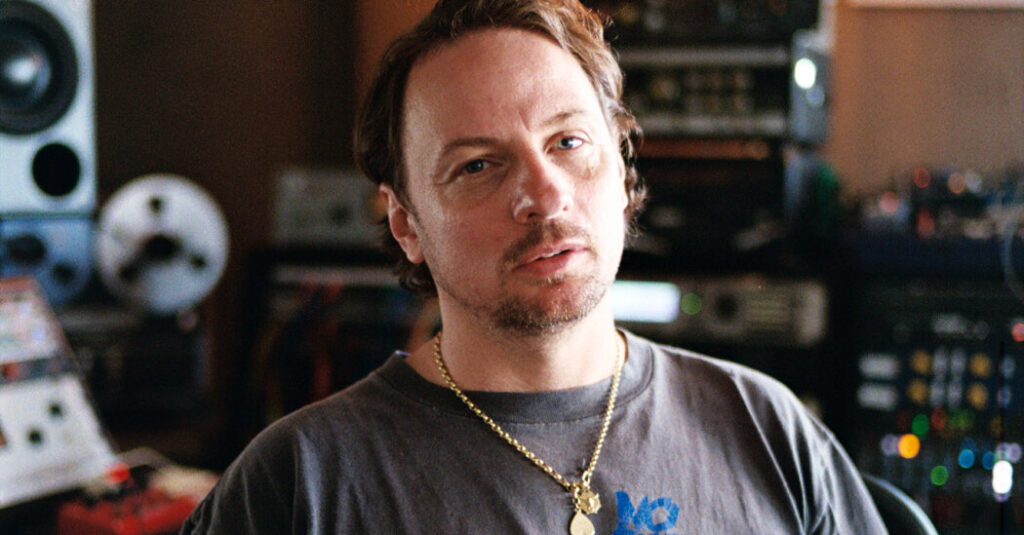
The pop star’s third album had rocketed to the top of the charts in a dozen countries and garnered reams of glowing reviews. The award nominations had started rolling in when Kid Harpoon, or Tom Hull, decided to talk. “I live in a town where everyone has a therapist, but I’d never really thought about it,” Hull, 43, said, smiling and squinting against the sun on the sweeping back porch of his Los Angeles studio.
“We kind of won the championship, which creates a lot of existential questions, like, ‘Why am I doing it?’”
Hull realized he had felt listless at work, showing up to write songs or make records with a sense of obligation rather than inspiration. In therapy, he had an epiphany: Instead of worrying about all the things he may never be, he needed to get more comfortable with the experiences and enthusiasms that had already shaped him. He remembered, for instance, the frisson he would feel when his dad took him to watch and, eventually, play the blues as a preteen phenom in Kent, England.
He liked that sense of being a hobbyist, of doing something simply because he enjoyed it. Hull already had a half-dozen extra-musical hobbies: tennis, a book club, a movie club, aquariums, building furniture, Dungeons & Dragons. So he began stockpiling modular synthesizers, discrete components that can be linked together to produce endlessly surprising sounds. He didn’t know how it all worked. The musician, who has been partly responsible for some of this century’s biggest pop songs, like Miley Cyrus’s “Flowers” and Styles’s “Watermelon Sugar,” felt like a kid again.
“You hit a point in your career where people are investing in stocks, but I don’t know anything about that. I decided to buy a whole modular synth rack instead,” he said, opening kitchen drawers to brandish circuitry he was still decoding.
That obsession is at the core of Styles’s fourth album, “Kiss All the Time. Disco, Occasionally,” out Friday. The pair made it at Berlin’s historic Hansa Studios, London’s Abbey Road and in his own Laurel Canyon studio, near where the producer has lived for a decade with his family of four. As Hull and Styles leaned into the idea of making their version of an art-pop record, they tinkered with the technology together. Their explorations reflect an abiding curiosity that Hull’s collaborators say is the true key to his work.
Maggie Rogers’s first-ever cowriting session, for example, was with Hull a decade ago. She was terrified. “I felt like everybody wanted to capitalize on me, so my guard was up to my eyeballs. And he goes, ‘We don’t have to make music. We can just hang out,’” Rogers remembered during a video interview. They walked his dog, Bama; talked; listened to records and finally wrote half a song. “Because of that, I went back to him two years later and wrote ‘Light On.’ He puts the truth of a moment before the product.”
At the start of his career, Hull thought he was the product. When his rock band broke up just before a big gig opening for a member of the Libertines, he decided to try it solo and acoustic as Tom Harpoon. (The “Kid” came soon thereafter.) His songs were frank and magnetic, his one-man shows live-wire acts. He generated British buzz and signed a record deal at 24. “We were all just enamored,” Jessie Ware said in a video interview. “We would go to all his shows and then roll in a gang of 20, dancing the night away and him making everyone laugh.”
The ’80s superproducer Trevor Horn helped Hull finish his 2009 debut, “Once.” By the time Hull released it, though, there was a sense Kid Harpoon’s moment had passed, and the finished album didn’t mirror what he had in mind. “I let myself down because I had a vision but didn’t finish the thought,” Hull said, frowning.
Hull felt a little lost, so he called in a favor from an old friend — Florence Welch, of Florence + the Machine. When they had both seemed like rising stars, they partied together, singing late into the night and sometimes working up lyrics. Her 2009 debut had soared where his had floundered. He asked for a day together. They wrote “Never Let Me Go,” the third single from her second album. Paul Epworth, the acclaimed producer who had just made Adele’s “Rolling in the Deep,” recognized Hull’s talent in the session.
“He was like, ‘You could perform, but you’re really good at this side. You get it, and you should focus,’” Hull remembered. “I spent 10 years thinking performing was my thing. I had to let go of that vision of me.”
The next decade proved Epworth right. Hull either wrote with or produced music by Shakira, Skrillex, Shawn Mendes, Haim, Lizzo and dozens more. One of his first joint efforts — “Wildest Moments,” with his former fan Ware — became one of his first hits. It happened, she said, because he let her vent for two hours about a fight she’d had that weekend with her best friend and roommate. The words came easy. “Tom has this very incredible power to extract raw feeling, but with such tenderness,” Ware said.
Early during his ascent, Hull met Styles through mutual friends. They worked on a few tracks together while the singer was still in One Direction. Hull was impressed by how much Styles loved music, how he’d talk about Bon Iver deep cuts with unguarded enthusiasm. Their working relationship escalated quickly: two songs on Styles’s debut, followed by almost everything on his second, “Fine Line,” and “Harry’s House,” the record that sent Hull into a little tailspin.
His hobbyist ardor for modular synths wasn’t the only thing to emerge from the resulting therapy. He started working on projects that made him forget he ever had a comfort zone. A huge fan of Kings of Leon’s first three records, he signed on to produce their 2024 album, “Can We Please Have Fun.” It was his first music with a proper rock band, so he scurried to mentors like Brendan O’Brien, a producer for Pearl Jam and Bruce Springsteen, for advice. (“All your pop insecurities? You’ve got to get over that, because this is the same thing,” he recalled O’Brien insisting.)
And when David Byrne realized Hull was the thread between songs he loved from Rogers, Styles and Cyrus, he went to a dance party thrown by a Foo Fighter just to meet him. Byrne asked about collaborating. The idea of working with one of his favorite bandleaders wasn’t the only thing that excited Hull; when Byrne told him a jazz orchestra would serve as his backing band, Hull recognized a chance to test himself.
“I felt completely out of my depth,” Hull said, laughing and scratching stubble as he admitted he can’t sight read music and always forgets what terms like mezzo forte mean. “I learned about notation through that process — ‘Oh yeah, I get why this makes sense.’”
Hull first brought his new synths to sessions with the British quartet Inhaler. The singer Eli Hewson remembered how joyous Hull seemed while he experimented, routing a drum kit through his circuits and finding a sound that became key to their 2025 album, “Open Wide.” Still, Hull admitted to some trepidation when he first thought about introducing his synths to sessions with Styles. This was still new.
But Styles responded immediately to the alien sounds, even helping Hull program the machines. At one point, Hull played a modular synth piece that he’d made as a 40th birthday present for their mutual friend, the sculptor Nikolai Haas. Hull simply thought it sounded cool, so it surprised him when Styles began singing over it, even suggesting they turn it into a song.
When the pair got to Berlin to work, Hull asked Tom Skinner, the drummer in Sons of Kemet and the Radiohead offshoot the Smile, if he would like to play on this strange instrumental they’d remade. Skinner wanted to make it sound like the German iconoclasts in Can, coincidentally a shared passion for Hull and Haas. Would the result be too weird for one of the world’s biggest pop stars? Styles loved it.
“There’s a million moments where that song doesn’t make the record,” Hull said. “Harry had to be brave enough to make that decision. That’s a song that slightly pushes the needle of what you can achieve.”
Titled “Season 2 Weight Loss,” it is now the four-minute centerpiece of “Kiss All the Time. Disco, Occasionally,” its distorted vocals, backing choirs and restless drums suggesting prog condensed into pop. Hull doesn’t know if “Season 2” will be a single, let alone a hit. He doesn’t actually care.
“It’s not like I have a sound. I don’t have a strict aesthetic. At the risk of sounding cheesy, I’m making someone’s dreams come true,” he said. “We had a hit, a big one. We can’t try and replicate it. But what we can do is get you somewhere. Where are you going in your life? What do you want to do next?”
The post Meet Kid Harpoon, the Architect of Harry Styles’s Sound appeared first on New York Times.