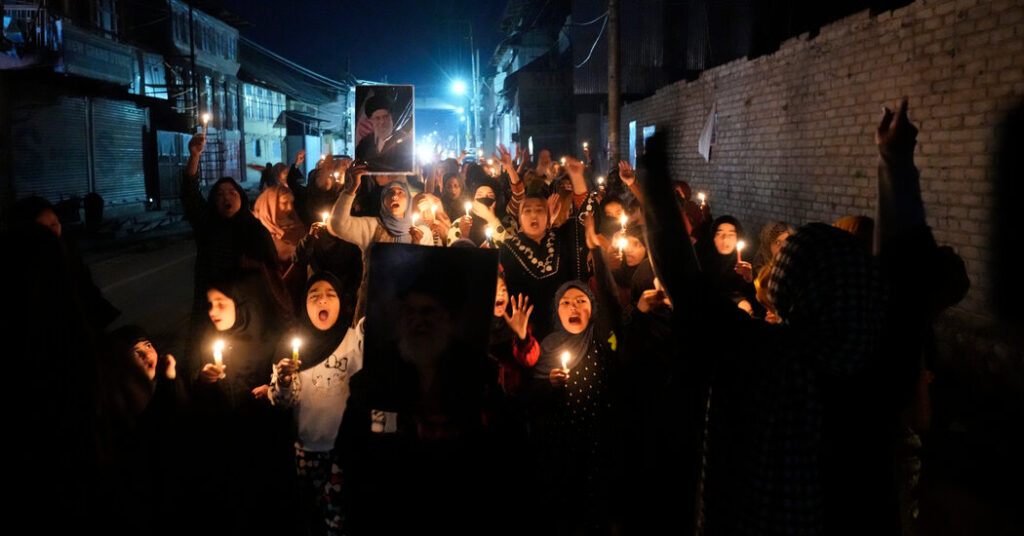
Ayatollah Ali Khamenei was not just the supreme leader of Iran but also a widely respected religious figure among followers of Shiite Islam. In Pakistan and India, both home to millions of Shiites, there was an outpouring of anger and grief after he was killed during U.S.-Israeli strikes on Saturday.
Thousands took to the streets in India and Pakistan, many chanting slogans against the United States and Israel. Some demonstrations spilled into violence in Pakistan, where the authorities say at least 25 people were killed during unrest on Sunday.
Mr. Khamenei, who died at 86, was considered the leader of all Shiites, not just Iran, said Nawab Masood Abdullah, a Shiite community leader in the city of Lucknow in India. “His status is similar to what the Pope means to Christians,” he added.
For more than three decades as Iran’s supreme leader, Mr. Khamenei cultivated the image of a resistance leader who united people opposed to the United States and Israel. For Shiites outside Iran, experts said, Mr. Khamenei symbolized the power of the world’s biggest Shiite country.
That influence extended to Shiite communities in India and Pakistan. In India, estimates of the Shiite population vary, but some experts and community leaders have put it at above 40 million. Many Shiites live in Indian-administered Kashmir, a Muslim-majority Himalayan region with cultural ties to Iran that go back centuries.
“Iran may be far away, but for many Shiites the bond is spiritual,” said Areeba Zahra, a college student in northern Kashmir. “When something happens there, people here feel it too.”
Many schools across the region have been closed this week as officials try to prevent further unrest.
On Monday, protests in Kashmir over Mr. Khamenei’s death escalated into clashes with police.
Mr. Khamenei’s killing set off a wave of protests in Pakistan, too, where Shiites are estimated to be around 15 percent of the population, or around 35 million people. Sunni Muslims are the majority in Pakistan.
On Sunday, thousands of people took to the streets across Pakistan to protest against the U.S.-Israeli strikes. In some places, there were deadly clashes with security forces. The unrest prompted the authorities in Pakistan to impose temporary curfews in some areas.
In Karachi, Pakistan’s largest city, 10 people died after protesters tried to storm the heavily guarded U.S. consulate, a police surgeon at the city’s main hospital told The New York Times.
“When Iran is attacked, we feel our faith, our identity and our very existence are being targeted,” said Asghar Jaffer, a Shiite student activist who joined the demonstrations in Karachi on Sunday.
Since the Islamic revolution of 1979 that brought clerical rule to Iran, the country’s leaders have sought influence among Shiites in other countries like Pakistan and Lebanon, often to counter the influence that its longtime regional rival, Saudi Arabia, has among many Sunni Muslims in those countries. Iran’s Islamic Revolutionary Guards Corps have been accused of recruiting Pakistani Shiites for proxy warfare in other countries, including Syria.
Shiite Muslims have for decades been frequent targets of deadly attacks by Sunni militant groups.
For Pakistan’s Shiites faced with this threat, “Iran was turned into a symbol of power, strength, and dignity that they could rely on,” said Simon Wolfgang Fuchs, a professor of Islam in South Asia at the Hebrew University of Jerusalem.
Pakistan has long sought to balance its relationships with Saudi Arabia, a close ally, and Iran, with which it shares a long border, because it does not want to take positions that might inflame sectarian tensions at home. So far, Pakistan’s government has condemned both the attacks on Iran and Iran’s retaliatory strikes on targets in Gulf countries.
The mood was far from neutral at the protests in Pakistan on Sunday.
“Khamenei’s assassination feels like an assault on the spiritual and political voice of the Shiite community worldwide,” said Azhar Naqvi, a banker who joined a protest in Islamabad, the capital
Around him, demonstrators chanted a line heard often at anti-U.S. and anti-Israel protests: “Death to America, death to Israel.”
Suhasini Raj is a reporter based in New Delhi who has covered India for The Times since 2014.
The post Khamenei’s Killing Sparks Anger and Grief in South Asia’s Shiite Muslims appeared first on New York Times.