The oil tanker standstill in the Middle East shows that Iran has been able to project enough of a threat that it has essentially shut down one of the world’s most important trade waterways, shipping analysts say.
By stopping the movement of tankers, Iran has exploited one of its strategic advantages even as it comes under heavy attack by the United States and Israel.
Ships that would normally be transporting millions of barrels of oil out of the Persian Gulf to the rest of the world are not sailing because their operators fear attacks by Iran.
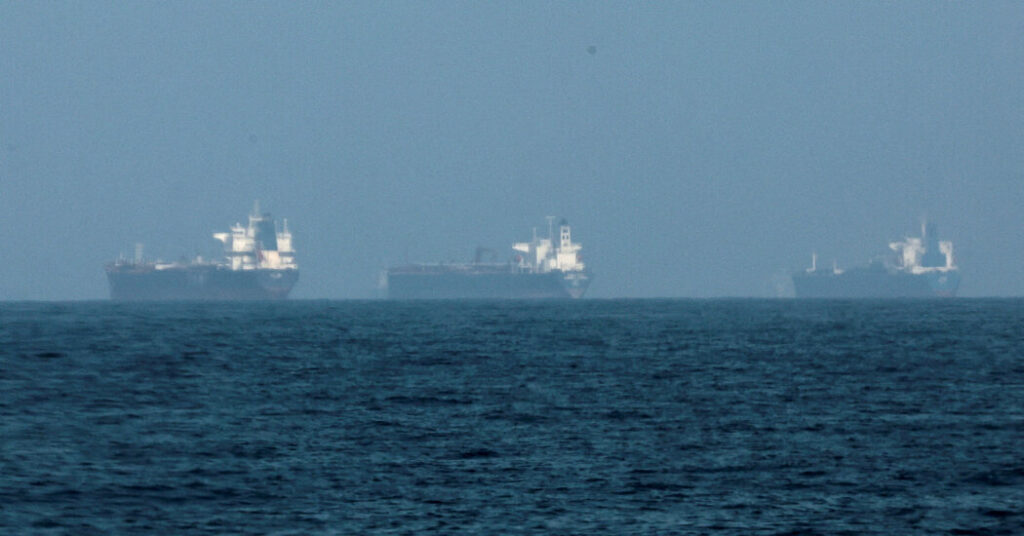
Instead, the tankers are hunkered down on either side of the Strait of Hormuz, the narrow artery on Iran’s southern border through which one-fifth of the world’s oil and a significant amount of natural gas pass. Other types of vessels are staying away. Maersk, a major container shipping line, said on Friday that it was going to suspend certain services to the Middle East.
“They are being successful in severely constricting the flow of everything — not just oil, it’s also natural gas — and that is clearly having an impact on world energy prices,” said Daniel Sternoff, a senior fellow at the Center on Global Energy Policy at Columbia University.
The threat is real: Five tankers have been struck since the U.S.-Israeli attacks on Iran began on Saturday, according to a New York Times analysis. The drastic reduction in tanker traffic through the strait has reduced the supply of energy products and helped push up oil prices, which is leading to higher gasoline prices.
Over the years, Iran has often used its proximity to the strait to threaten shipping, but if tankers continue avoiding the strait into next week, it will be one of the longest de facto shutdowns on record.
“We’re five days into it, and that’s approaching the longest pauses that happened,” said Eugene Gholz, an associate professor of political science at the University of Notre Dame and an expert on the Strait of Hormuz.
Some military and maritime experts, including Mr. Gholz, expect the tankers to venture back into the strait soon, possibly under U.S. naval protection, which President Trump said he might deploy, or if the United States and Israel largely destroy Iran’s ability to attack ships.
“Iran has no advantage, and the United States military is ensuring that their dismal situation only gets worse,” Anna Kelly, a White House spokeswoman, said.
And in an interview on Thursday with Reuters, Mr. Trump indicated that he was willing to tolerate the rise in gas prices.
“They’ll drop very rapidly when this is over, and if they rise, they rise, but this is far more important than having gasoline prices go up a little bit,” he said.
But until the tankers start sailing, analysts say, Iran has power that it can use to try to gain an advantage in the conflict with the United States and Israel.
“A central part of Iran’s strategy,” Mr. Sternoff of Columbia University added, is to “use leverage over global energy flows and prices to put pressure to force the U.S. into a cease-fire.”
Iran’s navy is not blockading the strait, and it has never closed the waterway since the Middle East became a big oil-producing region. But the recent attacks on vessels — including on one flying the U.S. maritime flag — have upended shipping in the Middle East.
The cost of insuring a vessel to go through the strait has soared, to the point that it is prohibitively expensive for nearly all companies.
Mr. Trump said the U.S. International Development Finance Corporation would provide affordable insurance coverage for all shipping lines.
But Karen Young, a senior fellow at the Middle East Institute, a nonpartisan research organization, said it was not clear whether the federal agency, which has limited capital, could provide enough coverage. Providing political risk insurance for shipping in the Strait of Hormuz could cost over $300 billion, she said.
Other organizations could contribute to the coverage, Dr. Young said, but added that there was little reason to bolster insurance if the attacks on shipping continued for months, which she thinks is likely.
“Iran has an advantage in being able to prolong a low-level conflict,” she said.
Indeed, shipping executives say that, even if they could get cheaper insurance, they are more concerned about the safety of their crews and the environmental damage that may occur if an oil tanker is hit.
Stamatis Tsantanis, chief executive of Seanergy Maritime Holdings, a shipping company, said the highest priority was “the safety of the ships and the safety of the people.”
Crew members are asking to avoid the conflict area. Half the crew on a Seanergy ship making its way from the South Atlantic to Oman’s port of Sohar, south of the Strait of Hormuz, asked to leave, Mr. Tsantanis said.
“We are not considering entering the Hormuz Strait whatsoever for the time being,” he said.
The United States and Israel are trying to destroy the weapons that Iran appears to be using to attack ships, according to military experts.
Kevin Donegan, a retired vice admiral and former top Navy commander in the Middle East, said the U.S. strikes on Iran’s navy were most likely intended in part to stop Iran’s ability to attack shipping.
“When you heard that the navy’s being destroyed, it’s not just their ships, it’s their capability to do these things,” he said, referring to Iran’s targeting of tankers.
The United States may also decide to provide a naval escort to try to protect commercial ships. Mr. Trump said on social media on Tuesday, “If necessary, the United States Navy will begin escorting tankers through the Strait of Hormuz, as soon as possible.”
In the 1980s, the United States provided an escort to protect against Iranian attacks, but it was not at war with Iran. Because it is a combatant now, some insurers may be reluctant to cover vessels in a U.S. escort.
These days, Mr. Gholz said, Iran has more effective weapons to target ships. Drones can target vulnerable parts of a ship, like the bridge, he said, but added that the war in Ukraine had shown there were ways to defend against drone attacks.
“We can give in right now, or we could try to innovate and adapt,” he said.
Christiaan Triebert contributed reporting.
Peter Eavis reports on the business of moving stuff around the world.
The post Iran’s Chokehold on Persian Gulf Waterway Strains Shipping appeared first on New York Times.