This obituary was originally published on Dec. 22, 1983. It is being republished for a package for Women’s History Month.
LONDON — Dr. Lise Meitner, the Austrian-born nuclear physicist who first calculated the enormous energy released by splitting the uranium atom, died today in a Cambridge nursing home. She was 89 years old.
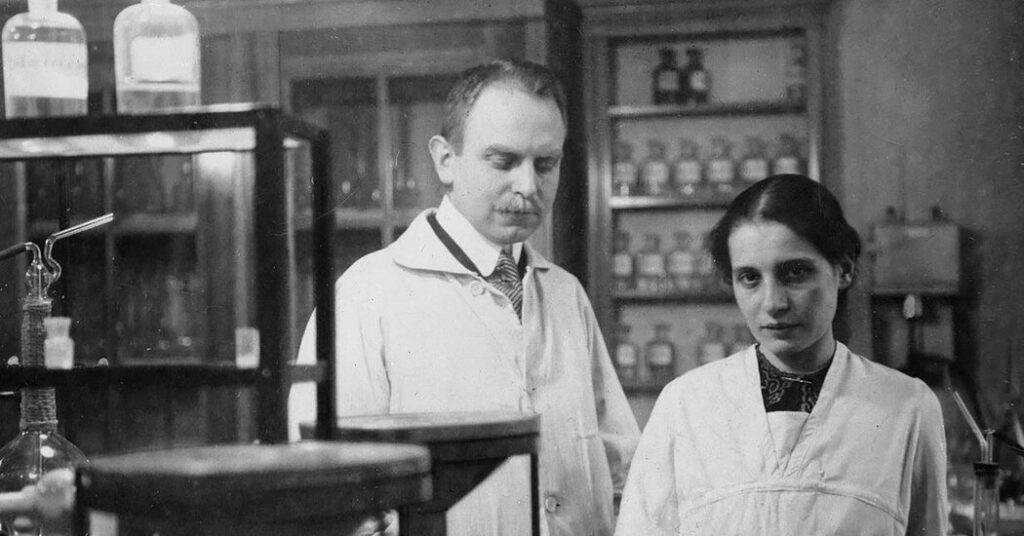
Dr. Meitner is credited with having laid much of the theoretical groundwork for the atomic bomb, although she did not participate directly in its production. For 30 years she was the scientific partner of Dr. Otto Hahn, the Nobel Prize-winning German nuclear chemist and discoverer of nuclear fission, who died July 28.
For three decades, a continuous flow of pioneering research in radioactivity at the Kaiser Wilhelm Institute in Germany had made the names of Meitner and Hahn inseparable in scientific circles throughout the world.
Forced to Flee
It was the great tragedy of Dr. Meitner’s life that she was forced to leave Dr. Hahn’s laboratory when it was on the verge of perhaps the most far-reaching scientific discovery of the century — the discovery that uranium atoms could be split.
But the diminutive, brown- eyed, gray-haired woman, from Vienna was Jewish. In March of 1938, with antisemitism reaching a fever pitch in Nazi Germany, Dr. Meitner fled to Sweden.
Nine months later Dr. Hahn announced to an astonished scientific community the results of experiments that made it clear that the atom could be split.
This had been thought impossible by physicists of the day. Six and a half years later, in August, 1945, the United States dropped an atomic bomb on Hiroshima.
Although Dr. Meitner was no longer working in the Hahn laboratory when the discovery was made, she contributed much to the work before she left and later expounded on the implications of the discovery, naming the phenomenon “nuclear fission.”
News of the atomic bomb came as a complete surprise to Dr. Meitner. “I did not know that the Allies had succeeded in constructing the atomic bomb until the Hiroshima announcement,” she recalled in 1946. “I was surprised that it had been perfected in so short a time.”
“It is an unfortunate accident that this discovery came about in time of war,” she said in another interview some years later.
Deplored the Bomb
Thereafter, she often took pains to dissociate her work from the atomic bomb.
“I do not see why everybody is making such a fuss over me,” she said in an interview shortly after the war. “I have not designed any atomic bomb. I don’t even know what one looks like, nor how it works technically.
“I must stress that I myself have not in any way worked on the smashing of the atom with the idea of producing death-dealing weapons. You must not blame us scientists for the use to which war technicians have put our discoveries.”
The story of how. Lise Meitner received word of the discovery of nuclear fission from: Otto Hahn and his collaborator Dr. Fritz Strassman, and how she demonstrated its momentous significance to the world, is one of the most dramatic in science.
The news came in a letter in December, 1939. Dr. Hahn, fearful that he had made a mistake, sent all the experimental details to his life-long colleague for her expert analysis. She read the letter over and over and was overwhelmed by its implications.
She showed the letter to her nephew, the physicist Otto Frisch, who resisted at first. “It took her a little while to make me listen,” he recalled many years later.
Dr. Meitner calculated that the energy released by bombarding one uranium nucleus with a neutron was 200 million electron volts — or 20 million times the explosive energy of an equivalent amount of TNT.
Report in British Journal
Together, Dr. Meitner and her nephew dispatched a report to the distinguished British journal Nature on Jan. 16, 1939. It was published about three weeks later with this historic passage:
“It seems therefore possible that the uranium nucleus has only small stability of form, and may, after neutron capture, divide itself into two nuclei of roughly equal size. These two nuclei will repel each other (because they both carry large positive charges) and should gain a total of kinetic energy of about 200 million electron volts.”
The nuclear age was not far off:
Dr. Meitner and Dr. Frisch agreed to inform the Danish physicist Niels Bohr of their interpretation of the Hahn work. Dr. Bohr, the story goes, was so excited that he almost missed the boat that was to take him to the United States, where he relayed the news to American scientists. The race for the atomic bomb was on.
Dr. Meitner was born on Nov. 7, 1878, one of seven children of a Viennese lawyer. She developed an interest in atomic physics as a student from reading newspaper accounts of the discovery of radium by Pierre and Marie Curie in 1902.
In 1906 she was graduated with a doctorate from the University of Vienna. She was one of the first women to do so. She moved to Berlin in 1908 to study under Max Planck, originator of the quantum theory and a Nobel Prize-winner.
Despite opposition to women in science, she managed to establish herself in Berlin and began her long association with Dr. Hahn in 1908. The team gained international repute for its work on radioactivity. In 1918, the two discovered the rare element protactinium, element 91, which filled the gap in the Periodic Table between thorium and uranium.
Dr. Meitner, who never married, served as an X-ray nurse in the Austrian Army during World War I, continuing her research during furloughs.
She and Dr. Hahn were the closest of friends. She often called him her “cockerel,” a play on the name Hahn, which means “rooster” in German.
Dr. Meitner remained in Germany as long as possible, but in 1938 decided to leave. She took a train to the Netherlands| on the pretext of wanting to spend a week’s vacation.
She slipped across the Dutch border after a close call with a Nazi patrol, and continued on to Denmark and Sweden. She made Stockholm her home for the next 20 years, working at the Nobel Institute and the Atomic Energy Laboratory, and became a Swedish citizen.
Dr. Meitner, a soft-spoken woman with an easy smile, spoke English well, but with a heavy accent. In 1946 she came to the United States, where she was a visiting professor for a year at Catholic University in Washington.
Moved to England
After retiring in 1958, she moved to England to join her nephews and nieces. Dr. Frisch holds the chair of natural philosophy at Cambridge University. She is survived by one other nephew and two nieces.
In 1966, Dr. Meitner shared the Atomic Energy Commission’s $50,000 Enrico Fermi Award with Dr. Hahn and Dr. Strassman. She was too frail to travel to Vienna to accept the award, so Dr. Glenn T. Seaborg, chairman of the A.E.C., traveled to Cambridge to present it to her.
Dr. Meitner had long been a proponent of international cooperation to prevent the destructive use of atomic weapons. In a radio conversation with Mrs. Franklin D. Roosevelt two days after the bombing of Hiroshima, Dr. Meitner said:
“I hope that by the cooperation of several nations it will be possible to come to better relations between all the nations and to prevent such horrible things as we have had to go through in the last few years.”
To preserve archival articles as they originally appeared, The Times does not alter, edit or update them.
The post From 1983: Lise Meitner, Physicist, Is Dead at 89; Paved Way for Splitting of Atom appeared first on New York Times.