The Gulf states are racing to strengthen their air defenses as the Iranian attack is beginning to shift from missiles to drones.
The barrage of missile strikes that marked the first days of the war has now dropped by 90 percent, a senior American commander, Adm. Brad Cooper, said on Thursday. But a continuing deluge of Iranian drones has prompted U.S. and European officials to step up support so that the Gulf states are not drained of weapons to defend themselves.
Not all Gulf nations are equally equipped, according to officials and experts, and the drone threat “is something that was underestimated,” said Fabian Hoffman, a missile analyst at the University of Oslo.
In response to the onslaught, Italy pledged on Thursday to send air defense systems, anti-drone and antimissile weapons to Gulf states to fend off Iranian strikes. Britain said it was deploying four fighter jets to Qatar. Diplomats from across the European Union and the Gulf region discussed the damage the Iranian attacks have caused.
At least five Gulf states — Bahrain, Jordan, Kuwait, Qatar and the United Arab Emirates — are in talks with Ukraine about how to counter drones, President Volodymyr Zelensky said on Wednesday.
On Thursday, Mr. Zelensky said that he had received a request from the United States to assist the Middle East in defending itself from the same kind of Iranian attack drones that had threatened Ukraine over the past four years during the war with Russia.
“Security support from Ukraine will be provided,” including in the Gulf, he said, although he did not specify exactly how or when.
The war began when the United States and Israel attacked Iran this past weekend. Iran has hit back with a vengeance, targeting American bases in the Gulf and energy sites that help fuel the global economy.
The first few days of the war saw the largest number of retaliatory ballistic missile strikes by Iran. Overall, the Gulf states have been targeted with about 500 missiles, causing a few fatalities, Mr. Hoffman, the analyst, said.
They are now down by 90 percent, said Admiral Cooper, commander of U.S. Central Command, at a news conference on Thursday.
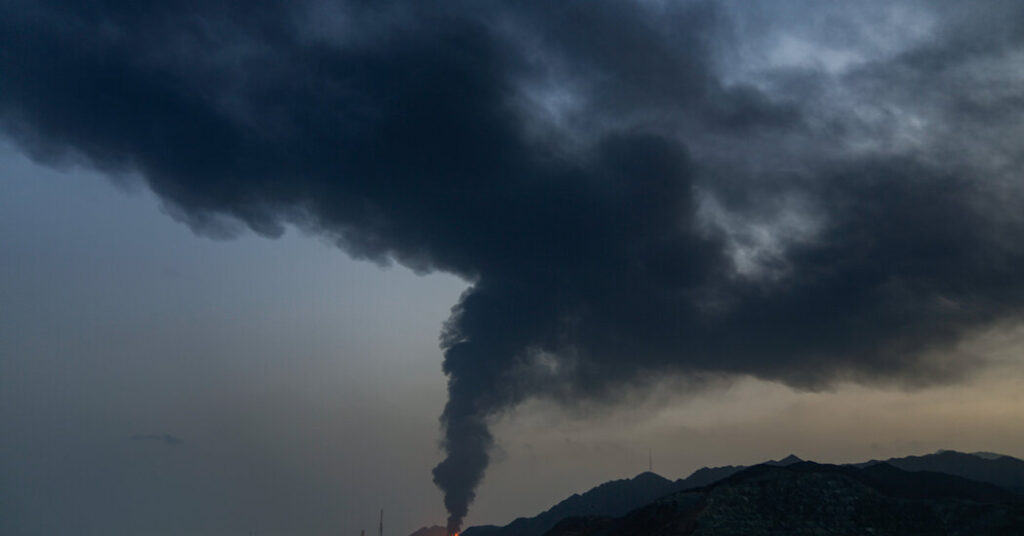
Iran is still launching some missiles, though, including attacks on Thursday in Qatar, in the United Arab Emirates and in Bahrain, where an oil refinery was hit. More missile strikes early Friday targeted Saudi Arabia.
Drone strikes have ebbed, Admiral Cooper said, by 86 percent as of Thursday.
But they still are coming, and probably pose a more lasting threat than missiles.
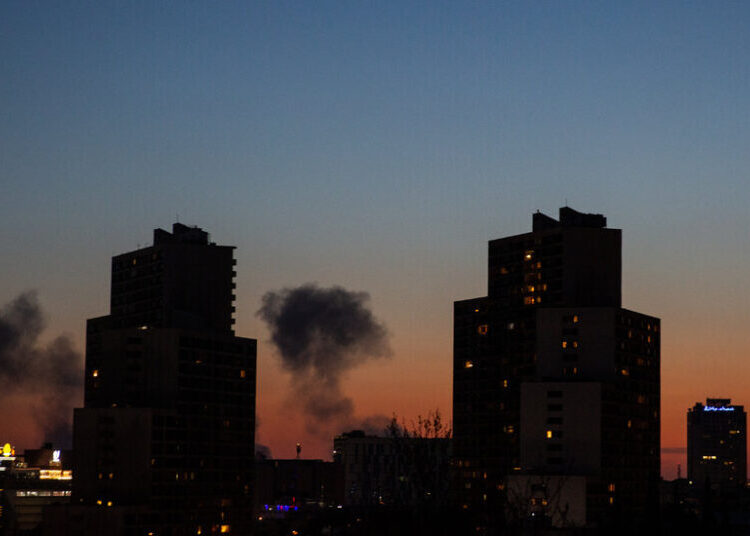
Over the past several days, Iran has launched drones against energy facilities, military bases, diplomatic compounds and civilian targets like hotels and apartment buildings in the Gulf.
Michael Kofman of the Carnegie Endowment for International Peace, who has studied drone warfare in Ukraine, said drones alone had the potential to cause “quite a bit of damage,” especially to energy infrastructure and civilian sites. They also can overwhelm air defenses when they attack in large numbers, he said.
But they are most effective when they are used in tandem with missiles, which are far more powerful and can cause more fatalities.
On Friday, the Qatari government said that it had thwarted a drone strike against a military base in Qatar that hosts American troops.
The United Arab Emirates said it had intercepted 1,110 drones out of 1,184 that its military had detected since the conflict began. On Friday alone, the Emirati military said that 112 drones had targeted the country — all but three of which were intercepted.
At least hundreds more have targeted Bahrain, Kuwait, Saudi Arabia, as well as Qatar, said Mr. Hoffman, whose estimate of missile and drone attacks is based on a tally compiled from government statements and media reports.
The damage inflicted by drones has been relatively minimal so far, Mr. Hoffman noted. But Iran has proved it can produce drones quickly and cheaply, meaning it may have a healthy supply to target the Gulf for the foreseeable future. If the drones keep coming in large numbers, Mr. Hoffman said, defense systems will be strained.
As part of its daily count of Iranian missiles and drones, the Emirates released a statement this week calling its air defense systems “capable of countering a full spectrum of aerial threats with high efficiency.” It also said it had a “robust” munitions stockpile.
Over the past few decades, the oil-rich Gulf nations have imported some of the most expensive and sophisticated air defense systems available. They also are protected by air defenses that the United States have moved to the region to safeguard American military bases there.
Bahrain, Kuwait, Qatar, Saudi Arabia and the United Arab Emirates all own billion-dollar Patriot batteries, according to a global weapons database compiled by the International Institute for Strategic Studies in London. The American-made Patriot is an advanced, ground-based system that uses interceptor missiles that can cost about $3.7 million each.
Saudi Arabia and the Emirates are the only two countries besides the United States that own Terminal High Altitude Air Defense, or THAAD, systems, which can shoot down ballistic missiles both inside the atmosphere and in space. Each THAAD interceptor costs about $12.7 million. There are only 10 active THAADs worldwide, and they are built in the United States.
Gulf militaries also rely on a mix of smaller air defense weapons, including shoulder-fired Stinger missiles from the United States, short-range French and Russian ground-fired missiles, towed guns made in Britain and the German Gepard antiaircraft tank, the weapons database shows.
But there are a limited number of sophisticated air defense systems worldwide. They were in high demand even before the war in Ukraine, which has created shortages and forced nations to move them from one region to another based on immediate threat levels.
Hasan Alhasan, a Bahrain-based expert in Middle East policy at the International Institute for Strategic Studies, noted that Gulf states were generally reluctant to join Israel and the United States in the conflict.
But he described a growing question in the region: “How long do we keep sitting on our hands and absorb these relentless Iranian strikes?”
“Do the Gulf states want to join a war that they did not start, whose goals are entirely unclear, and whose tempo and cadence they do not necessarily control?” Mr. Alhasan asked. “This is a key strategic consideration that’s weighing on the Gulf states right now.”
Lara Jakes, a Times reporter based in Rome, reports on conflict and diplomacy, with a focus on weapons and the wars in Ukraine and the Middle East. She has been a journalist for more than 30 years.
The post Daily Barrage of Iranian Drone Attacks Increases Pressure on Gulf States appeared first on New York Times.